F. Simon

5 articles · 30 co-authors · latest: 2026-08-05
358 citations · h-index 6 · 46 papersData: Semantic Scholar

We have retold 5 papers by this author. most often about: dark matter, dark photon, dwarf galaxy. 30 co-authors across our retellings.

Links in the knowledge graph
Hunting Light Dark Matter with a Silicon Detector
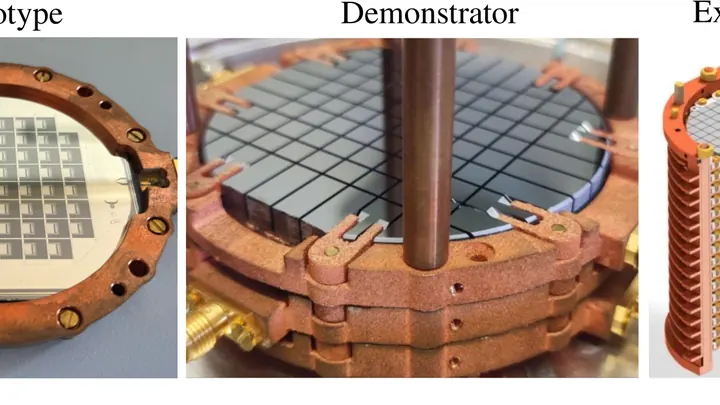
Dark matter is the invisible substance that holds galaxies together, yet it has so far escaped direct detection. The BULLKID-DM detector is designed to catch candidate particles with a mass around 1 GeV (roughly that of a proton) and an extremely weak interaction with ordinary matter — a…
HEP Experiment2026-02-102 minarXiv:2602.09800express
Rare Meson Decay: Hunting for Neutrinos
Inside the accelerator, particles collide, and for a fleeting moment a B meson is born — a heavy particle that lives for less than a billionth of a second. Usually, it decays into a shower of debris, but sometimes it transforms into just two particles: a muon and a neutrino. This rare path is like a lottery where the winning ticket appears once in every two million draws.
HEP Experiment2026-02-141 minarXiv:2602.13569express
Hunting Ghost Particles: What Belle II Saw
At Japan's KEK laboratory, electrons and their antimatter counterparts, positrons, collide inside the Belle II detector. In such collisions, new particles are born for a fleeting moment. Among them is J/ψ, a bound state of a charm quark and its antiquark.
HEP Experiment2026-03-241 minarXiv:2603.23256express
Hunting for Sterile Neutrinos
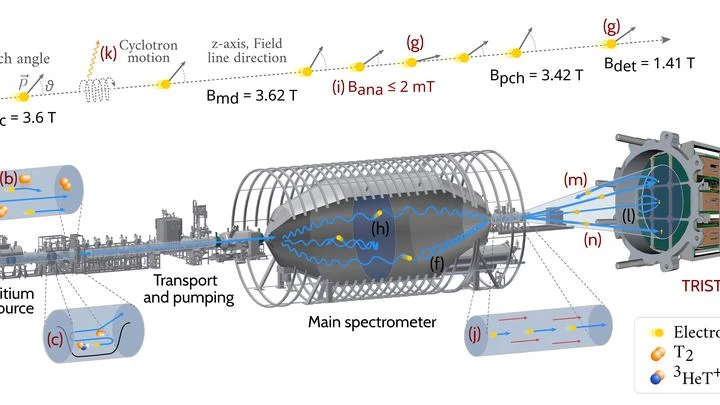
Radioactive tritium decays, emitting an electron. Its energy is almost always the same, but sometimes, just a little less. This shortfall could mean that alongside the ordinary neutrino, another, hidden particle was born. The Standard Model describes three types of neutrinos, but scientists suspect there is a fourth — the sterile one.
High Energy2026-08-051 minarXiv:2608.04658express
Moon Shadows Cast by Giant Cosmic Rays
Cosmic rays aren't rays in the usual sense: they're fast particles bombarding Earth from all directions. Mostly they're protons and atomic nuclei. Their energies vary widely, from modest to fantastically huge. When such a particle heads our way and the Moon or Sun gets in its path, it gets absorbed.