A dark matter detector is like a room where you're trying to hear a whisper while static electricity crackles nearby. This crackle is produced by radon atoms — a radioactive gas that seeps out from materials and air.
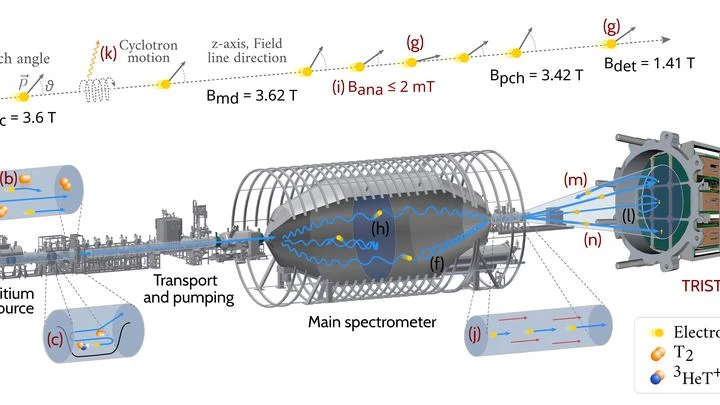
Radioactive tritium decays, emitting an electron. Its energy is almost always the same, but sometimes, just a little less. This shortfall could mean that alongside the ordinary neutrino, another, hidden particle was born.
The Standard Model describes three types of neutrinos, but scientists suspect there is a fourth — the sterile one.
Underground, in a former gold mine, sits a tank of liquid xenon. If a dark matter particle flies through it, the xenon flashes. But it also flashes from ordinary particles, like neutrinos or leftover radioactivity. The task is to tell which flash comes from dark matter and which from noise.