كيف تتحكم الفوضى في كيمياء العمالقة سريع
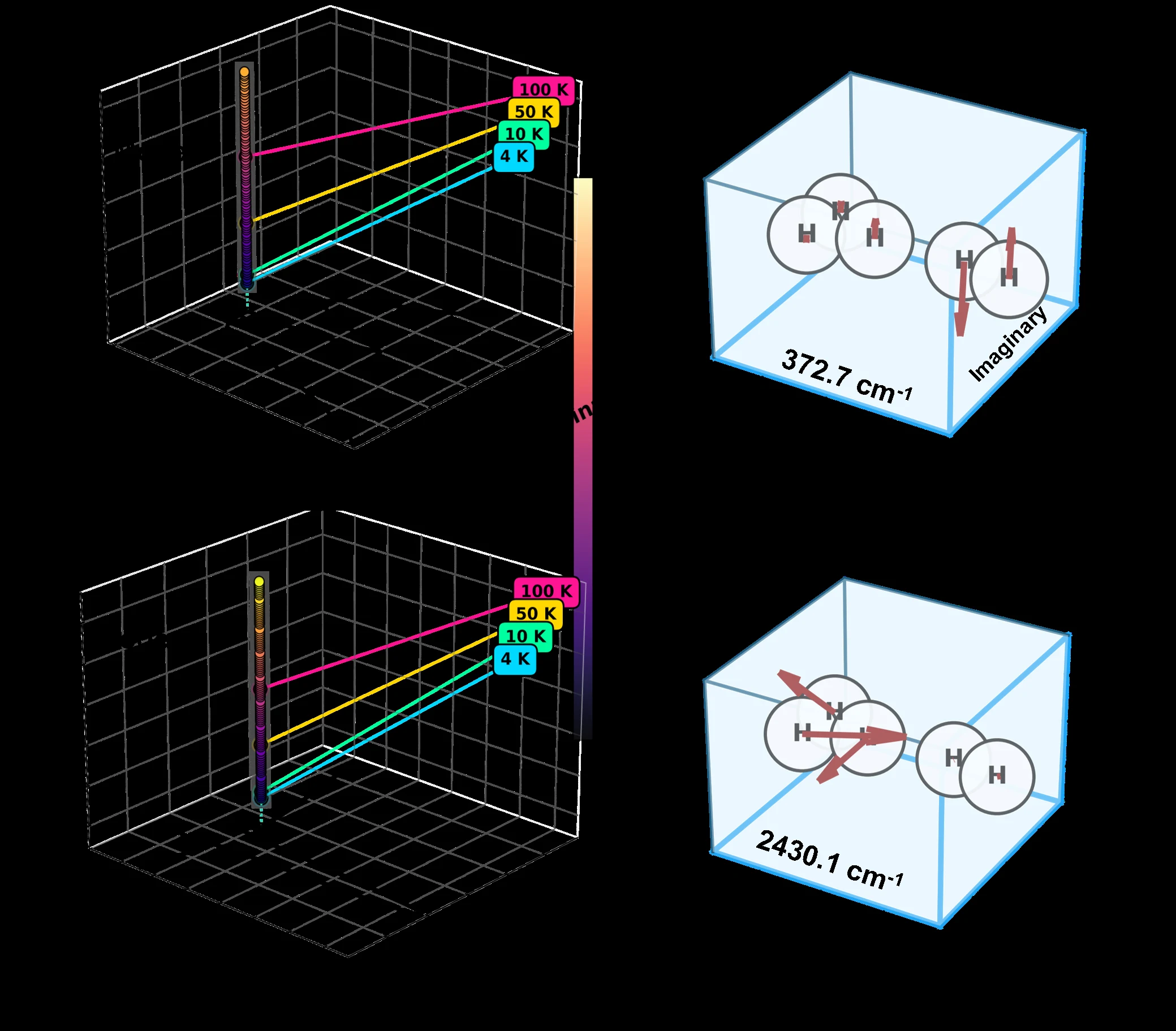
يشبه التفاعل الكيميائي المرور عبر بوابة دوارة: يسبب الازدحام فوضى فيعلق، بينما يتحرك الصف المنتظم. لكن في العالم الكمومي، عندما يهدأ التدافع، قد يصبح الحاجز شبحيًا — حيث يتسلل الجسيم عبره وكأن البوابة اختفت. هذا النفق الكمومي هو ما يتحكم في كيمياء الكواكب العملاقة.
أظهرت الدراسة: في الحالة الانتقالية، عندما تكون الجزيئات مستعدة للتحول، تخفت الفوضى. عندها تمامًا تترشح أيونات الهيدروجين عبر الحواجز، مكونةً جزيئات أساسية لغلاف المشتري الجوي.
قدم العلماء «مؤشر الهشاشة»: يتنبأ بأي اهتزازات الجزيئات تعيد الفوضى وتكسر النفق. الأكثر إثارة للدهشة: لولا هذا الهدوء الوجيز لما بدأت حتى أقوى التصادمات التفاعل. وهكذا، في أعماق المشتري الباردة، يكون قمع الفوضى، لا الحرارة، هو ما يشعل الشفق القطبي.
الملخص الأصلي
كما كتبه المؤلفون، بالإنجليزية arXiv:2604.21005
Accurate modeling of ion-molecule reaction networks is essential for understanding the chemical evolution of planetary ionospheres, particularly for giant planets where proton-transfer chains drive atmospheric composition. However, predicting reaction rates in these ultracold environments remains a challenge due to the non-trivial interplay between vibrational dynamics and quantum tunneling. In this work we present a chaos-diagnostic framework that integrates multireference electronic structure theory, Adiabatic Gauge Potentials (AGP), and Random Matrix Theory (RMT) to characterize the microscopic dynamics of proton transport. Using the formation of H+3 and the proton-bound cluster H+5 as representative model systems relevant to Jovian atmospheres, we demonstrate that the transition state acts as a dynamical bottleneck where quantum chaos is notably suppressed, effectively enhancing tunneling probabilities. We introduce a fragility index based on the AGP slope to quantify how specific vibrational modes reintroduce chaos and suppress reactivity. This diagnostic approach offers a generalizable, data-driven metric for identifying vibrationally gated pathways in complex astrochemical networks, providing a theoretical basis for refining kinetic models of planetary and interstellar plasmas
لا يقتصر وجود أيون H3+ بكثرة في غلاف المشتري الجوي — بل هو الذي يشعل شفقه القطبي.