ثقوب سوداء توأم: لماذا الخفيفة كسولة والثقيلة كالقمة الدوّارة سريع
متزلجان فنيان يدوران على الجليد. أحدهما خفيف وحذر، لا يكاد يدور. والآخر ضخم وسريع، يدور بكل قوته، بل وفي اتجاهات مختلفة. هذا تقريبًا هو المشهد الذي رسمته الموجات الثقالية الناتجة عن اندماج الثقوب السوداء.
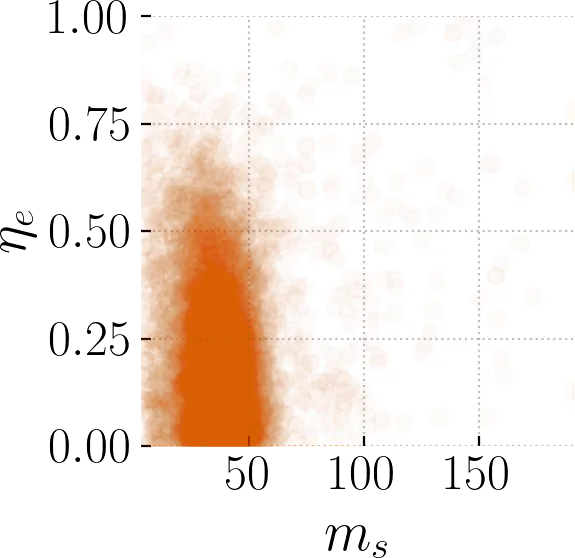
حلل العلماء بيانات الكتالوج الرابع لمرصدي LIGO–Virgo–KAGRA ووجدوا أن سرعة دوران الثقوب السوداء في الزوج تعتمد بشدة على كتلتها. فالثقوب الخفيفة — التي تصل كتلتها إلى 35–50 كتلة شمسية — لا تدور تقريبًا: فلفّها المغزلي (spin) (مقياس الدوران) لا يتجاوز 0.2 من أقصى قيمة ممكنة. أما الثقيلة، التي تبلغ كتلتها 70 كتلة شمسية فأكثر، فتدور بشراهة — بمتوسط حوالي 0.7 من الحد الأقصى، وغالبًا مع انحراف: فقد يدور أحد الثقبين في الزوج بسرعة بينما يدور الآخر أبطأ بشكل ملحوظ.
الدوران البطيء للثقوب الخفيفة يتوافق مع السيناريو الذي يولد فيه النجمان معًا ويعيشان حياة هادئة دون اكتساب دوران إضافي. أما الدوران السريع وغير المتناظر للثقوب الثقيلة فيشبه أكثر نتيجة اندماجات متعددة في تجمعات نجمية كثيفة أو عمليات التقاط فوضوية. ومع ذلك، فإن العلامة الواضحة المتوقعة للاندماجات "الهرمية" — حيث يدور أحد الثقبين دائمًا أسرع من الآخر — لم تظهر في البيانات. ومرة أخرى، تبين أن الطبيعة أعقد من توقعاتنا.
هذه الصورة للدوران هي هدف جديد للنظريين. الآن، يجب على نماذج توليد الثقوب السوداء الثنائية أن تفسر ليس فقط الكتل، بل أيضًا كيفية ارتباط هذه الكتل بدوران كل ثقب على حدة.
الملخص الأصلي
كما كتبه المؤلفون، بالإنجليزية arXiv:2605.24281
While the origin of merging black-hole binaries observed in gravitational waves remain uncertain, different formation channels are expected to leave distinct imprints on their observed mass and spin distributions. In this work, we focus on the mass dependence of the spin magnitudes $$(\chi_1,\chi_2)$$, allowing for multiple spin subpopulations whose relative fraction varies with mass. Using the binaries from the fourth LIGO--Virgo--KAGRA gravitational wave transient catalog (GWTC-4), we find strong evidence for two subpopulations, with a log Bayes factor of $$\log_{10} \mathcal B = 4^{+6}_{-2}$$. The data support a picture in which low-mass systems are composed almost entirely of slowly spinning black holes ($$\chi \lesssim 0.2$$), while high-mass systems are dominated by a broader component with moderate to rapid spins, peaking at $$(\chi_1,\chi_2)\approx(0.7,0.7)$$ and retaining a non-negligible tail toward asymmetric spins $$(\chi_1,\chi_2)\approx(0.7,0)$$. The transition between these regimes spans a broad range from $$m_1 \approx 35^{+20}_{-20} \,M_\odot$$ to $$m_1 \approx 70^{+90}_{-25}\,M_\odot$$. For the low-mass, slowly-spinning regime, a flexible model of spin orientations does not allow us to exclude identically vanishing spins, $$\chi_1 = \chi_2 = 0$$. Meanwhile, the high-mass, rapidly-spinning population does not neatly display the spin-magnitude asymmetry expected from hierarchical mergers, although the data do not exclude that. This kind of localized structure is generally difficult to access with standard Monte-Carlo likelihood estimators, which we replace with a regularized representation in terms of truncated Gaussian mixtures. Taken together, our results provide a new target for formation models, which should reproduce not only the mass and effective spin distributions, but also the mass-dependent structure of the individual component-spin magnitudes.
يُقاس اللف المغزلي للثقب الأسود برقم من 0 إلى 1. فالثقب ذو اللف المغزلي الأقصى 1 يدور بسرعة كبيرة لدرجة أن أفق حدثه يتحرك بسرعة تقارب سرعة الضوء.
في فيلم «Interstellar»، يدور الثقب الأسود الهائل Gargantua بلف مغزلي شبه أقصى، مما يسبب تمددًا زمنيًا شديدًا على كوكب Miller.