ممَّ خُبز الكوكب العملاق؟ سريع
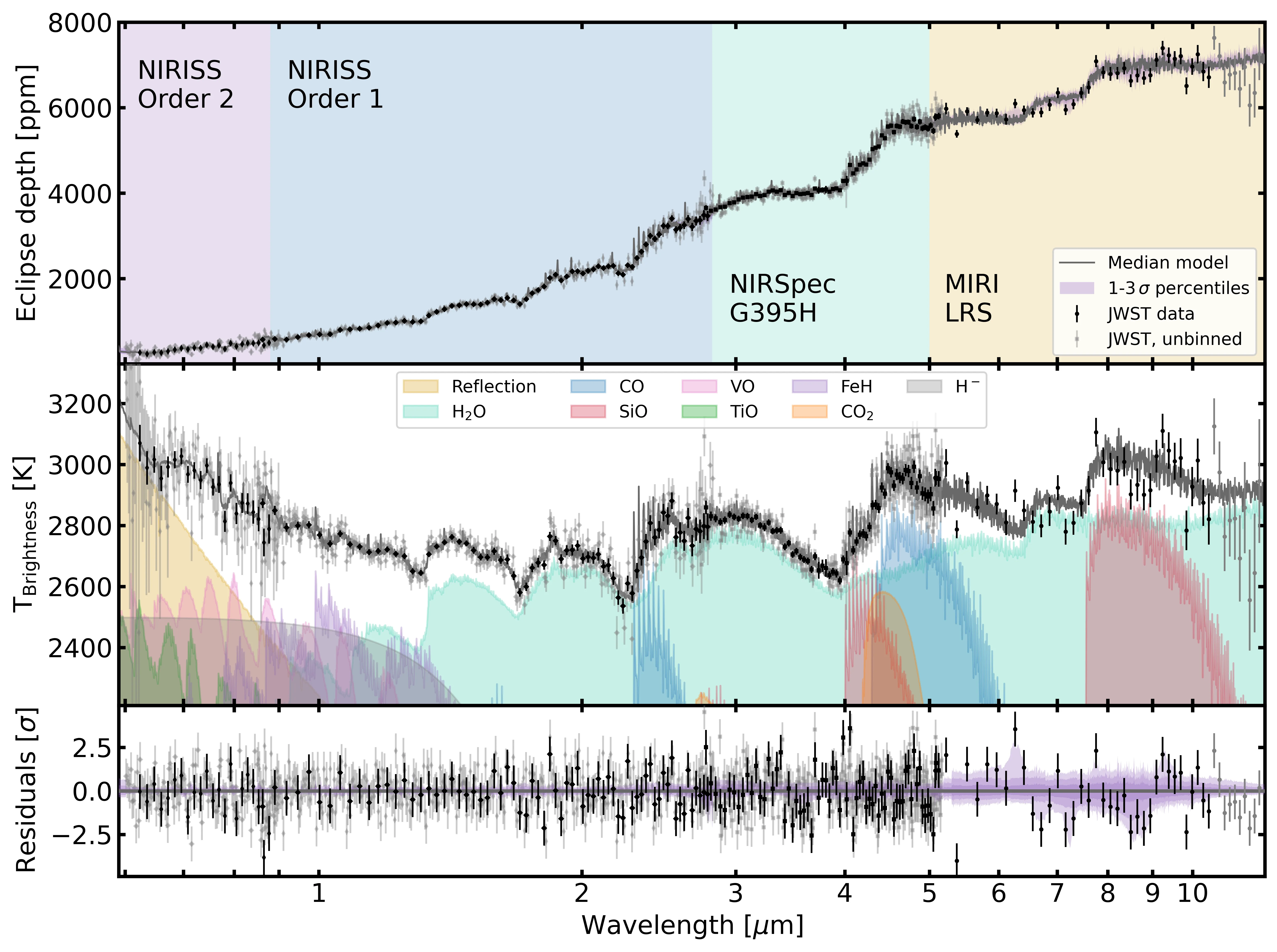
الكوكب WASP-121 b ليس مجرد كرة حارة. إنه عالم تتبخر فيه الحديد وتتوهج سماؤه بحرارته الذاتية. نظرة جديدة إليه ساعدتنا على فهم "المكونات" التي تشكل منها.
مزج العلماء البيانات الجديدة من ثلاثة أجهزة لتلسكوب ويب وأضافوا قياسات أرضية لتكوين النجم الأم. فظهرت صورة كاملة: في هواء الكوكب غازات خفيفة (ماء، أول أكسيد الكربون) وعناصر ثقيلة (سيليكون، حديد). لكن الأكثر إثارة هو النسبة. فقد وُجد أن كمية السيليكون بالنسبة إلى الأكسجين والكربون تزيد بأكثر من ثلاثة أضعاف عن نسبتها في النجم. مثل هذه "الوصفة" لا يمكن أن تنشأ من مصدر واحد. يبدو أن الكوكب في شبابه جمع مادته من مناطق مختلفة من القرص الكوكبي الأولي، جزءًا منها في صورة أجسام صلبة وجزءًا في صورة غاز. ثم تعرض بعد ذلك لاهتزاز أدى إلى ميل مداره بمقدار 90 درجة تقريبًا على محور دوران النجم. أظهرت النمذجة أن هذا قد يكون ناتجًا عن اقتراب وثيق من كوكب آخر أو رقصة طويلة مع نجم مرافق بعيد.
الملخص الأصلي
كما كتبه المؤلفون، بالإنجليزية arXiv:2606.21855
One path to understand how planets form is to link their present-day atmospheric composition to predictions from planet formation models. For the hottest planets, the abundances of refractory species can provide a useful formation tracer, complementing the traditionally used C/O and overall metallicity. Here we investigate the refractory abundance in the atmosphere of the ultra-hot Jupiter WASP-121 b, combining new JWST MIRI/LRS observations with archival NIRSpec/G395H and NIRISS/SOSS data to obtain a panchromatic dayside emission spectrum from 0.6 to 12 $$\mu$$m. Our retrieval analysis detects the refractory tracer SiO gas at high confidence, in addition to previously detected volatile species. The atmosphere is enriched in volatile and refractory species, with enhanced refractory-to-volatile ratios of Si/O=$$3.54^{+0.86}_{-0.69}$$x stellar and Si/C=$$3.05^{+1.12}_{-0.80}$$x stellar, relative to new stellar abundance constraints from ESPRESSO data. In addition, we confirm the depletion of TiO and the need for an additional source of reflected light opacity with a geometric albedo of $$0.22\pm0.03$$. The retrieved dayside temperature profile has a strong inversion layer, with a more complex structure than standard parameterizations can accommodate, and an eclipse map analysis indicates a small eastward hotspot offset of $$4.8^{+2.7\circ}_{-2.8}$$. Comparing our results with models of planet formation, we find that the measured enrichment pattern was shaped by accretion from multiple reservoirs, either through a mixture of solid and gas accretion interior to the water ice line or through continued solid accretion during inward migration from farther out in the disk. Finally, we model the planet's dynamical history and find that it could reach its current high-obliquity orbit as a consequence of a post-formation dynamical event, such as planet-planet scattering or von Zeipel-Lidov-Kozai cycles.
تصل درجة الحرارة على الجانب النهاري من WASP-121 b إلى 3000 درجة مئوية، وهي حرارة كافية لإذابة الفولاذ، وفي غلافه الجوي تطفو أبخرة المعادن.
عالم مشابه وُصف في رواية "موعد مع راما" لآرثر كلارك، لكن هناك، جاء الجسم الملتهب إلينا من الفضاء بين النجمي.