Thomas Henning

6 articles · 30 co-authors · latest: 2026-08-12
29 citations · h-index 2 · 14 papersData: Semantic Scholar

We have retold 6 papers by this author. 1 of them with a full read. most often about: Sun, exoplanet, brown dwarf. 30 co-authors across our retellings.

Links in the knowledge graph
A Beacon Near Our Nearest Sun: First Glimpse of a Planet around Alpha Centauri A
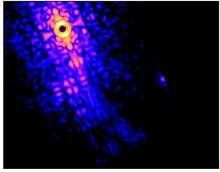
In August 2024, the MIRI coronagraph on the James Webb Space Telescope stared at Alpha Centauri A, the nearest Sun-like star to our Sun. At 1.5 arcseconds from the star, a point source, S1, blinked into view. Flux: 3.5 mJy, contrast: 5.5×10⁻⁵. Four to six sigma. A lighthouse flashing in the fog.
Stellar2025-11-191 minarXiv:2511.15667express
Exoplanets2026-02-181 minarXiv:2602.16646express
Two Restless Planets: Light but Different Inside
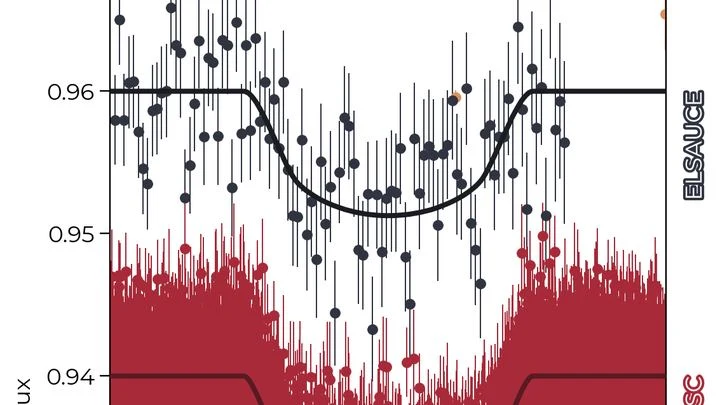
NASA's TESS space telescope monitors thousands of stars, catching the moment when a planet crosses its star's disk — the star's light dims slightly. That's how astronomers spotted two planets orbiting stars similar to our Sun. One, TOI-883 b, completes an orbit in ten days; the other, TOI-899 b, takes nearly thirteen.
Exoplanets2026-06-201 minarXiv:2606.21855express
What a Giant Planet Was Baked From
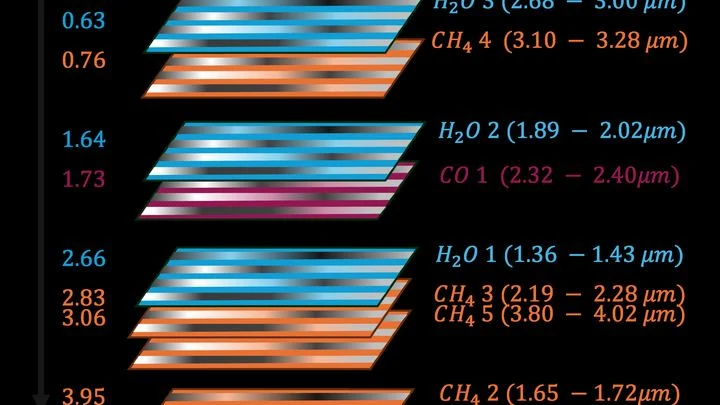
WASP-121 b is not just a hot ball. It's a world where iron vaporizes and the sky glows with its own heat. A fresh look at it has revealed what 'ingredients' went into making it. The James Webb Space Telescope has for the first time clearly detected vaporized silicon monoxide in its atmosphere — a refractory substance usually locked inside dust grains.
Exoplanets2026-07-212 minarXiv:2607.18683express
Chemical Portrait of a Young Star: When Infalling Gas Paints Patterns
The star AB Aur is young, about 4 million years old. Around it swirls a dense disk of gas and dust. Recently, a long gas stream, a flow of material from the surrounding cloud, crashed into it.
Galaxies2026-08-121 minarXiv:2608.11729express
Ice on Dust: How Surface Changes Cosmic Ice
In the coldest, darkest corners of space, dust grains get covered in ice, like a window on a frosty day. This ice isn't just frozen water: it also contains carbon monoxide and carbon dioxide. From such ice, comets and planets may eventually assemble. But until now, it was unclear how the dust grain itself affects the ice that forms on it.