الحياة على طرف قلم الرصاص: كيف تولد الخلايا من قواعد بسيطة سريع
في عام 1970، ابتكر عالم الرياضيات جون كونواي لعبة «الحياة» — حقل خلوي حيث تولد ثلاث قواعد فقط أنماطًا معقدة بشكل مدهش. بعد أربعين عامًا، ظهرت SmoothLife — نسخة توقف فيها الفضاء عن كونه خلويًا وأصبح ناعمًا مثل بقعة ضبابية. أخذ مؤلفو العمل الجديد نسخة أبسط من هذه اللعبة المستمرة: الآن كل شيء يتغير بسلاسة في الزمن أيضًا. وكانت النتيجة غير متوقعة — ظهرت في الحقل تلقائيًا بنى تشبه الخلايا الحية.
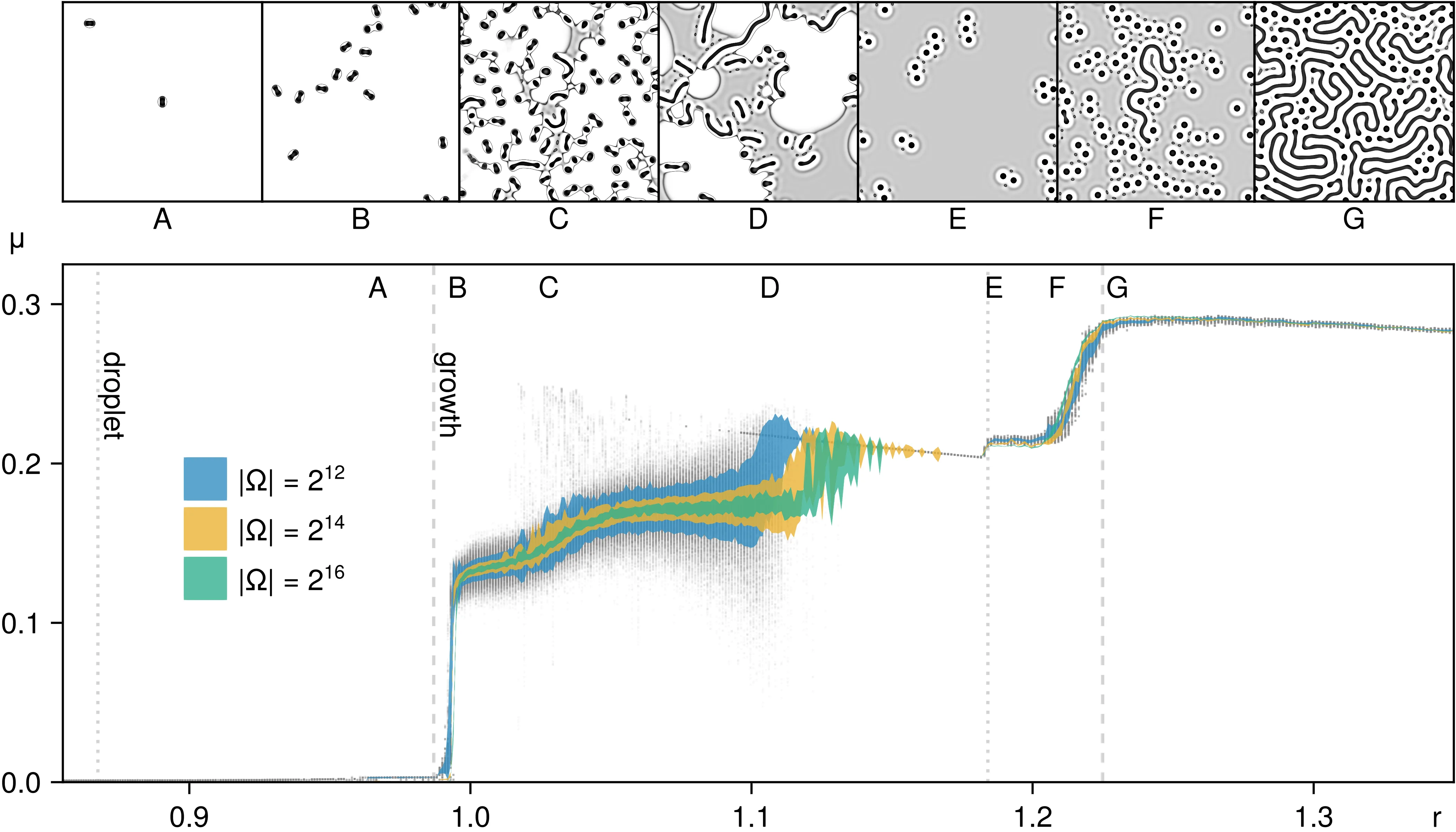
كل «خلية» من هذه (في الحقيقة هي مجرد كتلة من النشاط) تعيش حياتها الخاصة: يمكنها أن تزحف، أو تنقسم إلى قسمين، أو تذوب دون أثر. كل ذلك يعتمد على كمية «المورد» حولها — مادة افتراضية موزعة في الحقل. عندما يكون المورد قليلًا، تتجمد الأنماط؛ وعندما يكون كثيرًا، تبدأ في التكاثر دون ضابط. والأكثر إثارة للاهتمام يحدث عند الحدود حيث تكون كثافة الأنماط متوسطة. أطلق المؤلفون على هذه المنطقة اسم «حافة النمو» — هنا تحديدًا يولد كل تنوع الأشكال.
إذا أضفنا قانون الحفظ — أي قصر الكمية الإجمالية للمورد على الحقل بأكمله — يصل النظام نفسه إلى هذه الحافة. ينشأ التنظيم الذاتي: الأنماط لا تنتشر بشكل عشوائي، بل تتجمع في مجتمع متحرك ومتغير باستمرار. هذا يذكرنا بمستعمرة بكتيرية، حيث يبحث كل فرد عن غذائه، لكن التوازن العام يبقي الجميع معًا.
مثل هذه «الصندوق الرملي» البسيط لا يحتاج إلى جينات أو أغشية — فقط الرياضيات. لكنها تُظهر بالفعل بوادر الانقسام والحركة والموت. لعبة «الحياة» المستمرة تصبح جسرًا بين القواعد المجردة والبيولوجيا الحقيقية، مما يتيح لنا إلقاء نظرة على بدايات التنظيم الذاتي.
الملخص الأصلي
كما كتبه المؤلفون، بالإنجليزية arXiv:2607.27402
Conway's Game of Life shows that simple rules can generate a rich diversity of emerging structures. This cellular automaton has been translated to continuous space by Rafler (2011) in a simulation called SmoothLife. The isotropic rule of this continuous Game of Life generates patterns whose beauty has attracted the attention of a growing community at the intersection of science and computer art. We study a minimal variant of this model, continuous in space and time, that generates cell-like patterns capable of self-replicating, gliding and disappearing. The phenomenology of these unit patterns is reported and related to homogeneous-state bifurcations, symmetry breaking, observed shape instabilities, finite-amplitude morphological changes, and a dilute-to-dense transition associated with cell proliferation. Its mapping onto a large reaction--diffusion system is interpreted in terms of homeostatic concentrations of morphogens, regulated by the nonlinear survival rule and generated through a cell-sourced cascade of auxiliary reactions. Introducing a global conservation law that limits resource availability causes the system to self-organize at this dilute-to-dense transition, which we call the edge of growth. A further exploration of parameter space reveals a variety of phases and the richness of life-like morphologies organized around this edge. Resemblance to biological processes such as division, motility, and death, together with a concise formulation and numerical implementation, makes the continuous Game of Life an appealing model system for investigating the emergence and self-organization of life-like patterns.
في لعبة «الحياة» الكلاسيكية لكونواي، هناك شكل «الطائرة الشراعية» الذي يطير عبر الحقل إلى ما لا نهاية. في النسخة المستمرة، توجد أيضًا كتل منزلقة من هذا القبيل — تذكرنا بالكائنات وحيدة الخلية التي تسبح في قطرة ماء.