Frank Jülicher

4 articles · 14 co-authors · latest: 2026-07-29
33,555 citations · h-index 91 · 404 papersData: Semantic Scholar

We have retold 4 papers by this author. most often about: diffraction, evolution, mechanochemical_feedback. 14 co-authors across our retellings.

Links in the knowledge graph
Biological Physics2026-01-091 minarXiv:2601.05907express
Waves That Keep Their Formation
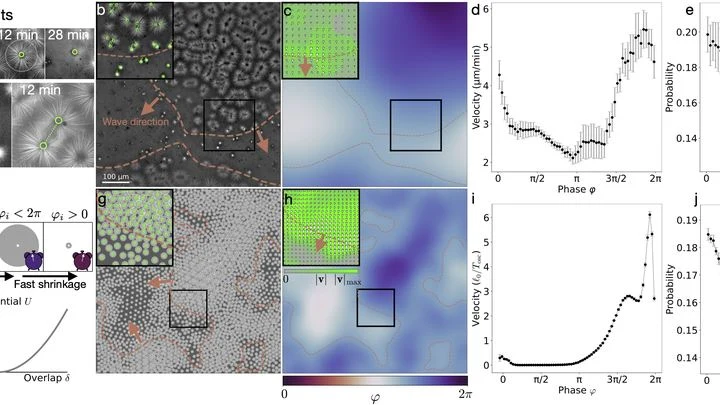
Inside a fertilized frog egg, waves ripple, like ripples on water, but made of proteins that command cell division. These waves travel millimeters, even though the egg itself is less than a millimeter across. Previously, it wasn't understood why they didn't fall out of sync. It turns out the waves clear their own path.

Biological Physics2026-01-221 minarXiv:2601.16151express
Switch Proteins: How a Cell Reads DNA
A cell is like a kitchen where thousands of recipes (genes) are collected in one thick book (DNA). The chef-protein Klf4 flips through the pages and decides which recipe to cook today. But how does it find the right line among billions of letters? Previously, researchers thought the protein looked for a short 'password'—a few consecutive letters.
Biological Physics2026-05-242 minarXiv:2605.24987express
How a cell catches broken DNA ends
A torn telephone wire is a nuisance, but a torn DNA is a catastrophe. A double-strand break, when both strands of the helix snap at the same spot, threatens the cell with death or transformation into cancer. Fortunately, the cell has its own 'glue': special proteins that gather into a droplet right at the accident site.
Biological Physics2026-07-292 minarXiv:2607.27402express
Life at the Pencil's Tip: How Simple Rules Give Rise to Cells
In 1970, mathematician John Conway invented the Game of Life — a cellular field where just three rules generate surprisingly complex patterns. Forty years later, SmoothLife appeared: a version where space is no longer cellular but smooth, like a blurred patch. The authors of the new study took an even simpler variant of this continuous game: now everything changes smoothly in time as well.
