المادة المظلمة أم قانون الطبيعة: جدل حول حركة المجرات سريع
عداد سرعة المجرة يتجاوز الحد الأقصى. النجوم الخارجية تدور بسرعة كبيرة لدرجة أنها وفقًا لجميع قوانين الجاذبية كان يجب أن تتطاير بعيدًا، مثل رذاذ من عجلة دوارة. لاحظ علماء الفلك هذا التناقض منذ زمن طويل واقترحوا تفسيرين: إما أن هناك كتلة غير مرئية حول المجرات (المادة المظلمة)، أو أن قانون الجاذبية نفسه على مسافات كبيرة يعمل بشكل مختلف عما تعلمناه في المدرسة.
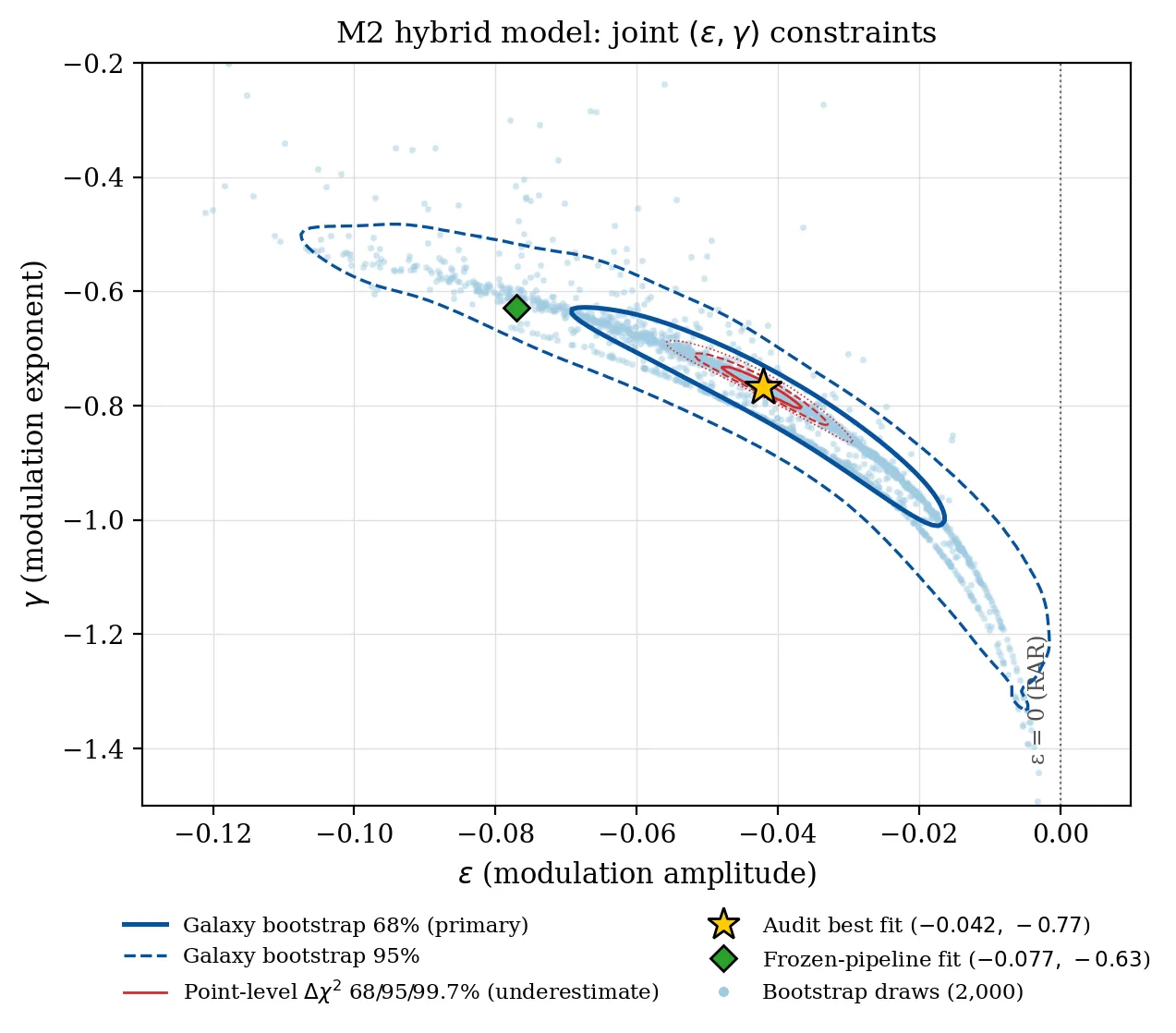
أجرى مؤلفو الدراسة الجديدة امتحانًا صارمًا للخيار الثاني. أخذوا بيانات دوران 126 مجرة واختبروا ما إذا كان تصحيح واحد لقانون الجاذبية يمكن أن يفسر جميع الملاحظات دفعة واحدة. اتضح أن لا: التصحيح يحسن التوافق مع البيانات، ولكن فقط لأن لكل مجرة "حرية" خاصة بها — كما لو كنت تضبط عداد السرعة لكل سيارة على حدة. في اختبار متقاطع نزيه، لا يتنبأ هذا التصحيح بأي شيء أفضل من حساب بسيط يعتمد على الكتلة المرئية.
النتيجة الرئيسية ليست اكتشافًا، بل حدًا. أي نظرية مستقبلية تريد الاستغناء عن المادة المظلمة يجب أن تتجاوز هذا المستوى من الدقة. وإلا فلا يمكن أخذها على محمل الجد.
الملخص الأصلي
كما كتبه المؤلفون، بالإنجليزية arXiv:2608.08945v1
We ask whether any one-parameter structural correction to the radial acceleration relation (RAR) can be uniquely recovered from SPARC rotation curves, and answer with an identifiability audit: each candidate is benchmarked against per-galaxy nuisance freedom, with predictive scoring against mass-only and data-quality baselines. In the full sample (N = 126) the answer is no: a hybrid compactness term improves the fit, but zero-point freedom absorbs the gain, and in cross-validation the model fails to out-predict a mass-only baseline and loses to a quality-flag baseline. One regime retains structural information: in gas-dominated, low-acceleration disks -- where MOND's strict locality and $$\Lambda$$CDM feedback models diverge most sharply -- the RAR residual correlates with compactness ($$r=0.46$$, $$p=1.3\times10^{-4}$$), remains significant under hierarchical partial pooling ($$\beta=0.23$$, $$p=1.7\times10^{-5}$$; N = 63), and survives canonical joint control for quality, sampling, mass, inclination error, and first-order pressure support ($$r=0.30$$, $$p=0.02$$). All significant results pass a Benjamini-Hochberg correction over the declared 27-test family. Three limits temper that survival: it is not significant under rank-based control over the widest proxy set; it resides in faint dwarfs independent surveys do not reach; and after mass control it is shared across the mass-size manifold. Pressure support brackets the interpretation -- isotropic drift correction absorbs a quarter of the amplitude, while a Jeans treatment overcorrects resolved cases -- leaving the physical origin undetermined. The audit's product is the extraction limit: claimed corrections must clear the 0.106 dex per-galaxy nuisance floor, a mass-only baseline, and data-quality stratification.
لا يمكن رؤية المادة المظلمة بأي تلسكوب، لكن بدونها لا تتطابق حسابات حركة المجرات والعناقيد وحتى انحناء الضوء القادم من الأجسام البعيدة.