كيف نقيس درب التبانة عبر نجومها المتربة سريع
العمالقة الحمراء في مركز درب التبانة تشبه منارات بعيدة تتوهج تارة وتخفت تارة أخرى. يخترق ضوؤها الغبار الكثيف، لكن الطرق المعتادة لقياس المسافات تفشل هنا: النجوم شديدة السطوع وغير مستقرة، والغبار يشوه الصورة.
وجد علماء الفلك طريقًا ملتويًا. أخذوا نجومًا معروفة المسافات من بيانات أخرى، وعلّموا نموذجًا حاسوبيًا ربط تلك المسافة بلون النجم في الأشعة تحت الحمراء. النموذج، الذي يشبه آلة حاسبة ذكية، يقدّر الآن المسافة من عدة "درجات" من التوهج تحت الأحمر. الخطأ صغير — حوالي 6% في بيانات الاختبار.
بفضل الأداة الجديدة، قاس علماء الفلك المسافات إلى أكثر من 36,000 نجم عملاق أحمر — من 0.5 إلى 20 ألف سنة ضوئية. الأمر أشبه بالحصول على خريطة تفصيلية لأعماق المحيط حيث كانت لدينا من قبل قياسات متفرقة فقط.
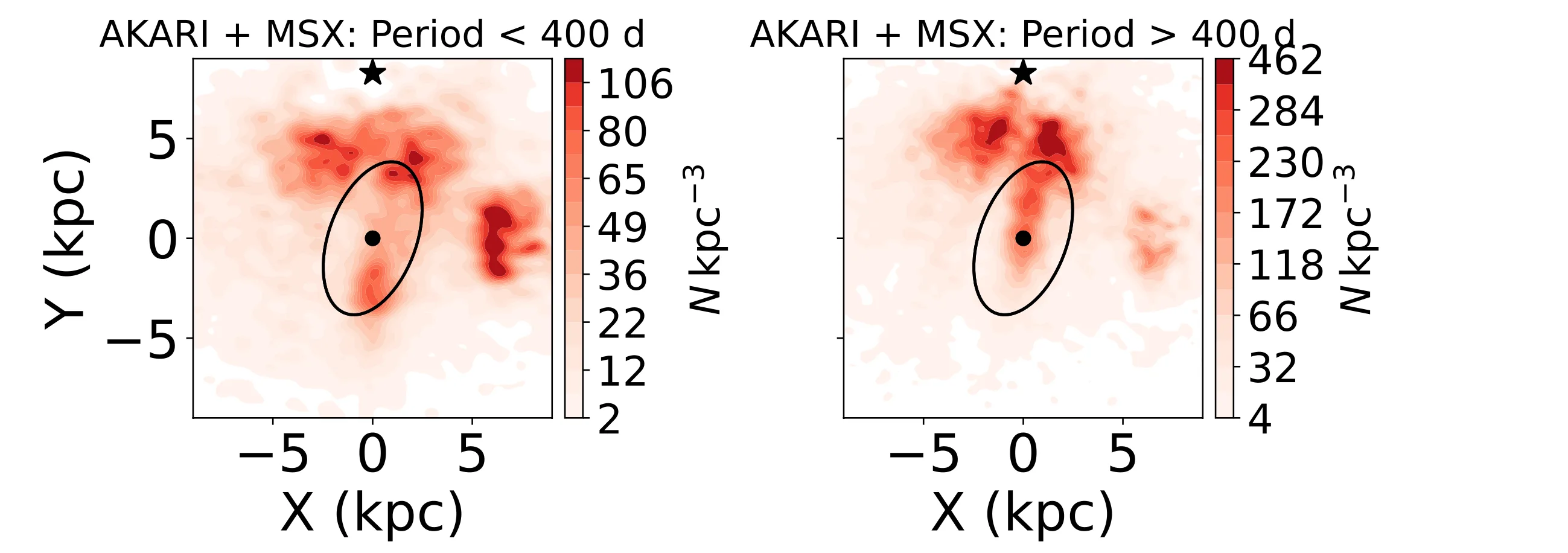
أثارت النجوم المتغيرة من نوع ميرا اهتمامًا خاصًا. تلك التي تنبض ببطء تجمعت في مركز المجرة، مكررة شكل القضيب الممتد — قضيب مجرتنا. أما النجوم النابضة السريعة فتوزعت عبر القرص. الفرق في "أعمار" هذه الطبقات النجمية يلمح إلى كيفية تشكل درب التبانة.
الملخص الأصلي
كما كتبه المؤلفون، بالإنجليزية arXiv:2608.10577v1
The structure and evolution of the Milky Way (MW) can be traced with distance estimates to the evolved stellar populations in the inner galactic region. However, direct astrometric distances remain unavailable or highly uncertain for the majority of these sources due to instrumental limitations, large angular diameters, and complex variability. In this work, we develop a supervised machine-learning model to estimate statistical distances to oxygen-rich asymptotic giant branch (AGB) stars selected from the AKARI mid-infrared survey. We build an XGBoost regression model that maps multi-band IR photometry to distance using a training set of AGB stars with previously derived SED-based distances achieving a mean absolute percentage error (MAPE) of 6% on an independent test set. Distance estimates for over 36,000 AGB sources are obtained within a 36% total error margin, greatly expanding distance coverage (0.5-20 kpc) for dust-obscured AGB populations in the Galactic plane. We find good agreement with reported distances for Galactic Mira variables and independent period-luminosity relations. Utilizing the expanded distance set, we further investigate the spatial distribution of Mira variables in the Galactic bulge and disk. Longer-period Miras preferentially trace the bulge's barred morphology compared to their shorter-period counterparts that populate the disk. We also find roughly constant, but differing, relative scale heights for the bulge and disk, with the bulge vertical dispersion about 30% larger. These findings show that IR photometry-derived statistical distances can recover large-scale Galactic structures and establish long-period Mira variables as efficient tracers of stellar populations in heavily obscured regions of the MW.
التلسكوب تحت الأحمر AKARI، الذي استخدم علماء الفلك بياناته، أطلقته اليابان في عام 2006 وعمل في المدار لأكثر من خمس سنوات، رغم نفاد وقوده في وقت أبكر.