الليزرات تعمل على تقويم الإشارة سريع
في الألياف البصرية، تنتقل البيانات بسرعة الضوء، لكن الطريق ليس مثاليًا: الإشارة تصبح ضبابية، مثل صوت يتحدث في ممر طويل. كلما زادت السرعة والمسافة، زاد التشوه. عادةً ما يتم تصحيح ذلك إلكترونيًا، لكن الإلكترونيات لا تستطيع مواكبة الضوء.
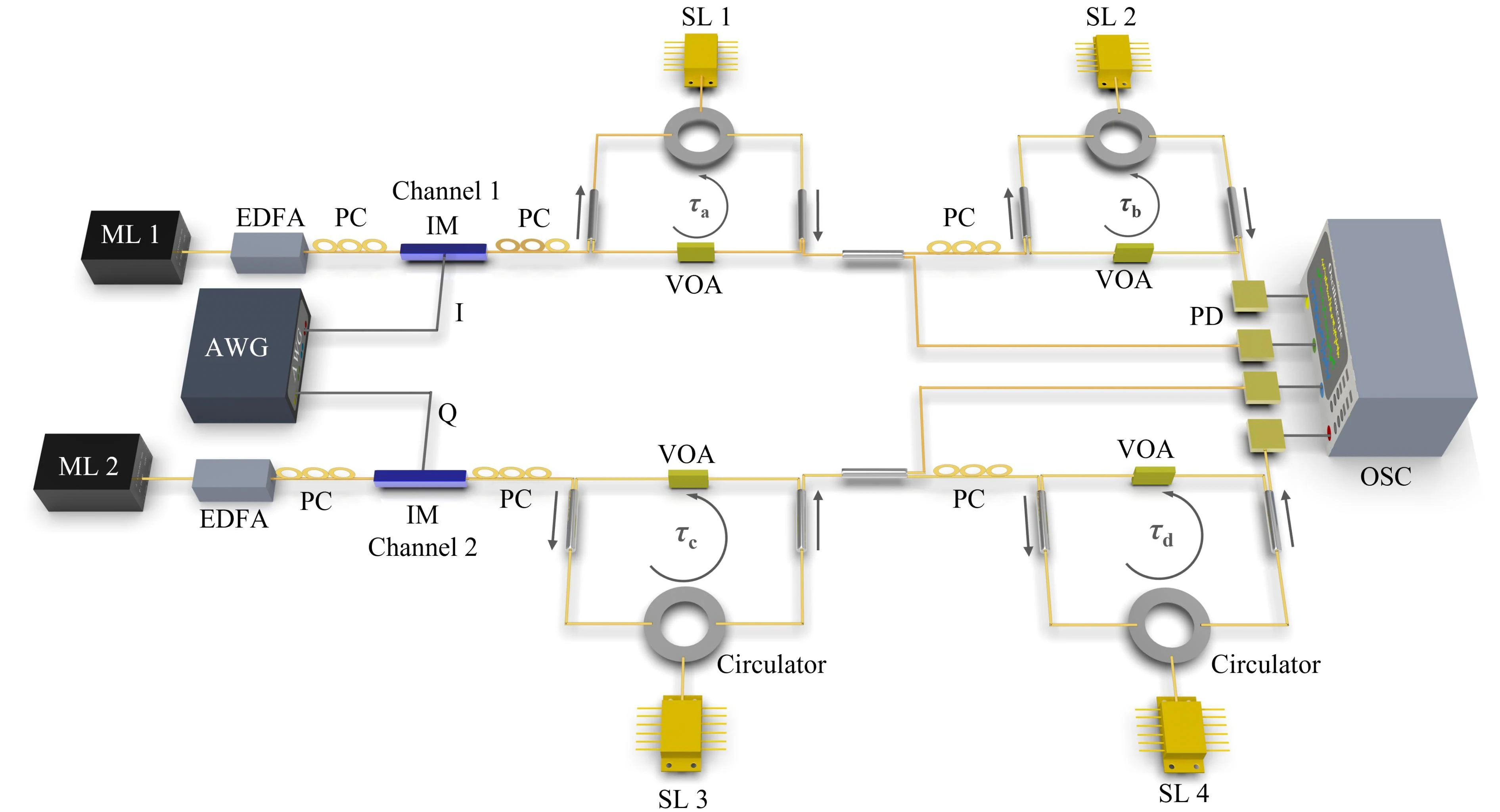
بنى العلماء حاسوبًا ضوئيًا من عدة ليزرات مرتبطة في سلسلة. كل ليزر يشبه عقدة في الشبكة تصحح الإشارة قليلاً. معًا، يتعلمون أثناء الطيران: الطبقة الأولى تلتقط الأخطاء الكبيرة، والطبقات التالية تلتقط أخطاء أدق فأدق. في التجربة، عالج هذا الحاسوب إشارة بسرعة 240 جيجابت في الثانية — أي حوالي 30 جيجابايت من البيانات كل ثانية.
أظهرت الاختبارات أن الحاسوب الضوئي يتعامل مع التشوهات عند قدرات إشارة مختلفة وعلى مسافات مختلفة. هذا يعني أنه يمكن دمجه في خطوط الاتصال الفعلية — وعندها ستصل البيانات أبعد وبدقة أكبر، دون الحاجة إلى إلكترونيات ضخمة.
الملخص الأصلي
كما كتبه المؤلفون، بالإنجليزية arXiv:2608.17419v1
Photonic reservoir computer (PRC) is a promising optical computing framework for high-speed optical signal processing, and various reports have shown its functionality of linear equalization for intensity-modulation direct-detection communication links. However, coherent communication links suffer more from nonlinear impairment, whereas its nonlinear equalization is very challenging. Here we demonstrate the nonlinear equalization of coherent 16-level quadrature amplitude modulation (16-QAM) signals using a deep PRC in experiment. The deep PRC consists of cascading injection-locked semiconductor lasers with optical feedback loops. For 16-QAM signals with a transmission rate of 240 Gbps and a launch power of 12 dBm, the single-channel PRC with 3 hidden layers raises the Q factor by as high as 0.58 dB, while the dual-channel PRC with 2 hidden layers raises the Q factor by 0.55 dB. In addition, we prove that the deep PRC is able to equalize 16-QAM signals of different launch powers and transmission distances.
تعمل الليزرات في هذا النظام مثل الموسيقيين في الأوركسترا: كل واحد يسمع الإيقاع العام ويضبط نفسه لتصبح الموسيقى أنقى.