A Living Database for Solar Cells express
Scientific papers are published faster than people can read and organize them. In the field of perovskite solar cells, the main database has been stuck in 2021, even though research is in full swing. Now PERLA comes to the rescue — an autonomous living database that keeps an eye on the flow of publications on its own.
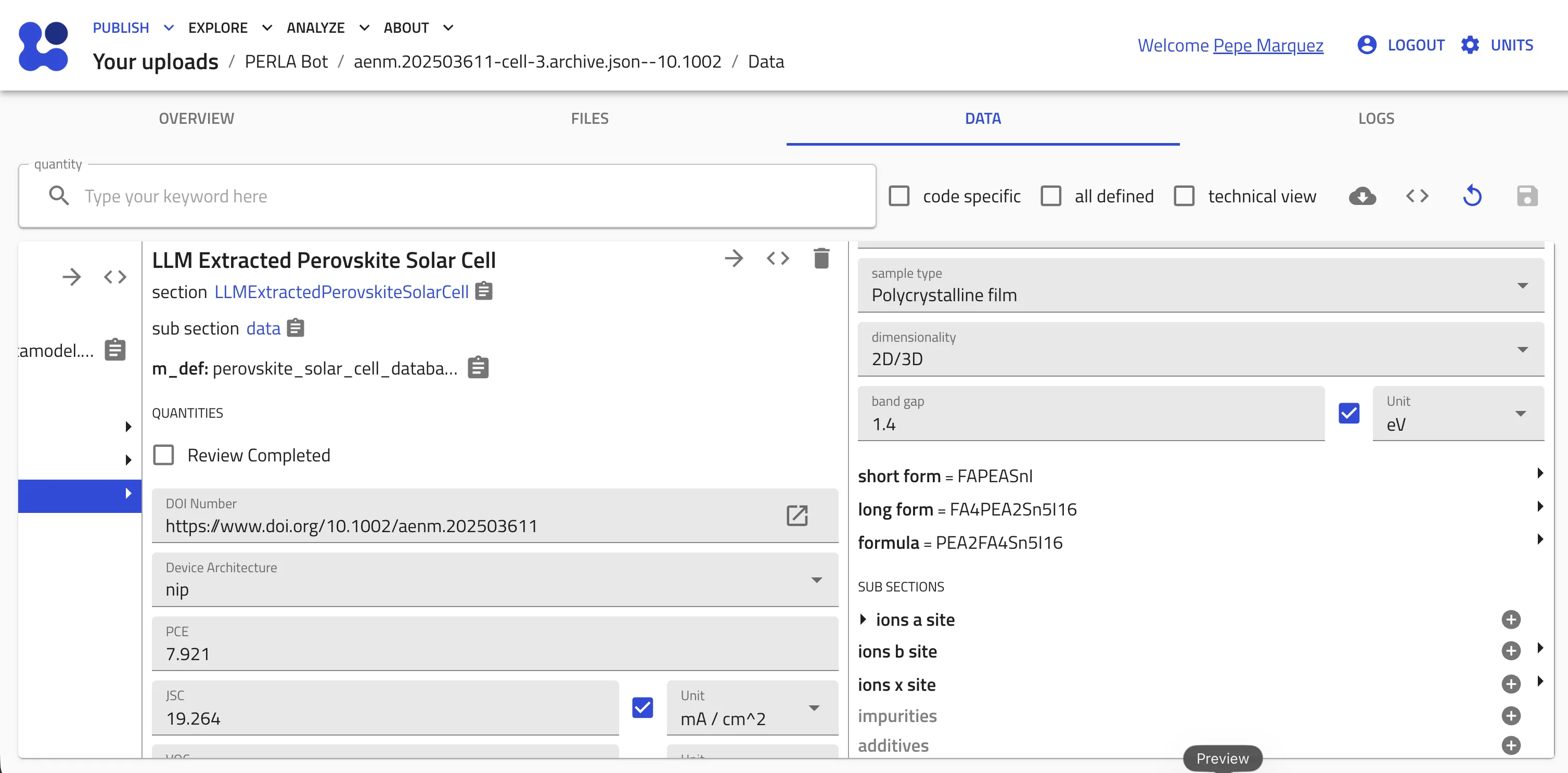
PERLA uses large language models to extract complex device data from texts and then verifies it using physical rules. Extraction accuracy exceeds 90%, and unlike humans, the system does not suffer from inconsistencies in assessments. It is like a diligent librarian who never gets tired and never makes mistakes from fatigue.
Thanks to PERLA, static publications turn into a dynamic knowledge resource. Now researchers can rely on up-to-date data and move faster toward new discoveries. The database grows with science, not a day behind.
Original abstract
as written by the authors arXiv:2601.17807
Scientific discovery is severely bottlenecked by the inability of manual curation to keep pace with exponential publication rates. This creates a widening knowledge gap. This is especially stark in photovoltaics, where the leading database for perovskite solar cells has been stagnant since 2021 despite massive ongoing research output. Here, we resolve this challenge by establishing an autonomous, self-updating living database (PERLA). Our pipeline integrates large language models with physics-aware validation to extract complex device data from the continuous literature stream, achieving human-level precision (>90%) and eliminating annotator variance. By employing this system on the previously inaccessible post-2021 literature, we uncover critical evolutionary trends hidden by data lag: the field has decisively shifted toward inverted architectures employing self-assembled monolayers and formamidinium-rich compositions, driving a clear trajectory of sustained voltage loss reduction. PERLA transforms static publications into dynamic knowledge resources that enable data-driven discovery to operate at the speed of publication.
PERLA's data extraction accuracy is above 90%—comparable to an experienced expert, but without human errors and fatigue.