Optics That Fix Themselves
An orchestra of a hundred musicians plays without a conductor. Every instrument is tuned perfectly, but one violin goes slightly off, and the harmony falls apart.
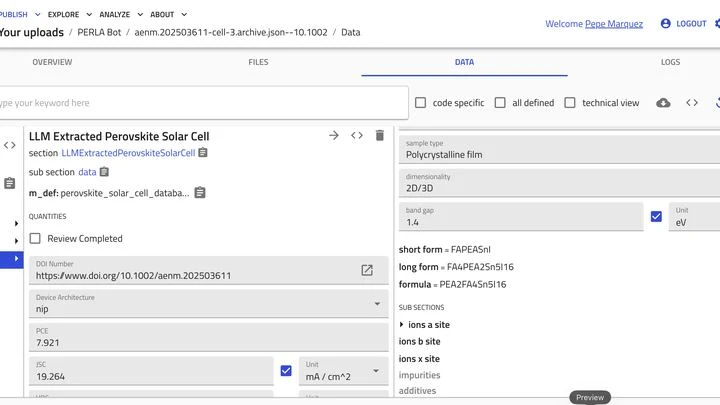
An organized collection of data stored and accessed electronically, here a self-updating repository of solar cell research.A database is a structured collection of data that is stored and accessed electronically. In the context of scientific research, it serves as a living repository that continuously updates with new findings. For example, a database of solar cell research would compile experimental results, material properties, and performance metrics from studies worldwide, enabling researchers to compare and analyze data efficiently.
The concept of databases dates back to the 1960s with the development of navigational databases like CODASYL and the relational model proposed by Edgar F. Codd in 1970. Since then, databases have evolved into sophisticated systems used across all fields of science.
Databases organize data into tables with rows and columns, allowing for efficient querying and retrieval. They use a database management system (DBMS) to handle data storage, indexing, and transaction management. In scientific applications, databases can be designed to automatically ingest new data from publications or experiments, ensuring the repository remains current.
Databases are used in materials science to catalog properties of compounds, in genomics to store DNA sequences, and in astronomy to manage catalogs of celestial objects.
The largest scientific databases, like those used in particle physics at CERN, store petabytes of data and are accessed by thousands of researchers worldwide.