Are you one of the authors of this paper? Email us from your institutional or work email address mentioning this article's arXiv ID and we'll verify you and give you edit access to this page.
Are you an author who sees something we missed or got wrong? Write to us — the subject line already carries the paper id. We read every note and correct the write-up.
A robot scientist reads papers on its own and updates data on perovskite solar cells.
📄 Showing the "Simple" version — "Popular" is not ready yet. Add it to favorites to help prioritize it.
Scientific papers are published faster than people can read and organize them. In the field of perovskite solar cells, the main database has been stuck in 2021, even though research is in full swing. Now PERLA comes to the rescue — an autonomous living database that keeps an eye on the flow of publications on its own.
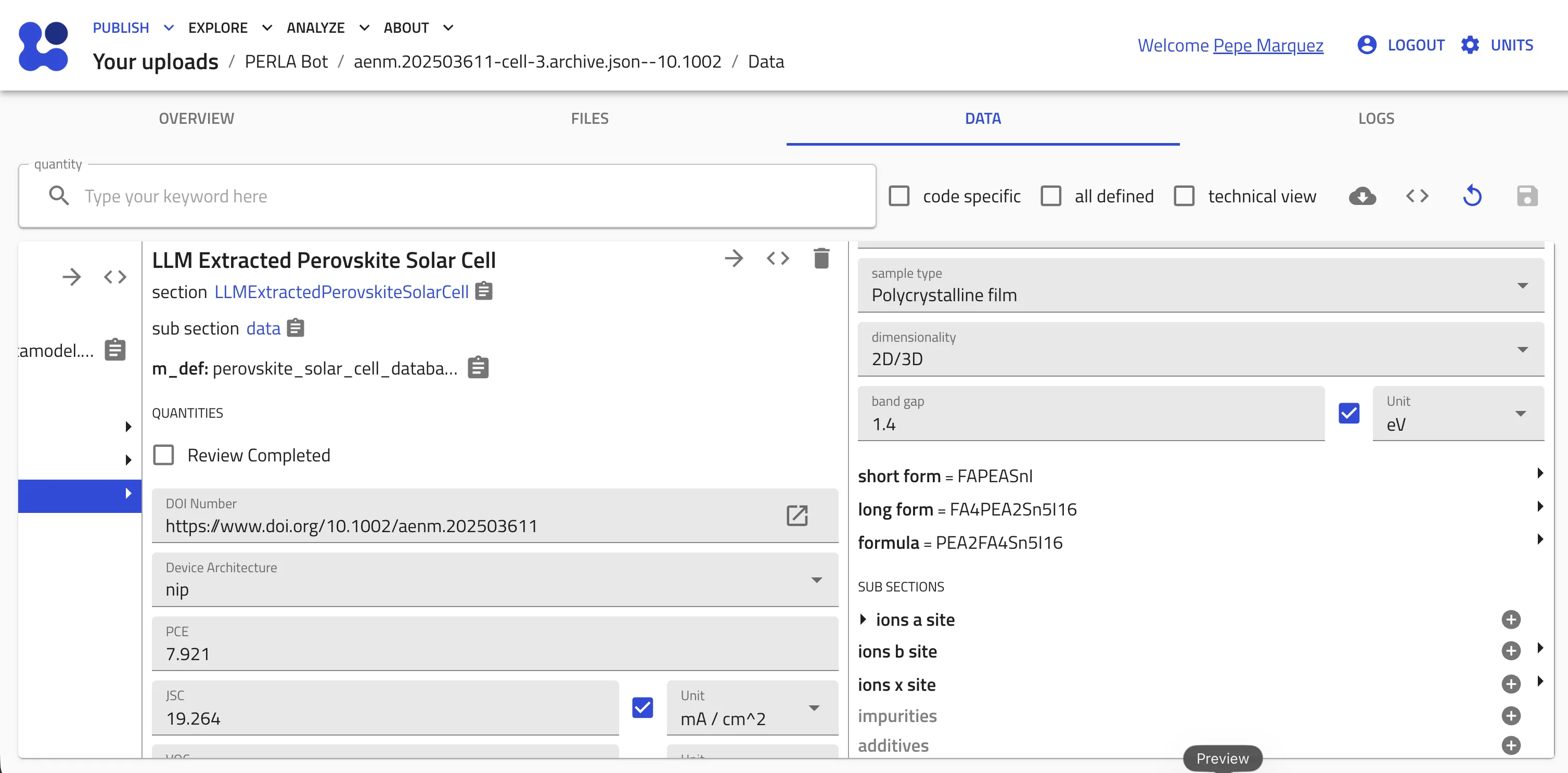
PERLA uses large language models to extract complex device data from texts and then verifies it using physical rules. Extraction accuracy exceeds 90%, and unlike humans, the system does not suffer from inconsistencies in assessments. It is like a diligent librarian who never gets tired and never makes mistakes from fatigue.
After processing papers published after 2021, PERLA uncovered an important trend: researchers have shifted to inverted architectures with self-assembled monolayers and formamidinium-rich compositions. This has led to a steady reduction in voltage losses — meaning solar cells have become more efficient at converting light into electricity.
Thanks to PERLA, static publications turn into a dynamic knowledge resource. Now researchers can rely on up-to-date data and move faster toward new discoveries. The database grows with science, not a day behind.