Perovskite refers to a class of crystalline materials with the general formula ABX₃, where A and B are cations of different sizes and X is an anion (usually oxygen or a halogen). The name comes from the mineral calciumtitanate (CaTiO₃), discovered in the Ural Mountains. Perovskites have a distinctive cubic crystal structure that can accommodate a wide variety of elements, leading to a remarkable range of physical properties, including ferroelectricity, superconductivity, and, most notably, excellent photovoltaic performance.
History
The perovskite structure was first described in 1839 by Gustav Rose, who named it after the Russian mineralogist Lev Perovski. The photovoltaic potential of hybrid lead halide perovskites was first demonstrated in 2009 by Tsutomu Miyasaka and colleagues, sparking a rapid surge in research.
How it works
The perovskite structure consists of a three-dimensional network of corner-sharing BX₆ octahedra, with the A cation occupying the large cavities between them. This flexible framework allows for easy substitution of different elements, which tunes the electronic band structure and optical properties. In solar cells, the material absorbs light efficiently due to its high absorption coefficient and long carrier diffusion lengths. Charge transport often occurs via hopping between localized states, especially in disordered or hybrid organic-inorganic perovskites, where the organic cation introduces dynamic disorder.
In practice
Perovskites are used in high-efficiency, low-cost solar cells, light-emitting diodes, photodetectors, and are being explored for use in lasers and radiation detectors.
Fun fact
Perovskite solar cells have achieved power conversion efficiencies exceeding 25% in just over a decade of research, a rate of improvement faster than any other photovoltaic technology.
A transparent film of bismuth tungstate sits on a substrate and does not conduct electricity. Three minutes in a cloud of nitrogen plasma, and it turns black, with resistance dropping by a factor of a billion.
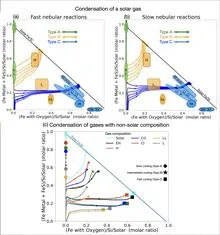
Three cabinets full of rocks. In one, metallic grains and the gray mineral enstatite; in the second, the same grains but with rusty streaks; in the third, layered clays swollen with water. All three sets were pulled from meteorites that fell to Earth: chondrites. They were born in the same gas-and-dust disk around the young Sun, yet somehow turned out so different.
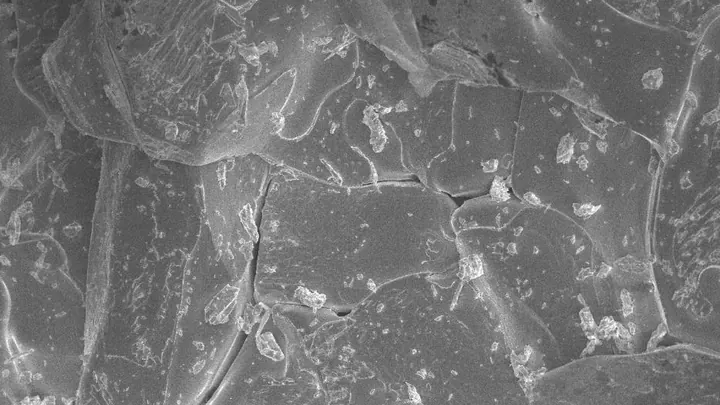
In a chunk of the meteorite EET 87720, found in Antarctic ice, lies a pink grain of sand. It's spinel, a mineral almost never seen in ureilites, and here it grew to half a millimeter. Such a find is like a time capsule from an early melt: it solidified when the parent body was just beginning to cool.
In a thin layer of liquid crystal, molecules usually lie like matches in a box — aligned in one direction but randomly oriented: some point up, others down. To make all the matches point the same way, you need a special molecular architecture. Scientists have found a chemical trick that does this almost automatically.
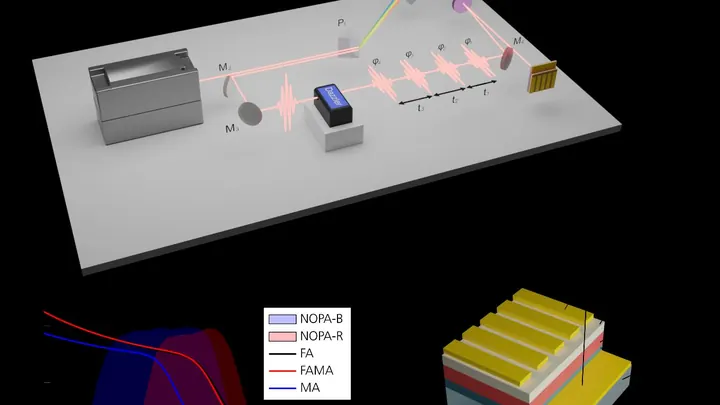
Light hits a solar cell, and inside, charges are born, hot and bothered. Like a person after a jog, they carry extra energy. To deliver current to an external circuit, they need to cool down and reach the edges of the crystal. If cooling drags on, part of the energy is wasted.
Perovskite is a mineral that scientists have learned to make artificially.
In a thin perovskite film, a material for cheap solar cells, light creates pairs of charges: an electron and a "hole." They need to reach the electrodes and produce current, but many vanish along the way. Where exactly they go is the question that determines how efficient the cell will be.
A perovskite solar cell is like a young athlete: it performs brilliantly at first, but tires with age. Over eight hours, its performance drops noticeably, with no visible cause like cracks or dust. Scientists took one cell and recorded its performance at 0, 90, 280, and 480 minutes of its life.
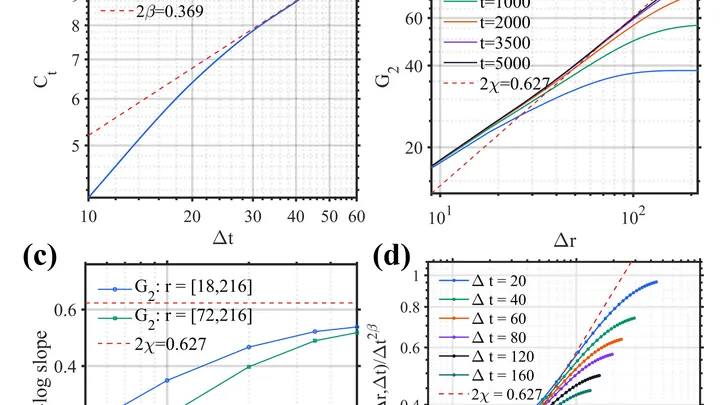
A snow-covered mountain slope looks like a chaotic jumble. But measure the roughness and you find that the height variations follow strict mathematics. Stochastic modeling shows these random processes aren't entirely random. They produce universal patterns, whether in snow, the flame front of a wildfire, or the growth of a bacterial colony.
In extreme cold — minus 268 degrees — a crystalline perovskite film starts transmitting light differently depending on its polarization. The beam seems to split in two: one part travels slightly faster, the other slightly slower.
Hybrid perovskites are the rising stars of photovoltaics: their efficiency is growing so fast it feels like we're on the brink of a solar revolution. But these materials, like intricate atomic mosaics, are extremely vulnerable — moisture, heat, and light quickly turn them to dust.
In 2019, an unusual visitor, comet 3I/ATLAS, zoomed into the Solar System. It came from another star, and for the first time, astronomers were able to see what its dusty tail is made of.
The atmosphere of Titan, discovered by Christiaan Huygens, is opaque to ordinary telescopes. But spectral analysis finds 'windows' of transparency — narrow regions where the haze parts.
Perovskite crystals harvest sunlight almost as well as silicon, but cost pennies. Their trouble is an inborn fragility: from warmth and ordinary water in the air, they “get sick.” Inside, disorder builds up, and the shiny plate turns cloudy, losing its abilities within a couple of days.
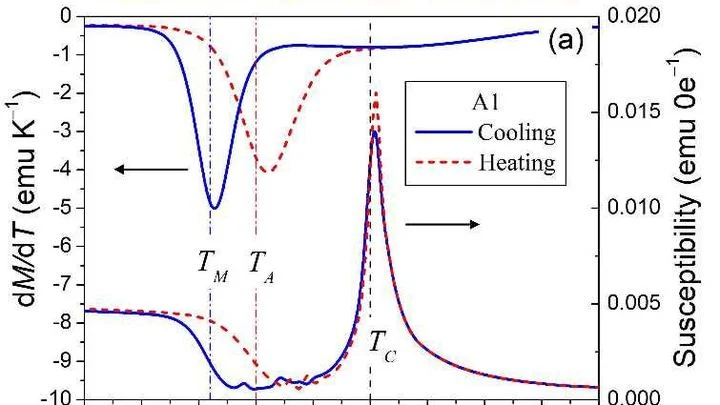
A metal bar suddenly becomes stiff when heated, and at the same time loses or gains magnetic properties. In alloys based on nickel and manganese, such transformations occur not smoothly but abruptly — atoms rearrange into a new order, and the material changes its behavior.
A tiny grain of sand, older than Earth, was found in the meteorite Meteorite Hills 00526. It measures about one thousandth of a millimeter. It consists of three parts: a silicate with magnesium and calcium, aluminum oxide, and a speck of titanium oxide.
Plutonium is a metal with attitude. One form shrinks when cooled, another swells. But at room temperature, the alloy behaves strangely: the ruler says one thing, X-rays say another. The ruler shows the sample barely grows, while X-rays see atoms in the crystal lattice moving further apart.
A crystal is like a city: if the streets are crooked, traffic jams. In a crystal, the streets are atomic rows, and the traffic is the flow of electrons. Any tiny imperfection, impurity, or atomic displacement makes electrons scatter. Scientists from several labs have learned to grow crystals so that the "streets" are almost perfectly straight.
The method is called horizontal vapor transport.
A superconductor is a material that, when strongly cooled, loses its electrical resistance: current flows through it without losses. Scientists took a layered crystal of PdTe2, similar to a stack of sheets of paper, and cooled it to temperatures below 1.8 kelvin (that's about -271°C).
An alloy of palladium and tellurium with a small amount of gold added behaves like a wire that loses its resistance when cooled. At ambient pressure, the three samples with different gold contents had superconducting transition temperatures of 2.7, 4.1, and 4.6 kelvin — colder than a freezer, roughly like deep space.
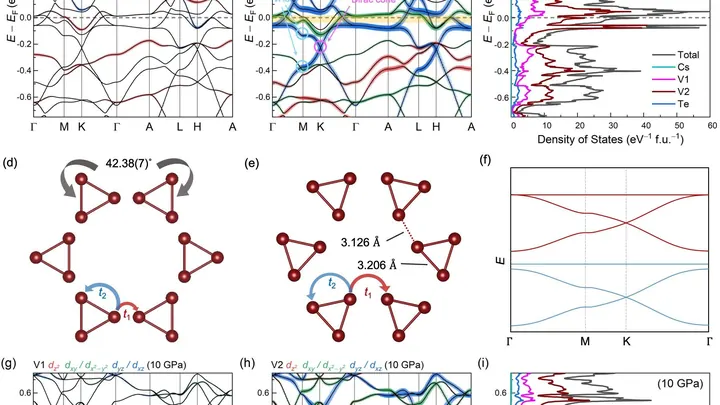
A woven basket made of willow twigs holds its shape thanks to the interweaving. A similar pattern, triangles linked into a flat network, has been found in a new crystal with the formula Cs₃V₉Te₁₃. Here, vanadium atoms form two sets of triangles that pierce each other like threads in fabric.
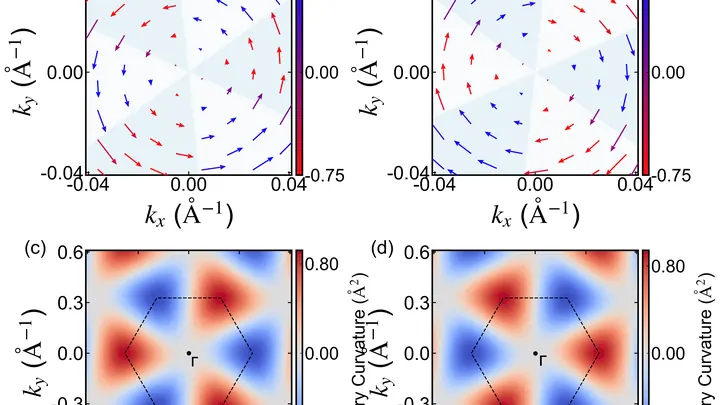
This pattern is not just pretty: it forces electrons to move along special "flat" energy pathways.
A barium titanate crystal is like a crowd where everyone holds a pointer. Normally, the pointers face in random directions, but when you apply an electric field, they all snap to point the same way. This ordered state is called ferroelectric: it stores information the way a compass needle stores direction.
A thin film of nickel oxide, tens of nanometers thick, is like a sheet of paper folded hundreds of times thinner. At room temperature, it conducts electricity, but cool it slightly and it becomes an insulator.
A solar cell is like a heart: if you force it to beat out of rhythm, it tires quickly. Usually, cells are tested by applying reverse voltage, but in real life, a shadow from a leaf or a bird forces neighboring cells to pass foreign current through themselves.
A light beam inscribes a pattern on a thin crystal, and heat runs along that pattern in the desired direction, like water along a dug channel. This is how the new method works to control energy flows over distances of tens of nanometers — hundreds of times thinner than a human hair.
A crystal the size of half a matchbox was grown in a furnace, where a molten zone slowly crept along a rod, leaving perfectly ordered layers behind. Inside this crystal, copper ions sit at the nodes of a triangular lattice, but the triangles are slightly skewed, as if someone pressed on one corner. Each copper ion behaves like a tiny magnetic needle that can point up or down.
Titan, Saturn's largest moon, is wrapped in a thick orange haze. It's made of hydrocarbons and other organic molecules that are born when sunlight breaks apart methane and nitrogen in the upper atmosphere.
A sheet of paper hundreds of times thinner than a human hair: that's roughly the thickness of the vanadium oxide film scientists grew. Inside this film, electrons, the tiny carriers of electric current, move almost without collisions. Like cars on an empty night highway, they accelerate and don't lose speed.
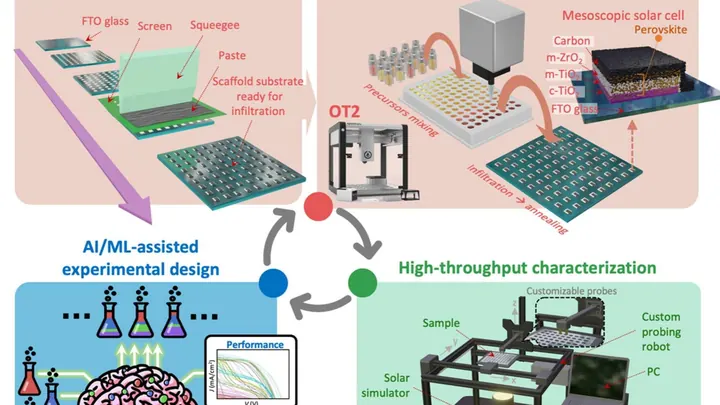
Testing molecules for solar cells is like trying a new sauce in a restaurant where the chef changes every five minutes. Disturbances (humidity, substrate cleanliness, deposition method) hide the true effect. To extract real benefit from noisy data, scientists created a 'smart sieve'—an algorithm that sifts through the results and leaves only reliable improvements.
An electron is like a tiny spinning top — it's constantly rotating. This property is called spin, and it's crucial for quantum technologies. But under normal conditions, the environment quickly disrupts the rotation, like a top stumbling on gritty sand.
Silver niobium oxide, AgNbO₃, is a layered pie of silver, niobium, and oxygen atoms. At room temperature, it behaves like an ordinary dielectric, but when cooled, the atoms start to shift, and the crystal gains electric polarization, like a compass needle, but instead of pointing north, it points in the direction of the internal…
When a young star ejects jets of gas, they slam into the surrounding cloud like a fist into a pillow. At the impact site, the gas is compressed and heated — creating a shock wave. In this hot zone, atoms and simple molecules collide and assemble into larger compounds, known as complex organic molecules.
A quantum dot the size of a few thousand atoms blinks like a faulty light bulb. It flashes brightly, then almost goes dark. Previously, it was thought that in dark moments it emits not only single photons but also extra pairs — a defect for quantum communication.
Light from tiny perovskite crystals is like a choir performance, where voices sound sometimes solo, sometimes in a tight duet. Previously, such a duet could only be heard under extreme cooling, nearly to the chill of outer space. Now the choir sings at room temperature.
A beam of circularly polarized light hits a MAPbI3 perovskite crystal. The electrons inside start behaving like tiny spinning tops, their axes aligning along the beam. This phenomenon is known as optical spin orientation.
Sometimes a fiery streak crosses the night sky. It's a piece of rock from space burning up in the air, and the color of the flash can tell you what elements it contained. Astronomers pointed sensitive cameras at such flashes and, among 180 images, found two rocks that stand out from the majority of shooting stars.
A flashlight beam in fog spreads out within a couple of meters. Light particles scatter in all directions, like a crowd in a square. But sometimes they can march in formation — without spreading, without mixing. That's exactly the kind of march achieved in a tiny perovskite crystal.
The crystal was placed between two mirrors.
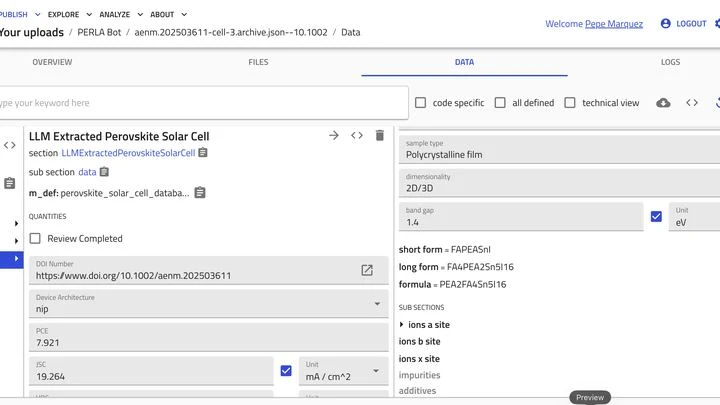
Scientific papers are published faster than people can read and organize them. In the field of perovskite solar cells, the main database has been stuck in 2021, even though research is in full swing. Now PERLA comes to the rescue — an autonomous living database that keeps an eye on the flow of publications on its own.
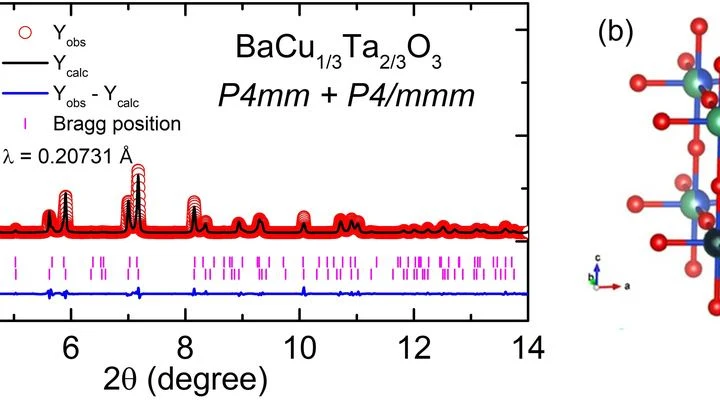
Atoms in a crystal usually sit in their designated spots, like passengers on a plane with assigned seats. But in this material, copper and tantalum have taken their places randomly, as if the tickets got mixed up. Scientists peered into the crystal using X-rays and saw that the disorder is not just on paper but in the actual arrangement of atoms.
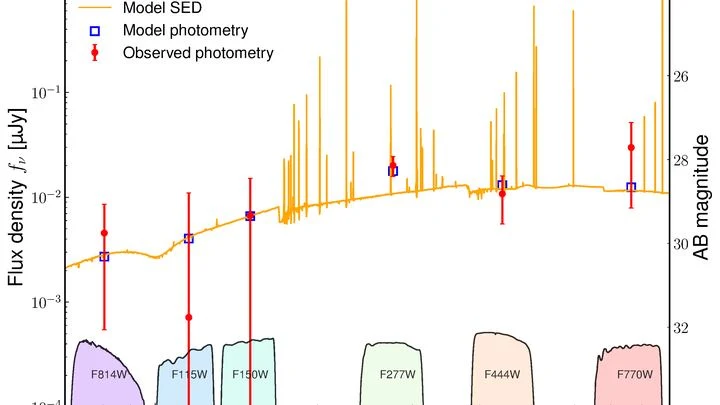
In the deep cosmos, more than 12 billion light-years away, the James Webb Space Telescope has spotted a galaxy that looks like a visitor from the dawn of creation. Its light has been traveling to us since the universe was only about two billion years old — a time when galaxies were growing especially vigorously, a period astronomers call the cosmic noon.
A cube of potassium tantalate behaves like an ordinary dielectric: it doesn't store an electric field. But grow this material as a thin film on a substrate of another crystal, and everything changes.