Liquid and Ultrasound Move Objects Without Touch express
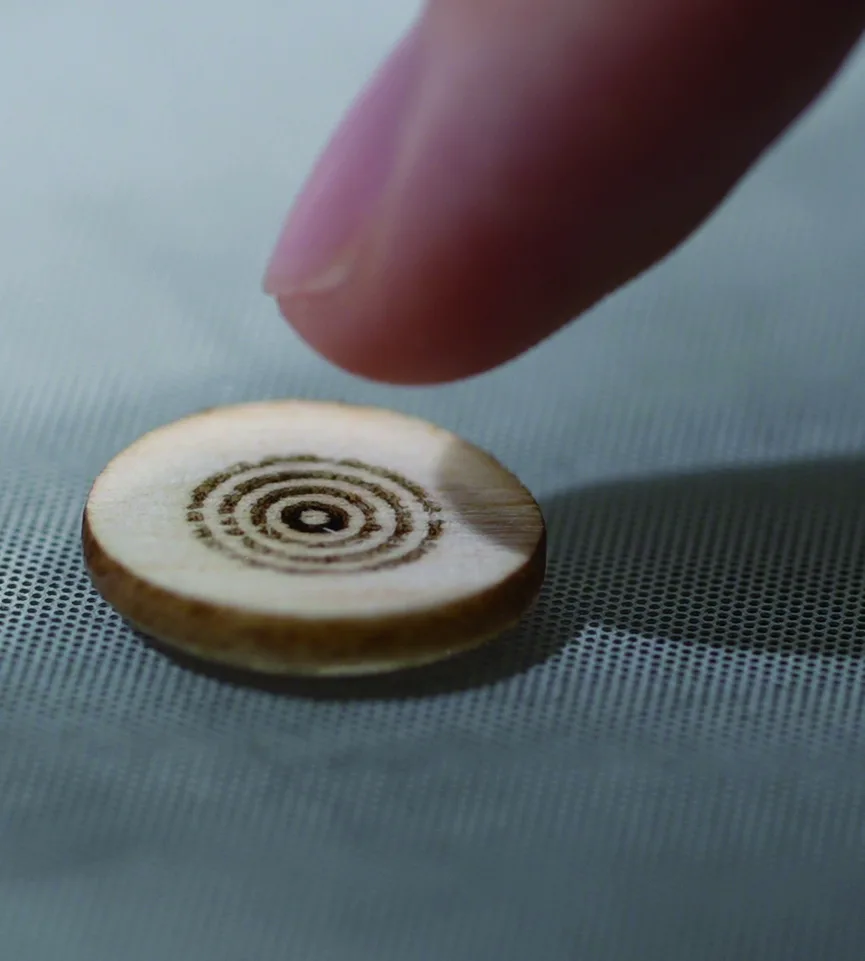
On the table sits a plastic figurine. Underneath it is a drop of water, and around it, a mesh that keeps the drop from spreading. From below, inaudible sound waves strike the drop, propelling it, and the figurine glides across the table like a little boat on an invisible river. No motors, no wires, just sound and water.
The scientists tested how much weight this system can carry. It managed more than half a gram — about ten grains of rice. If you press down on the figurine, the drop springs back and returns it to its place, like a button. And if you vibrate at a frequency of 22 times per second, the drop trembles and transmits the vibration to your finger — giving haptic feedback, just like a phone.
Such a table can be made large or small, and it's not afraid of open air. In the future, you could assemble puzzles on it, control robots, or play board games where pieces move on their own.
Original abstract
as written by the authors arXiv:2602.18730
Interfaces that couple digital information with physical matter enable computation to be expressed through tangible motion and touch, yet typically rely on embedded actuators, rigid mechanisms, or enclosed environments. Consequently, contactless manipulation and interaction with centimeter-scale tangible elements in open settings remain difficult to achieve. Here, we present PolygonWave, a solid--fluid acoustic interface that enables transport and tangible interaction by coupling airborne ultrasound with liquid-mediated support. The system employs lightweight Janus icons with asymmetric wettability: a superhydrophobic upper surface permits dry touch interaction, while a hydrophilic lower surface couples to a water droplet resting on a superhydrophobic mesh. Focused acoustic fields generated by a 256-element phased array induce lateral forces, enabling programmable motion without mechanical contact. Systematic characterization demonstrates transport of payloads up to 525 mg across variations in icon size, droplet volume, and applied load. Beyond translation, the liquid layer functions as a reconfigurable mechanical element, enabling button-like input with self-recovery and resonance-driven vibro-visual feedback, exhibiting a peak response near 22 Hz for 200 \textmu L droplets. Liquid-mediated acoustic coupling provides a unified mechanism for mechanically expressive, touch-accessible tangible interfaces bridging acoustics, soft matter physics, and physical human--computer interaction.
A drop of water on a superhydrophobic mesh resembles a bead of mercury: it doesn't spread and glides easily when nudged.