An interface is the boundary between two different materials or phases of matter, such as between a liquid and a solid, or between two different metals. At this boundary, the properties of the material can change dramatically, often giving rise to phenomena that do not exist in either of the bulk materials alone. Interfaces are central to many areas of physics and chemistry, from the behavior of biological membranes to the operation of electronic devices.
History
The concept of an interface has been implicit in physics since the study of surface tension in the 19th century, but its modern importance grew with the development of semiconductor physics and the discovery of phenomena like the quantum Hall effect, which occurs at interfaces.
How it works
At an interface, the atoms or molecules on either side have different environments than those in the bulk. This can lead to rearrangements of atomic structure, changes in electronic states, or the accumulation of charges. For example, in superconductors, the interface between a superconductor and a normal metal can host exotic electronic states that are absent in either material. Similarly, in topological materials, the interface between layers with different topological properties can support conducting states that are protected against scattering.
In practice
Interfaces are crucial in modern technology, including transistors, solar cells, and superconducting circuits, where the properties of junctions between different materials determine device performance.
Fun fact
The interface between graphene and salt water can be used to generate electricity, as the flow of ions across the boundary creates a voltage.
It is easier to turn a jar lid by gripping its edge than its center. Layered crystals such as graphite behave similarly when one layer is twisted relative to another: the resistance arises not from the whole contact area but only from its rim.
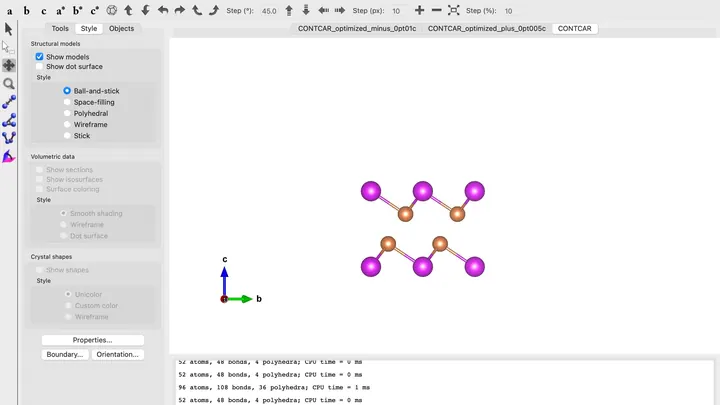
A deck of cards in which each card is slightly rotated cannot lie flat: the backs and faces will never align. But if the cards are flexible, they will start to adjust, shifting by fractions of a millimeter to find the perfect match. Something similar happens inside crystals when two thick layers of MoS2 or MoS2 with WS2 are stacked with a twist of 1–2 degrees.
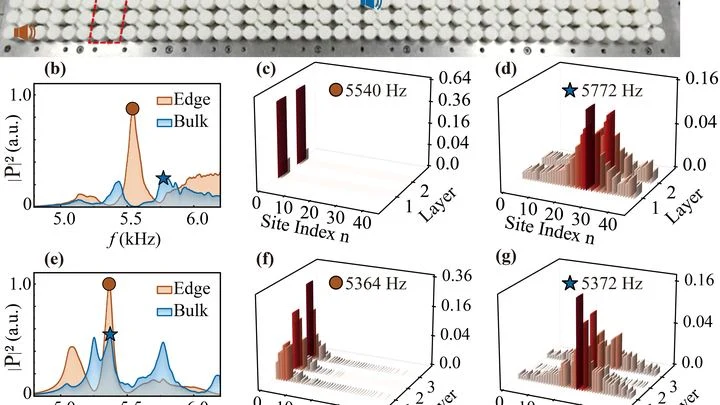
The book is open to the middle. Current runs along the spine, while the pages remain cool. That's roughly how a two-dimensional topological insulator works — a material where electricity flows only along the edges, while the interior stays still.
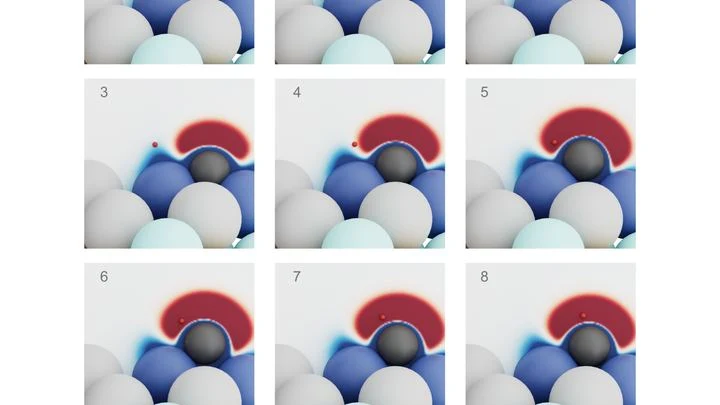
A kitchen sponge soaked in syrup: in some spots there's more syrup, and your finger sticks right away; in others, it barely touches. That's roughly how a catalyst surface works. Molecules don't react everywhere but at especially sticky points — active sites.
Ordinary ice at very low temperatures and high pressures does not melt but transforms into another solid — equally shapeless (amorphous) but much denser. For a long time, no one could understand exactly what happens at the moment when low-density ice begins to become dense.
Two grains of salt fall into a glass of water. They dissolve, and sodium and chloride ions spread throughout the volume. The schoolbook truth is simple: like charges repel, opposite charges attract. But recent experiments with tiny spheres in liquids have revealed a picture that breaks this rule.
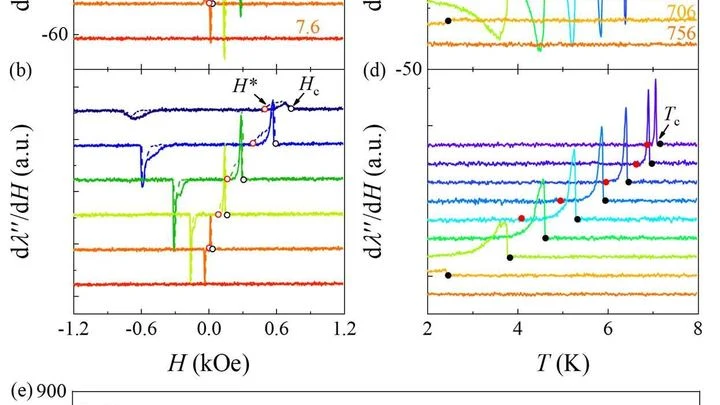
Ordinary magnetic measurements only see the surface of a superconductor, where barriers and viscous flows of magnetic field get in the way. Inside, in the so-called intermediate state, superconducting and normal domains coexist, separated by thin walls. These walls can oscillate, but hearing them directly has been difficult.
Inside the kidneys, liver, and other organs, fluid flows through channels that squeeze and release like a hose underfoot. The walls of these channels are not rigid: they are porous, elastic, and soaked with moisture.
The boundary between two liquids is like an invisible skin: it's there, but you can't touch it with your finger. Scientists have found a way to measure its elasticity without touching it. They made a tiny probe oscillate above the surface, and between the probe and the interface lay a thin film of liquid.
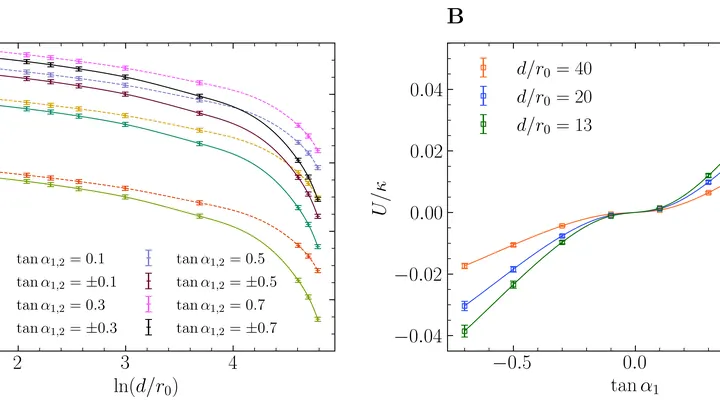
Normally, electric current is the same in both directions, like water in a straight pipe. But at the boundary between a normal metal and a superconductor, this rule breaks down. Two waves on water, going around a wide obstacle from different sides, can arrive with different delays and meet ‘out of step’.
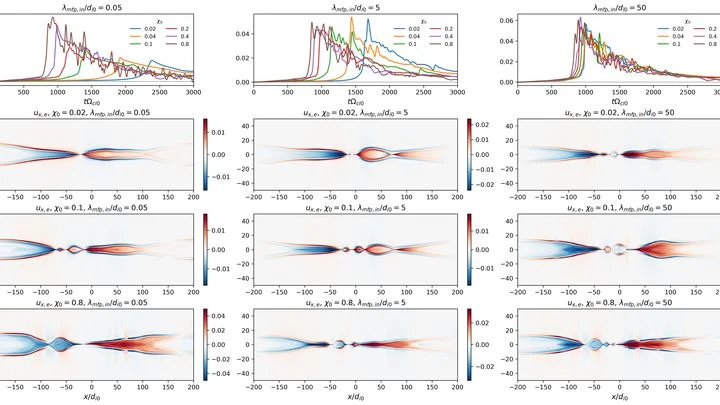
In plasma where some atoms remain neutral, magnetic field lines can rearrange at different speeds. This is like two rubber bands that are initially stuck together, then suddenly snap apart and contract, releasing energy.
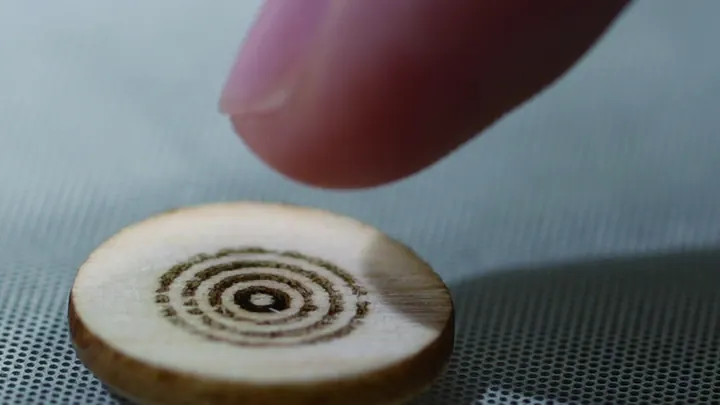
On the table sits a plastic figurine. Underneath it is a drop of water, and around it, a mesh that keeps the drop from spreading. From below, inaudible sound waves strike the drop, propelling it, and the figurine glides across the table like a little boat on an invisible river. No motors, no wires, just sound and water.
A stack of identical pancakes on a plate is just a stack. But if you arrange them with a certain order, something new suddenly appears: for example, a pattern that was not visible in each pancake individually. Physicists have performed a similar trick with thin layers of materials.
A graphene sheet is placed in a solution of sodium sulfate — an ordinary salt, similar to table salt. Near the surface, water stops being uniform: it arranges into layers, like a stack of pancakes. Between and within these layers, ions, charged particles from the dissolved salt, distribute themselves.
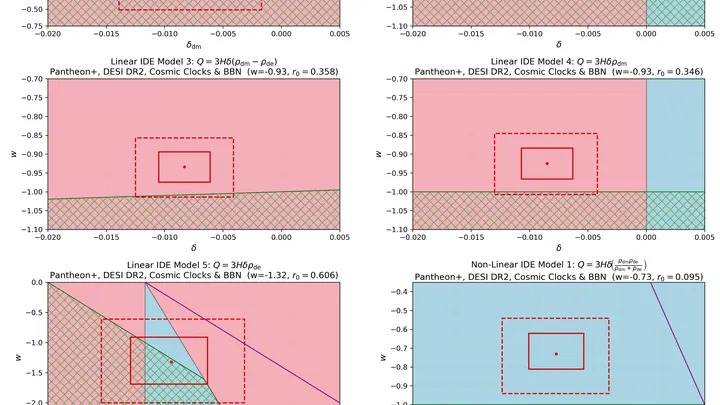
In the cosmic dance, dark energy and dark matter exchange energy. For a long time, dark energy was thought to be a constant force accelerating the universe — an insight that earned the Nobel Prize for Riess, Perlmutter, and Schmidt.
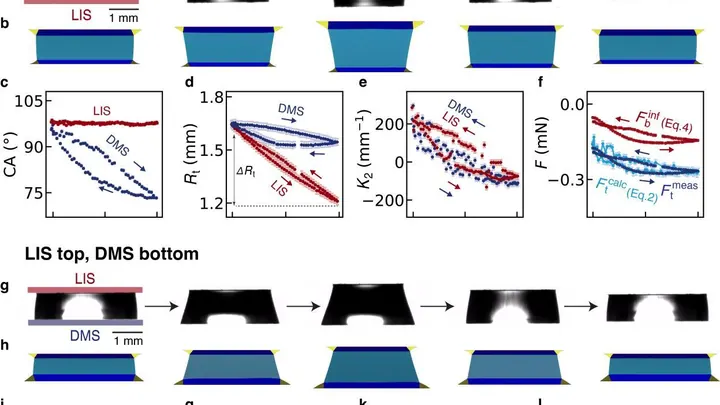
A drop of water squeezed between two close surfaces turns into a tiny bridge. Such bridges are everywhere: they hold sand grains together in wet sand, make hair clump after a shower, and even help insects walk up walls.
Scientists took three kinds of surfaces: plain glass, glass with a water-repellent coating, and glass infused with silicone oil.
A supersolid is ice that flows. Think of a pond with a frozen crust, but beneath it, a liquid depth without friction. Usually, creating that crust means changing the liquid's properties throughout its entire volume.