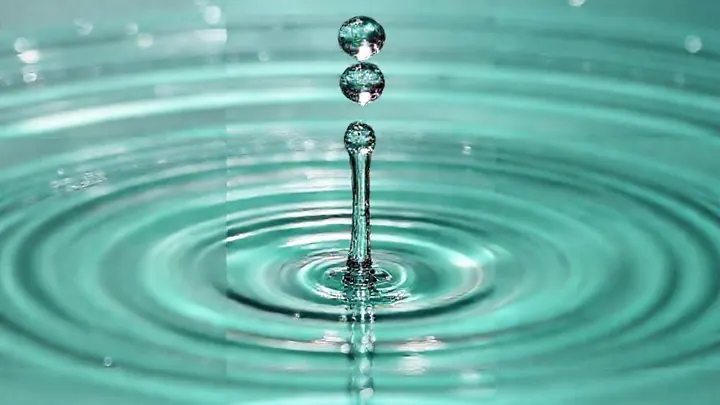
A macroscopic silicone oil droplet that exhibits quantum-like behavior in a vibrating bath is a striking example of how classical physics can mimic quantum phenomena. When a droplet of silicone oil is placed on a vertically vibrating fluid bath, it can 'walk' across the surface, guided by its own wave field. This system, often called a 'walker,' reproduces behaviors previously thought to be exclusive to the quantum realm, such as tunneling, quantized orbits, and wave-particle duality.
History
The phenomenon was first reported by Yves Couder and Emmanuel Fort in 2005, who observed that bouncing droplets could exhibit wave-like behavior. The term 'walker' was coined to describe these self-propelled droplets.
How it works
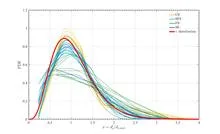
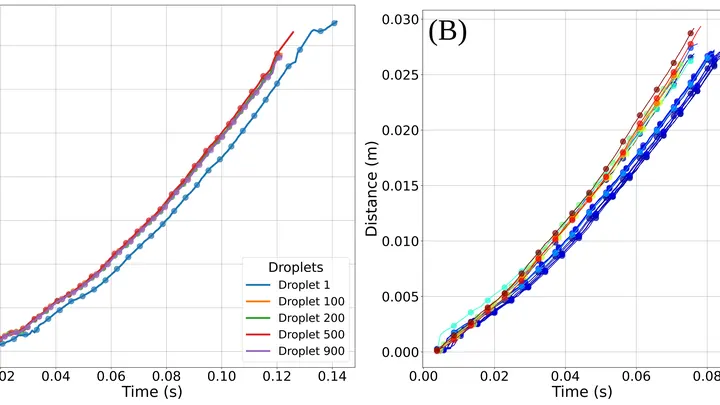
The vibrating bath creates a thin layer of air between the droplet and the fluid, allowing the droplet to bounce without coalescing. Each bounce generates a new wave that propagates outward, and the droplet interacts with its own wave field, creating a feedback loop. This coupling between the droplet and its wave field leads to complex trajectories that statistically resemble quantumprobability distributions.
The walker system can exhibit 'quantum' tunneling, where the droplet passes through a potential barrier that it classically should not cross, purely due to its wave interactions.
In a molecule, hydrogen sometimes resembles not a ball but a wave that can leak through an energy barrier, like a ghost through a wall. Chemists call this tunneling, and it underlies many processes, from enzyme function to charge transfer in materials. But how exactly does a molecule find its path for such a transition?
A raindrop slides on the wind and hits the ocean not straight down but at an angle. At that moment, its energy splits into two channels: one pushes the water forward along the flight path, the other presses it downward into the depths. Which channel proves stronger determines what happens at the surface: a quiet submergence, a fan of spray to one side, or a crown that shatters in all directions.
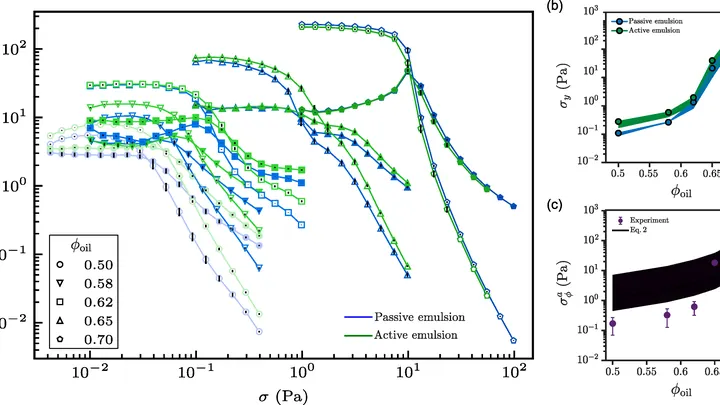
An oil droplet in water is like a ball in a crowd. When the crowd is sparse, the balls move apart freely. But if there are many people, each is squeezed by its neighbors, and the whole mass behaves like a single body. That's roughly how an emulsion works — a mixture where oil droplets float in water or vice versa.
A drop of saltwater dries on a table. The salt doesn't settle just anywhere: crystals first appear at the rim, forming a ring, like coffee grounds at the bottom of a cup. Everyone who has seen the stain left by a dried droplet knows this behavior. But what if the droplet contains swimming bacteria?
A stone drops into a pond, and ripples spread across the water. In the same way, massive bodies generate gravitational waves, except it's space itself that ripples. So far, these waves have been caught by giant detectors that barely flinch as a wave passes through. But what happens on the microscopic scale, inside a tiny piece of matter?
A courtroom interpreter is distracted by every rustle: the creak of a chair, a cough in the back row, the rustle of papers. By the end of the day, they are translating not what the witness said, but what they heard through the noise. Rare translation errors are not the result of a single loud shout, but of the accumulation of many small disturbances.
Quantum tunneling — the ability of particles to pass through barriers forbidden by classical physics — powers stars with thermonuclear fusion, ignites primordial nucleosynthesis, and gives us flash memory.
Inside every cell, construction never stops: molecules constantly cluster together and drift apart. Sometimes they form dense droplets, like oil in water, but without a membrane. These droplets act as temporary storage: they hold proteins, gene copies, or DNA repair tools.
A time crystal resembles an eternal clock: its atoms spontaneously perform rhythmic movements. In ordinary clocks, a pendulum is driven by a spring or battery, but here the motion arises without an energy supply — the system simply returns to its initial state at regular intervals. This idea was proposed by Frank Wilczek in 2012.
A flashlight beam in a dark room can hold a dust mote almost still: that's how optical tweezers work. But light doesn't just push the particle; it also jostles it with random kicks. Each absorbed photon strikes it like an invisible hammer. The authors of the new study have devised a light trap of a special shape.
In the first moments of the universe's existence, space was filled with hot plasma, where particles emerged and disappeared like bubbles in a boiling pot. The traces of these processes, stretched to gigantic sizes by expansion, are preserved in the cosmic microwave background — ancient light that has reached us across billions of years.
The void can produce particles if a strong enough field is applied. Physicists call this the Dirac–Klein paradox. Previously, explaining it required the most complex calculations of quantum field theory. But we can make do with a visual image: a tightly stretched rubber band with a knot. The knot is a particle.
The Sun drives the water cycle, and rain returns it to the ground. But now, every drop is a tiny hammer striking the surface. Floating plastic particles (microplastics, mostly carbon) upon impact jump up like popcorn kernels on a hot skillet. But instead of popping, they get wrapped in a thin water film and turn into weightless beads.
A snowdrift grows by strict rules: falling snowflakes form bumps, those attract more snow, and the bumps amplify. The same mathematics describes city growth, patterns on bark, ripples on water, and clusters of cosmic dust. Physicists call this uniformity universality.
A spring compressed to the limit breaks. Likewise, classical gravity theory leads to a singularity — a point where all laws break down. Quantum mechanics turns this end into an elastic bounce.
A water droplet races across a taro leaf like a bead on a freshly waxed floor. But it doesn't just glide: it picks up electricity. Thirty years ago, scientists explained why lotus leaves stay dry: their surface is covered with microscopic bumps that trap air. Now it turns out that water on leaves has another, hidden power.
Ultrasound in a liquid is like shaking a bottle of soda vigorously: shake it, and bubbles appear. In science, this is called cavitation, and the bubbles don't just float around: they are born, grow, and collapse with tremendous force.
Our Universe may have arisen from a highly unstable state that physicists call the false vacuum. Imagine a glass of water cooled below its freezing point: the liquid remains liquid only until the first jolt, which instantly triggers crystallization into ice.
Two glasses of water: one scalding hot, the other just warm. The warm should cool first — but in the 1960s, a student from Tanzania noticed that hot ice cream freezes faster. This paradox was named the Mpemba effect. Recently, physicists found its quantum analog.
Two seemingly incompatible mathematical languages describe a single quantum reality. The first is the language of quantum walks: here, a particle (such as an electron or even a quasiparticle in a condensed medium) takes a stroll on a graph, simultaneously exploring all possible paths — much like a pedestrian in an unfamiliar city instantly finding…
Two vortex rings launched one after the other pass through each other and swap places. This dance, first seen in the 19th century with smoke rings, has now been reproduced on a quantum processor. Vortices are the actors on a quantum stage where time plays the role of an extra dimension.
In the quantum world, particles do not have precise properties until they are measured. The official model refuses to explain what lies behind this uncertainty. But the idea that invisible 'pilots' control particles has been around since the 1920s.