Vibration is the oscillatory motion of a physical system about an equilibriumposition. It is a universal phenomenon, from the jitter of a single electron (Zitterbewegung) to the collective sway of bacterial colonies. Vibration underpins how sound travels, how molecules interact, and how crystals form in melts, as shown by the title 'Вибрация будит кристаллы в расплаве'.
History
The mathematical description of vibration was developed by Galileo Galilei and Christiaan Huygens in the 17th century, with Huygens observing synchronization of pendulum clocks.
How it works
A system displaced from equilibrium experiences a restoring force pulling it back. Inertia carries it past the equilibrium, leading to periodic motion. The frequency depends on the system's stiffness and mass, while damping (energy loss) gradually reduces amplitude. In complex systems, vibrations can couple, leading to synchronized behavior or chaos, as in 'Нити в потоке: как шум рождает порядок и хаос'.
In practice
Vibration analysis is used in engineering to monitor machine health, in seismology to detect earthquakes, and in quantum physics to study phenomena like Zitterbewegung.
Fun fact
In 2013, researchers observed Zitterbewegung—the trembling motion of a free electron—in a solid-state analogue, confirming a prediction made by Erwin Schrödinger in 1930.
At a concert, moving through a dense crowd is tough — the tighter the pack, the less you want to move. That's how active matter usually behaves: swarms of bacteria or robot flocks freeze in tight quarters. But one research group found the opposite effect.
A mosquito swarm resembles a living cloud — hundreds of bodies circle together, but no one lines up or mimics a neighbor's movements like starlings or fish. For a long time, it was unclear what held such unity together. The authors of a new study suggested that the insects communicate by sound.
In 1915, Albert Einstein and Wander Johannes de Haas demonstrated that when an iron rod is magnetized, it twists slightly — the angular momentum of electrons is transferred to the crystal lattice.
In a world where Reynolds numbers are minuscule, water turns into thick syrup, and the swimming tricks we know stop working. Here reigns the insidious scallop theorem: reciprocal motions produce no net displacement. Microorganisms found a way out: they grow polymer tails.
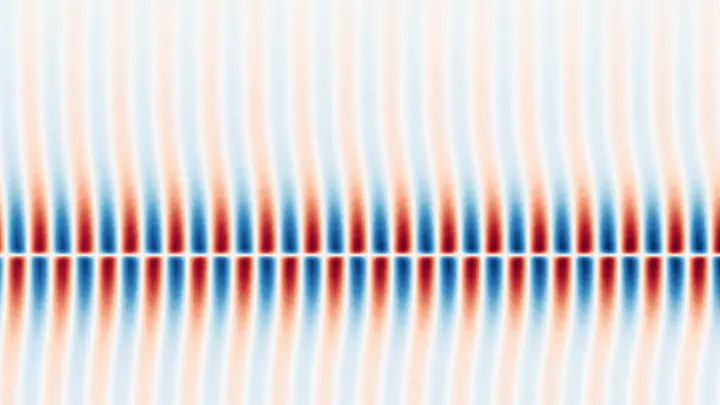
A lone fold runs across a taut sheet — a sharp drop in height that doesn't spread out but moves as a whole. Physicists call such a fold a 'kink'. If you give the sheet a sharp tug in one spot, ripples will travel across it. But in some media, these ripples don't disperse; instead, they gather into a clump and tremble in place for dozens or hundreds of cycles. Such a clump is an oscillon.
Inside every cell, construction never stops: molecules constantly cluster together and drift apart. Sometimes they form dense droplets, like oil in water, but without a membrane. These droplets act as temporary storage: they hold proteins, gene copies, or DNA repair tools.
In superfluid helium, friction disappears — the liquid flows like a mountain stream, but without a single eddy. A short laser pulse rippled this smooth surface, and scientists using spectroscopy captured the spreading ripples — quantum waves with many speeds.
A hot spoon in a cup of tea — heat runs along the metal from the hot end to the cold one. Textbooks describe this process as atoms jiggling and passing on their jolts to each other. But atoms don't just jiggle: they also spin, like tiny tops. Until now, physicists had no common language to describe both motions at once.
The authors of the work built such a language.
A flock of birds or a school of fish sometimes swirls into a vortex, even though no individual commands 'spin.' Such collective rotation helps the group stay together and mix better. It is usually explained by the individuals being asymmetric, like a screw, or pushing each other with a twist. But a new study finds another route.
When a crowd of bacteria (mostly composed of carbon) gathers in a droplet of water, a synchronized round dance begins: millions of tiny ones glide along giant ellipses, like dancers on a ballroom floor. Without a conductor, complex patterns emerge from simple movements.
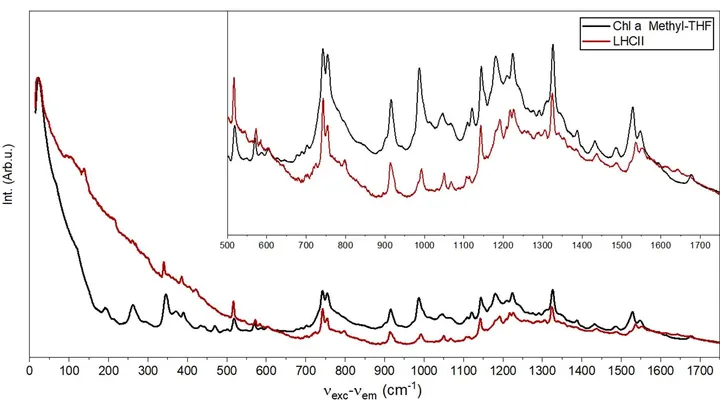
When a sunbeam hits a leaf, a relay race begins inside it. The energy of light passes from one chlorophyll molecule to the next until it reaches the reaction center — the place where the chemistry of life kicks off. This relay runs with astonishing accuracy: nearly every quantum of light finds its way.
Molten metal is like an overcrowded hall where everyone is waiting for a signal to start dancing. Crystallization is that very moment when chaos turns into order. But to start the dance, you need a first step: the appearance of tiny crystal nuclei. Usually, this requires the metal to be cooled a lot. It turns out that a simple shake can replace some of that cooling.
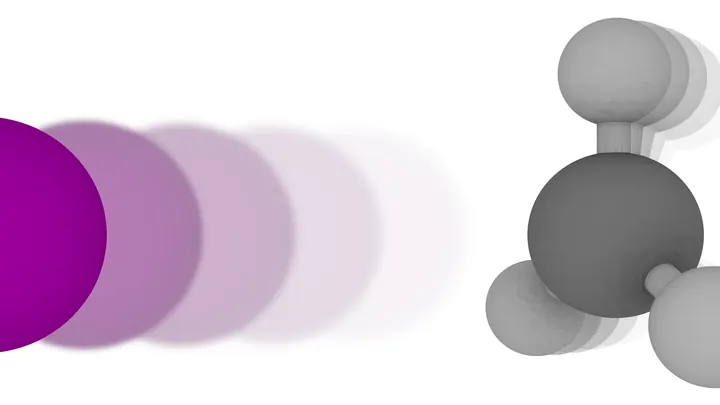
A chemical bond is like a stretched spring between atoms. When it's snapped, the molecular fragments fly apart, but they don't freeze: they keep vibrating, like a plucked string. That's exactly the vibration a team of researchers caught when they broke a methyl iodide molecule with an ultraviolet laser.
A bacterium swims like a tiny motorboat with a propeller — except its propeller is a long flagellum that rotates and pushes the body forward. But the body doesn't move in a straight line; it sways like a bobber on a wave. This swaying isn't random: it's part of the mechanics of motion.
Until now, such swaying was studied in still water.
Ultrasound in a liquid is like shaking a bottle of soda vigorously: shake it, and bubbles appear. In science, this is called cavitation, and the bubbles don't just float around: they are born, grow, and collapse with tremendous force.
According to the laws of the microworld, an electron obeying the Dirac equation trembles even at complete rest. This is Zitterbewegung — an oscillation with an amplitude of trillionths of a millimeter, like a spinning top on an invisible axis.
In 1946, Felix Bloch predicted that even without an external magnetic field, a fluctuating magnetic moment exists in an ensemble of spins. It grows as the square root of the number of particles, and in small samples this noise can exceed thermal polarization.