Dose Under Control express
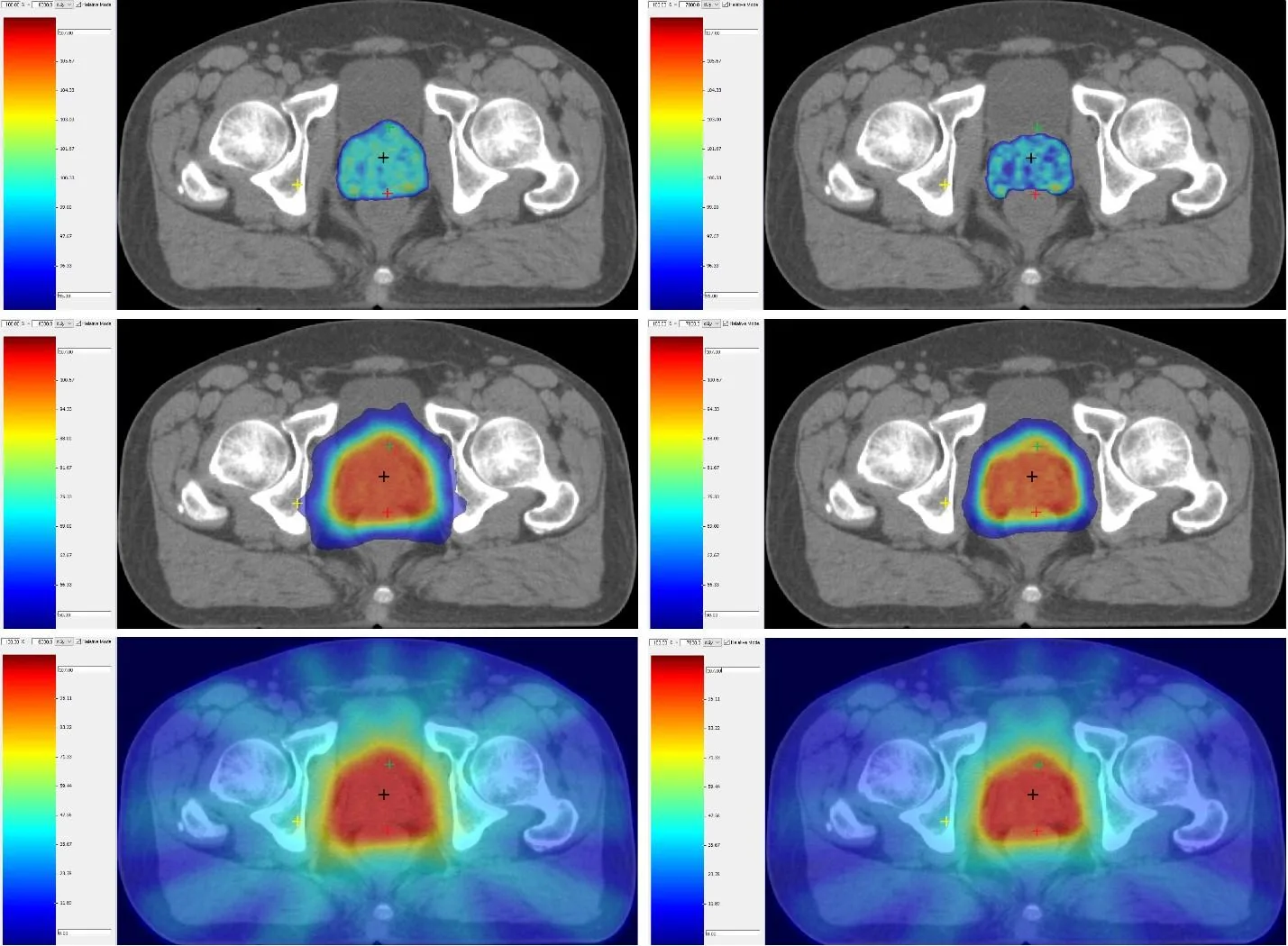
When a doctor irradiates a tumor, they try to spare nearby healthy organs. In the past, the standard approach was to give many small doses of radiation, like watering a lawn with a fine-spray watering can. Now, hypofractionation is increasingly used: fewer sessions, but larger doses, like a high-pressure hose. The question is how to tell whether the neighboring garden beds got overwatered.
To compare different regimens, doses are converted into the equivalent of a standard schedule — usually a dose per 2 grays (the unit of absorbed radiation). But old formulas work well only for large doses; in areas receiving very little radiation, they give inaccurate numbers. The authors of the new method proposed a hybrid: use one model for small doses, another for large ones, with a smooth transition in between. This approach is like shifting gears in a car: one gear for low speeds, another for high speeds.
The method was tested on a prostate cancer case. It turned out that in high-dose areas, the new calculation gives values close to standard limits for healthy organs. In low-dose areas, however, it shows higher numbers than the old method. This means doctors can more accurately assess whether the bladder or rectum is overloaded during short treatment courses.
So far, the method has been tested on only one case, and broader trials are needed. But if it holds up, it could become a bridge between new short radiation schedules and old, proven safety standards. The patient gets modern treatment, and the doctor gets familiar reference points, like a compass in an unfamiliar forest.
Original abstract
as written by the authors arXiv:2604.10227
Objectives: Existing voxel-based dose converters transform hypofractionated dose distributions into biologically effective dose (BED) or equivalent dose in 2 Gy fractions (EQD2), but they are not reliably applicable to organ-at-risk (OAR) dose constraints, particularly in low-dose regions, which may lead to dose misinterpretation. This study develops and demonstrates a voxel-based method to convert hypofractionated dose distributions into 2 Gy-equivalent OAR constraints. Methods: To2GyConstraints converter (www.healthy-innovations.com) was applied to a prostate cancer case. The method uses the Linear Quadratic (LQ) model for doses per fraction less than or equal to 7.5 Gy and the Linear Quadratic Linear (LQ-L) model for higher doses. For voxel fraction doses below a threshold defined as the mean between the prescribed hypofractionated fraction dose and 2 Gy, an equivalent number of fractions is calculated. The method then applies an EQDx-type conversion, rather than EQD2, using this calculated fraction number to better reproduce normofractionated dose behavior. Results: For doses above the defined threshold, unlike BED, the To2GyConstraints model produced results consistent with EQD2 and provided clinically realistic dose values comparable to standard dosimetric constraints, thereby offering a clearer demonstration of the radiobiological benefits of hypofractionation in prostate cancer. For doses below the threshold, unlike EQD2, the To2GyConstraints model showed behavior consistent with BED, yielding higher dose estimates when converted to a normofractionation scheme. Conclusions: To2GyConstraints converter shows promising results for radiobiological interpretation of hypofractionation. Further multicenter validation is required. Advances in knowledge: A voxel-based method enabling application of normofractionation OAR constraints to hypofractionated dosimetry after conversion.
The word 'hypofractionation' comes from the Greek 'hypo'—meaning less, and the Latin 'fractio'—meaning breaking. So the dose is 'broken' into fewer pieces, but each piece is larger.
In the TV series 'Star Trek', the medical tricorder could instantly assess radiation dose and its biological effect — roughly what these converters try to do in real life.