Dose Under Control express
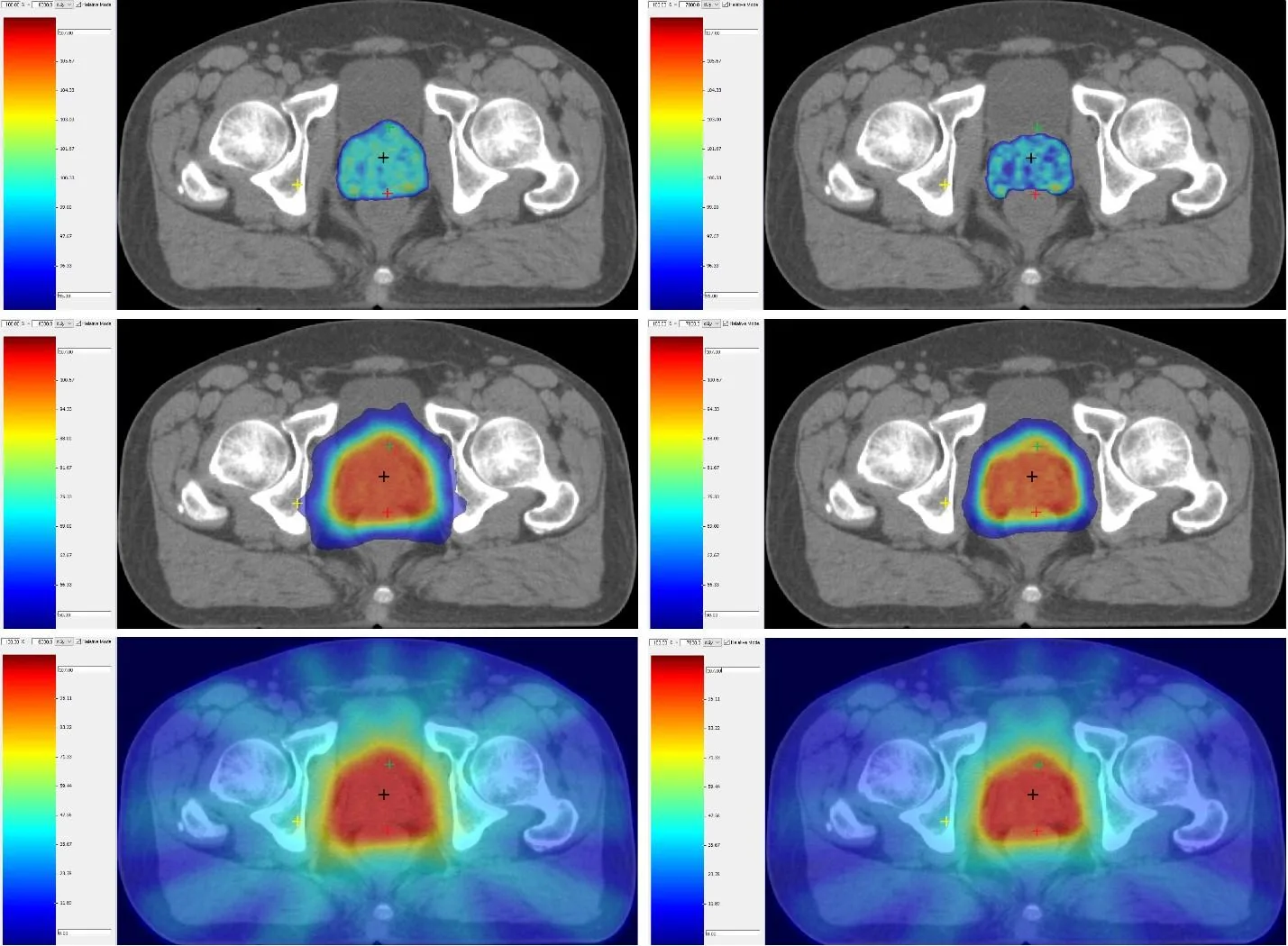
When a doctor irradiates a tumor, they try to spare nearby healthy organs. In the past, the standard approach was to give many small doses of radiation, like watering a lawn with a fine-spray watering can. Now, hypofractionation is increasingly used: fewer sessions, but larger doses, like a high-pressure hose. The question is how to tell whether the neighboring garden beds got overwatered.
To compare different regimens, doses are converted into the equivalent of a standard schedule — usually a dose per 2 grays (the unit of absorbed radiation). But old formulas work well only for large doses; in areas receiving very little radiation, they give inaccurate numbers. The authors of the new method proposed a hybrid: use one model for small doses, another for large ones, with a smooth transition in between. This approach is like shifting gears in a car: one gear for low speeds, another for high speeds.
The method was tested on a prostate cancer case. It turned out that in high-dose areas, the new calculation gives values close to standard limits for healthy organs. In low-dose areas, however, it shows higher numbers than the old method. This means doctors can more accurately assess whether the bladder or rectum is overloaded during short treatment courses.
So far, the method has been tested on only one case, and broader trials are needed. But if it holds up, it could become a bridge between new short radiation schedules and old, proven safety standards. The patient gets modern treatment, and the doctor gets familiar reference points, like a compass in an unfamiliar forest.
The word 'hypofractionation' comes from the Greek 'hypo'—meaning less, and the Latin 'fractio'—meaning breaking. So the dose is 'broken' into fewer pieces, but each piece is larger.
In the TV series 'Star Trek', the medical tricorder could instantly assess radiation dose and its biological effect — roughly what these converters try to do in real life.