Radiation dose quantifies the energy deposited by ionizing radiation per unit mass of a material, typically tissue in medical contexts. It is a critical parameter in radiotherapy, where the goal is to deliver a lethal dose to tumors while sparing healthy tissue. The concept also underpins radiation protection standards and the understanding of radiation effects on biological systems.
History
The concept of dose was formalized in the early 20th century, with the introduction of the roentgen (1928) and later the rad (1953) and gray (1975). The development of dosimetry paralleled the rise of radiation therapy after the discovery of X-rays by Röntgen in 1895.
How it works
When radiation (photons, electrons, protons, etc.) passes through matter, it transfers energy via ionization and excitation. The absorbed dose is measured in grays (Gy), where 1 Gy = 1 joule per kilogram. The biological effect depends not only on the total dose but also on the dose rate, the type of radiation (its linear energy transfer), and the tissue's radiosensitivity.
In practice
Radiation dose is used in cancer radiotherapy planning, where advanced techniques like intensity-modulated radiation therapy (IMRT) and FLASH therapy optimize dose distributions. It is also essential in diagnostic imaging (CT scans), nuclear power safety, and space exploration to assess astronaut exposure.
Fun fact
The FLASH effect, where ultra-high dose rates (above 40 Gy/s) spare healthy tissue while maintaining tumor control, has been observed in animal models and is a major frontier in radiotherapy research.
When an alpha particle tears through a gas, it leaves behind not a continuous track but a chain of individual ionizations: tiny flashes where electrons are knocked off atoms. In a living cell, such flashes damage DNA, and the denser they are packed into a clump, the more severe the damage.
After a nuclear explosion, soot rises into the sky. It settles high above the clouds, in the stratosphere, and stays there for years. This soot acts like a thick curtain: it blocks some sunlight and alters the chemistry of the sky.
A sponge slowly watered from a watering can gets soaked all the way through. But if you dump the same bucket of water on it all at once, the middle gets wet while the edges stay almost dry. That's roughly how a material with nonlinear absorption behaves: the more intense the flux, the more it gets stuck at the point of impact.
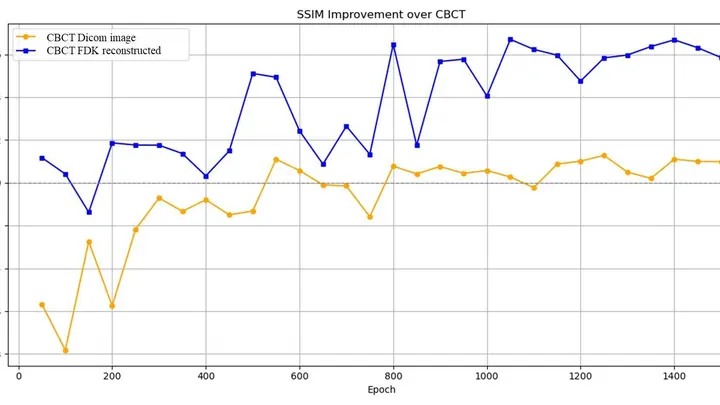
A low-dose X-ray image looks like a view through a fogged-up window: outlines are there, but details drown in a hazy veil. Doctors need such images during radiation therapy — to aim the beam precisely at the tumor and spare healthy tissue. But saving on radiation comes at the cost of noise, streaks, and artifacts that obscure what matters.
A cosmic "caliper" will soon measure a neutron star to within a hundred meters. For an object a couple dozen kilometers across, that's like measuring the thickness of a human hair from a kilometer away.
A neutron star is the remnant of an exploded supernova.
Radiation therapy is a precision strike on a tumor, but every shot must be calibrated to within a millimeter and a fraction of a second. The problem is that existing dosimeters are either bulky, or they distort the beam themselves, or they require pauses for readout.
A camera flash that fires in a thousandth of a second doesn't heat the subject — unlike a regular flash that lasts a full second. A similar trick has been found in radiotherapy: when a radiation dose is delivered in milliseconds instead of minutes, healthy tissues suffer less. This is called the FLASH effect.
Imagine a smart antenna panel, a phased array, that steers radio waves traveling at the speed of light. It works like an orchestra: hundreds of tiny emitters, like musical instruments, shift their phase (the moment they 'join' the overall sound) on command via a variable voltage.
Neutron stars are the final chord in the evolution of massive suns. Born in the cataclysm of a supernova, they pack a mass comparable to the Sun's into a sphere the size of an earthly metropolis.
A pot of boiling soup bubbles away, and you'd love to know how hot individual droplets are inside. But you can only dip your thermometer at the edge, where things are calmer. Laser fusion is a bit like that: a powerful laser pulse hits a target, creating a cloud of fast protons.
A stone falls into a pond — near the shore, the ripples are barely visible, while the water churns at the point of impact. The electric field around a charge behaves similarly: close in, it's sharp and tangled, but at a distance it stretches into a smooth wave that carries energy away. Physicists call this distant region the radiation zone.
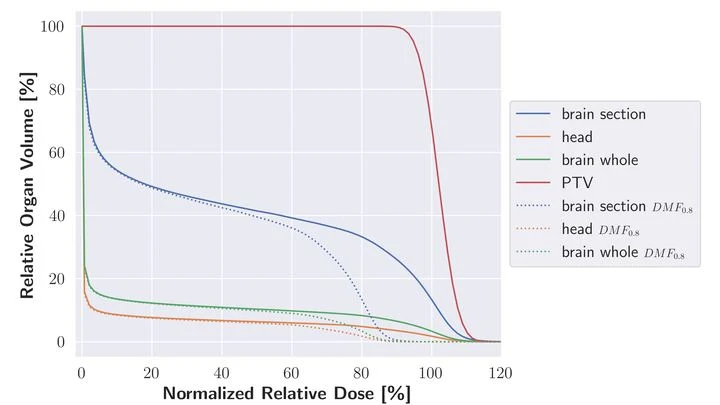
Radiation therapy targets tumors, but healthy tissue suffers too. Flash therapy delivers radiation in a fraction of a second and, remarkably, spares healthy cells without reducing the punch to the cancer. Exactly how this works remains unclear, but the authors set out to test whether this protection depends on the organ's own architecture.
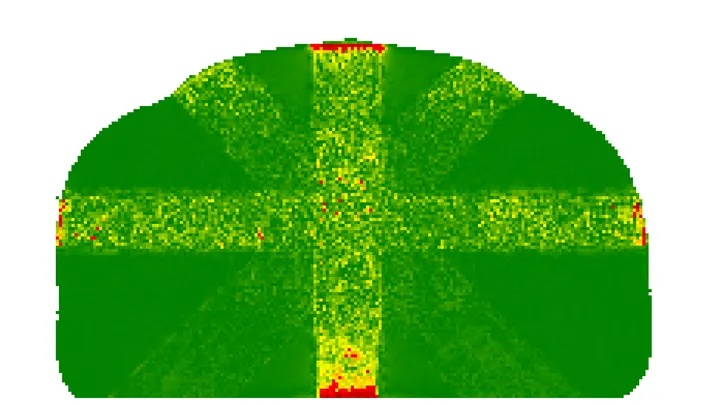
A garden hose shoots a thin, powerful jet. If you sweep it across the yard, you can water the whole bed without flooding the path. That's roughly how the new approach to treating deep tumors works: instead of a broad radiation field, you take a narrow beam of electrons accelerated to nearly the speed of light and scan it across the tumor like a jet of water.
When a person's brain tumor is irradiated, some of the energy also hits healthy cells. A few months later, MRI scans of some patients show bright spots — places where tissue has changed due to radiation. Doctors call them "radiation-induced contrast enhancements." These spots aren't always dangerous, but they show where the brain took the hardest hit.
Prostate cancer radiation therapy requires precise calculation of the radiation dose at every point in the body. The classic Monte Carlo method simulates millions of particles and takes hours, while adapting the plan to daily anatomical changes needs seconds.
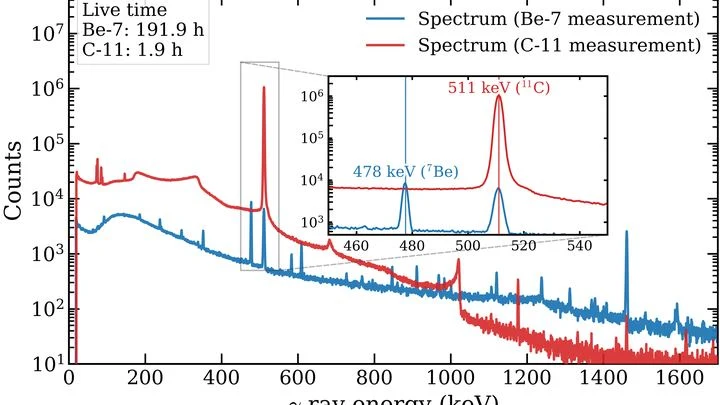
Inside the Sun, invisible nuclear transformations occur every second. One of them is the birth of boron-8: a beryllium-7 nucleus captures a passing proton and momentarily becomes a new element. This step kicks off a chain that ends with the emission of a neutrino — a particle capable of passing straight through Earth.
An X-ray image is like a photo taken in the dark: the less light, the harder it is to see details. Doctors wanted to know how much you can dim the "light" in computed tomography (CT) and still not miss a disease. To do this, they took 50 pairs of chest images: one with a full radiation dose, the other with a low dose.
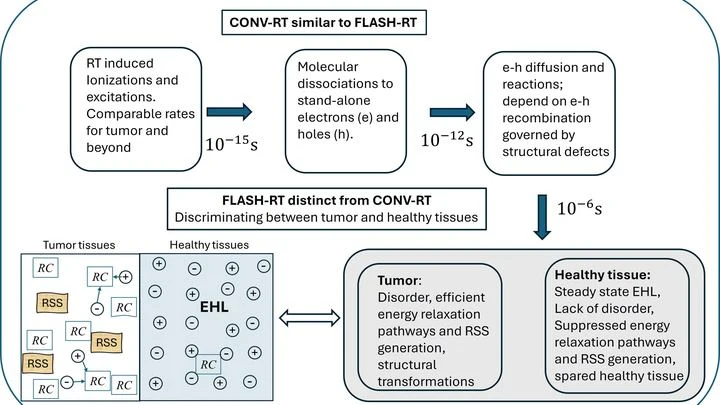
Two cities: one with neat, straight streets, the other with a tangle of alleys. If you send a powerful flood of water through both, in the first the water quickly drains away through channels, while in the second it swamps everything. That's roughly how tissues behave under ultrafast radiation therapy, known as FLASH.
A beam of carbon ions strikes the tumor precisely, like a surgeon who can only see the skin. Inside the body, the beam stops, and exactly where used to be a mystery. Now, helium is mixed into the same beam: it passes through the body like an X-ray, and its trail shows where the carbon went.
A lightning bolt strikes an anthill. Some ants die instantly, some freeze, and a few days later the survivors start rebuilding the tunnels. That's roughly how a tumor behaves after electroporation — a method where short electric pulses are passed through tissue to poke holes in cancer cell membranes and kill them.
During a course of radiation therapy, the tumor and surrounding tissues can shift or change size. Doctors regularly take images and sometimes adjust the plan to keep the radiation on target. But how do you know how much dose has already been delivered and how much is still to come? Usually, this is estimated using simple rules that don't account for uncertainty.
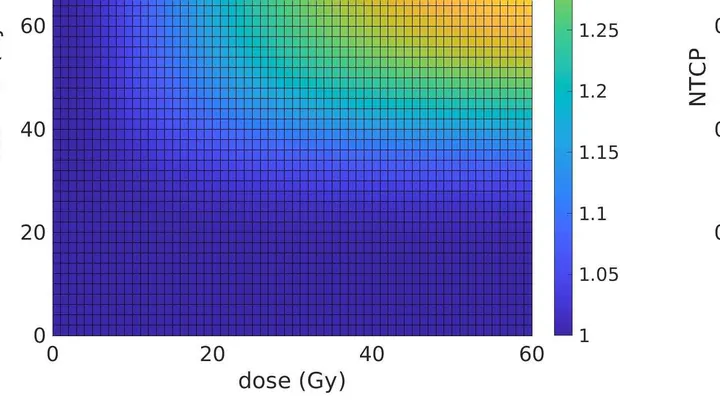
When a person receives radiation for a tumor in the head or neck, the rays pass through healthy tissue as well. Sometimes the jawbone starts to die afterward — a severe complication called osteoradionecrosis. The question isn't whether it happens, but how much the radiation dose itself increases the risk.
A cell hit by a proton beam is like a city after a pinpoint bombing: some blocks are leveled, others just have broken windows. Whether the city survives depends on which buildings are hit and how the strikes are distributed.
Inside a large particle accelerator, an invisible shower of gamma rays reigns, like leaving a glass thread under an X-ray machine switched on for years. Ordinary electronics there quickly fail, yet data from the detector still needs to get out. The solution is optical fiber: a thin glass core that carries light.