How to Spot a Naked Singularity by the Bend in a Wave express
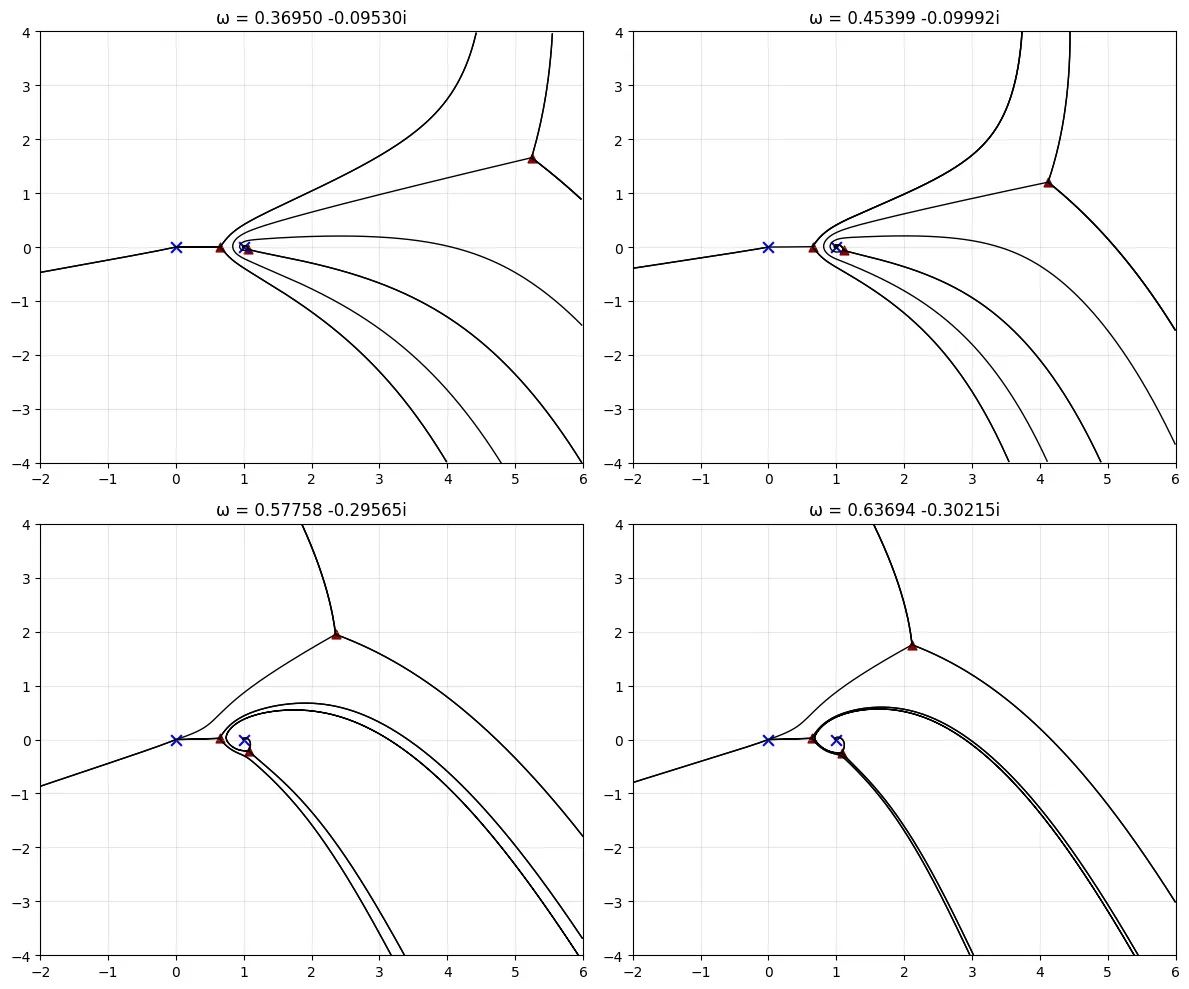
Drop a stone into a pond — the ripples spread evenly. Now imagine that at the center of the pond, instead of a simple point, there's a bottomless whirlpool where water vanishes into nothing. The ripples around such a whirlpool would not be ordinary rings; they'd curve like the string of a drawn bow. That's exactly the picture physicists have painted when peering into the 'trembling' of space near a naked singularity — a place where matter is squeezed into an infinitely dense point, but unlike a black hole, it has no impenetrable boundary, no horizon behind which everything disappears.
In the new work, the scientists used a precise calculation method (WKB, named after its creators) to understand how the damped oscillations — the 'ringing'—of such spacetime behave. They moved to the complex plane, where numbers gain a second dimension, and traced the path of the waves. It turned out that the lines along which the wave phase remains constant bend into an arc near the center. The cause is a logarithmic discontinuity at the core of the singularity, as if the clock face at the compression point had cracked, and the hand couldn't complete a full circle. In an ordinary black hole, this doesn't happen: there the center is hidden, and the lines stay straight.
This 'bow-like' bend is not just a mathematical curiosity. It could become a reliable signature by which future astronomers will distinguish a true black hole from its more exotic cousin. If we can catch gravitational waves from such an object, their frequency pattern would reveal the topology of the hidden center. Thus, the bend in a wave becomes a fingerprint left by the very structure of space.
The WKB method used in the study was originally devised nearly a hundred years ago to calculate radio waves in the atmosphere, and now it helps hunt for objects that no one has ever seen in person.
In Peter F. Hamilton's novel 'The Reality Dysfunction,' naked singularities are used as a source of energy, but their instability threatens to destroy entire star systems — much like in real life, where we still don't know if they can exist.