Popular

Karl Schwarzschild

1873-1916 · astrophysics, theoretical physics, general relativity
Karl Schwarzschild is a German astrophysicist who found the first exact solution to Einstein's equations of general relativity, describing the gravitational field around a spherical mass. This solution predicted the existence of an event horizon — a boundary beyond which light cannot leave a body — and laid the foundation for the theory of black holes.

Biography

Born in Frankfurt am Main into a wealthy Jewish family. Showed exceptional abilities: published his first scientific paper at the age of 16. Studied at the Universities of Munich and Strasbourg. Was director of the Potsdam Astrophysical Observatory. At the outbreak of World War I, he volunteered for the front. While in active service, he received the new theory from Einstein and within a few days derived his famous solution, sending it by letter. Soon died of pemphigus. Einstein presented his work to the Prussian Academy of Sciences, calling it outstanding.

Key discoveries

💡 Schwarzschild derived the solution to Einstein's equations while in the trenches of the Eastern Front, suffering from a fatal illness. In a letter to Einstein, he wrote: 'As you see, the war has been kind to me, despite the heavy fire...' His work was completed just a few months before his death but became an immortal contribution to science.
Quote: "When gravity becomes sufficiently great, light cannot leave the star — it becomes invisible. Today we call this a black hole."
Links in the knowledge graph 1
Related tags
black holegravityspacetime curvature
Related laws
Einstein field equations
Related scientists
Robert HookeFritz ZwickyJacob BekensteinSubrahmanyan ChandrasekharRainer WeissStephen HawkingJoseph WeberEmmy Noether

Related articles

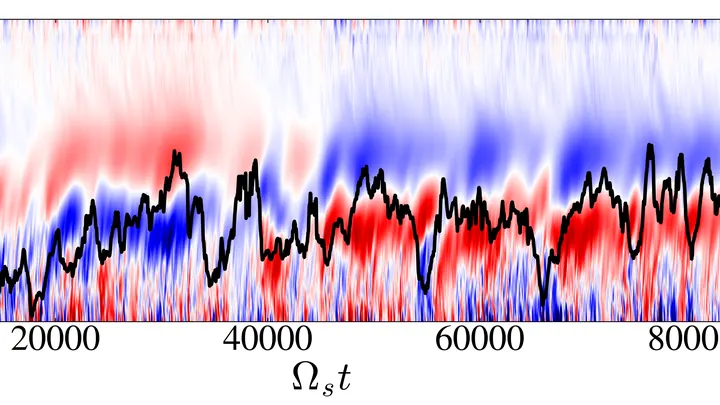
A Black Hole with Three Event Horizons: A New Recipe

A new model combines loop quantum gravity and dark energy, giving birth to a black hole with a triple horizon. This layered structure affects the shadow, vibrations, and light deflection, promising to become a key to testing quantum gravity and the nature of the universe's accelerating expansion.
arXiv:2505.12291 · 2025-05-18

Magnetic Brakes for Cosmic Spinning Tops

Scientists simulated the birth of black holes from massive stars and saw that magnetic fields act as a cosmic brake. A strong field slows the hole's spin, a weak one spins it up to near-light speed. This explained why detectors occasionally see pairs of heavyweight black holes, like the record-break
arXiv:2508.15887 · 2025-08-21

The Birth of a Gravastar: How a Star Escapes a Black Hole

New simulations show that a dying star can turn into a glowing bubble—a gravastar. At its core, a microscopic seed of dark energy emerges, expanding and halting the collapse exactly at the boundary where a black hole would normally form. Researchers pinpointed the key condition: a sufficiently 'fluf
arXiv:2509.15302 · 2025-09-18

How Dark Energy Makes Black Holes Less Destructive

Calculations show: dark energy weakens tidal forces at the black hole’s horizon. So a large object has a chance to survive if the universe’s expansion is accelerating. Without dark energy, any body would be torn apart.
arXiv:2509.18903 · 2025-09-23

How to Make a Black Hole Perfectly Black

Black holes usually reflect some waves. By shaping these waves to hit a precise resonance, physicists forced a black hole to absorb all energy, turning perfectly black. The absorbed energy is then released as a distinct ring, like a bell's tone revealing its shape. This technique could unveil the se
arXiv:2509.19451 · 2025-09-23

Black Holes: A Rip Instead of an Event Horizon

Combining the expansion of the universe with a black hole, physicists have found that at the event horizon, spacetime doesn't just bend — it tears, with curvature shooting to infinity. Inside, the ban on faster-than-light energy flow is violated, making the hole unstable. This challenges the usual i
arXiv:2510.04165 · 2025-10-05

Gravitational Atoms: The New Voice of Black Holes

Clouds of ultra-light particles turn black holes into gravitational atoms. New calculations show that after black hole mergers, such clouds noticeably change their ring, which can be detected by gravitational wave detectors.
arXiv:2511.13848 · 2025-11-17

Ghost Neutrinos: Born in the Coronas of Black Holes

Scientists have discovered that quiet galaxies with hot coronas, rather than bright jets, generate almost all the neutrinos that reach Earth. The finding, made with the Antarctic IceCube detector, changes our understanding of the origin of these elusive particles.
arXiv:2601.01533v2 · 2026-01-04

A Black Hole Like a Bell: How a Light Pulse Gives Rise to Echoes

Light delayed by a black hole generates a prolonged echo with bright bands—like a bell tolling after a strike. Physicists recreated this on a tabletop using a curved surface, and can now study the echoes in the lab.
arXiv:2601.02197 · 2026-01-05

A Lunar Telescope Will Reveal the Shadows of Distant Black Holes

Combining antennas on Earth and the Moon will deliver incredible sharpness. Astronomers have selected six black holes in alien galaxies whose silhouettes will become visible. The real twist: to glimpse the thinnest ring of light around them, we'll need antennas floating in space between planets.
arXiv:2601.02812v2 · 2026-01-06

A Black Hole with an Icy Surface

Scientists have proposed a model of a black hole where matter and light freeze at the edge, like a whirlpool gripped by ice. Its shadow betrays itself with unexpected brightness—a path to testing quantum gravity.
arXiv:2601.10806v2 · 2026-01-15

Red Dots in Space Turned Out to Be Growing Black Holes

Data from the James Webb Telescope showed: mysterious red dots in the early universe are growing black holes. They emerged directly from gas clouds, without forming stars, and are now devouring matter at an incredible rate. This explains how supermassive black holes managed to grow so quickly.
arXiv:2601.14368 · 2026-01-20

Black Hole Did Not Destroy Quantum Entanglement

Physicists tested a special entangled state of four particles near a black hole. Usually, temperature and gravity destroy any quantum bonds, but here the entanglement remained maximal, as if frozen. This is the first case where strong gravity does not suppress but preserves a quantum link.
arXiv:2602.11586 · 2026-02-12

A black hole can turn into a wormhole

Scientists have modeled how streams of negative energy transform a black hole into a stable wormhole. Colliding, they create a through-tunnel that doesn't collapse. This is a new look at the birth of traversable portals.
arXiv:2602.13609 · 2026-02-14

The Rhythm of Black Holes from the Early Universe

Scientists have discovered that in the expanding universe, primordial black holes are born rhythmically: their mass grows not smoothly, but in jumps, forming a repeating pattern. Previously, this behavior was only observed in models without expansion. The discovery suggests that the mass distributio
arXiv:2604.21520 · 2026-04-23

The Black Hole's Spin Signature: Polarization Ripples on Its Shadow

New research reveals a subtle mechanism: polarization doesn't just illuminate a black hole's shadow — it deforms it. The effect, predicted for rotating holes, is vanishingly small but fundamental: polarimetry transforms from a passive spectator into an active probe of extreme gravity. In a static sc
arXiv:2605.02136v2 · 2026-05-04

Breath of the Abyss: How a Black Hole's Horizon Pulsates to the Rhythm of Accretion

Analog gravity doesn’t freeze in weak perturbations. When gas roars onto a black hole, it gives birth to a living acoustic spacetime—a horizon that oscillates and shifts. Using an equation of state for ultrahot plasma with a variable adiabatic index, the authors showed that the horizon radius dances
arXiv:2605.04158v2 · 2026-05-05

The Invisible Artist: How Dark Matter Distorts Portraits of Black Holes

Simulating black hole images against different dark matter profiles revealed a frightening flexibility: a cored-NFW-type flattened halo noticeably inflates the bright ring, shifts its center, and amplifies asymmetry — almost exactly replicating real Event Horizon Telescope data. The Einasto profile,
arXiv:2605.05635v3 · 2026-05-07

Weighing the invisible: how light reveals the secrets of black holes

By comparing the redshift and blueshift of light from two symmetric points in orbit, scientists can calculate the mass and distance to a black hole. Gravity distorts the color, but a pair of beams allows its influence to be isolated. The method works even if the system is moving.
arXiv:2605.08582 · 2026-05-09

Symphony of Collapse: The Algebraic Key to Black Holes

At the heart of a dying star lies an algebraic cipher that translates the language of matter into the language of black hole geometry. Physicists have found a precise two-way map: given a density profile, you can recover the exterior metric—and vice versa—without solving complex differential equatio
arXiv:2605.08807v1 · 2026-05-09

Stellar Mimicry: Boson Stars Pretend to Be Black Holes

The heart of the Milky Way, the object Sagittarius A*, might turn out not to be a black hole, but its perfect cosmic counterfeit — a boson star. Data from the infrared interferometer GRAVITY were compared with models of twelve such stars — giant scalar clumps — and the Bayesian verdict could not tel
arXiv:2605.09521v1 · 2026-05-10

Astrons: Electric Leviathans That Defy Cosmology

Astrons — hypothetical relics of the early Universe with a mass on the order of 10¹² solar masses and a gigantic electric charge — could explain dark energy. However, rigorous analysis crushes the simple hopes: ordinary accretion does not yield the required charge, and phenomenologically interesting
arXiv:2605.10587v1 · 2026-05-11

The Horizon's Silent Roar: The Fading Ring of Analog Black-White Holes

A new theoretical study demonstrates how analog black-white holes created in superconducting SNAIL chains respond to perturbations: they don’t explode, but quietly fade, emitting a pure dissipative tone. Supersymmetric quantum mechanics proves the absence of growing modes, and quasinormal frequencie
arXiv:2605.11565v1 · 2026-05-12

Black Holes: The Perfect Mask of the Abyss

All the headline discoveries — from mergers detected by LIGO to the image of M87*’s shadow — are interpreted as direct proof of black holes’ existence. But a careful analysis shows that the same signatures arise from any ultracompact horizonless object, if its radius differs from the gravitational r
arXiv:2605.13901v1 · 2026-05-12

Bottomless Black Hole: A Quantum Recipe

Usually, a black hole’s center is an abyss of infinite density. But quantum effects, like an invisible spring, create a cushion of resilience. Even without complex quantum gravity, simple laws of the microworld can turn black holes from dead ends into passages.
arXiv:2605.13508 · 2026-05-13

How Brane Tension Changes Black Holes

Brane theory predicts that a hidden dimension weakens gravity. For light black holes in a dense particle cloud, this prevents horizon formation. Their shadow grows while the light ring shrinks — astronomers are hunting for these signs.
arXiv:2605.26124 · 2026-05-14

Black Hole Without a Dangerous Center

In the new model, the black hole lacks a deadly point: its center is a smooth, empty region. A key internal barrier makes the space dip gentle, avoiding infinities. This is a step toward a unified theory of gravity and quantum.
arXiv:2605.15576 · 2026-05-15

A Scout Probe Will Uncover the Mystery of the Nearest Black Hole

A journey to the nearest black hole will take a century, but for the first time it will test gravity's laws at their limits. The probe will set out on an automated voyage to understand: is it a bottomless pit in space or a super-dense star with a solid crust? The answer will rewrite textbooks.
arXiv:2605.19176 · 2026-05-18

Quantum Cloud Near a Black Hole

Near a black hole, the usual quantum rules for solitary particles break down. Physicists tweaked the equations and got a stationary cloud of such particles. This may explain matter's behavior at the horizon and even help unite micro-world physics with gravity.
arXiv:2605.21064 · 2026-05-20

A Star Dances with Dark Matter Near a Black Hole

Astronomers used the orbit of star S2 near the black hole at the center of the Galaxy to measure invisible dark matter. The new model didn't require guessing the shape of the dark cloud—it adjusted itself to the observations. This opens the door to understanding how invisible mass governs the evolut
arXiv:2605.22210 · 2026-05-21

Black Hole Shadows Put Quantum Gravity to the Test

Images of the shadows of M87* and Sgr A* provided a way to test the predictions of loop quantum gravity. Quantum corrections slightly enlarge the shadow, and even without an event horizon, it remains a ring—classical models might be just an approximation.
arXiv:2605.28871 · 2026-05-23

The Black Hole's Record: Flare Rhythm Reveals Its Spin

Astronomers cracked the flare pattern of a distant galaxy. A tiny orbiting object repeatedly punches through a gas cloud — the remains of a torn-apart star. The cloud is bent, so some bursts shine brighter, others dimmer. This on-off rhythm unveils the central black hole's spin. In a few decades, th
arXiv:2605.24905 · 2026-05-24

Light Delay Near Black Holes Will Uncover the Mystery of Dark Matter

Astrophysicists have shown: dark matter around a black hole barely distorts images of distant galaxies, but it alters the delay between the distorted images. For giant holes like M87*, the difference in light arrival time can be measured—a path to solving the dark matter puzzle.
arXiv:2605.27242 · 2026-05-26

Phantom Glow: A Wormhole's Shadow Shines Brighter Than a Black Hole's

Scientists compared images of an Ellis-Bronnikov wormhole and a Schwarzschild black hole with accreting plasma. It turns out the central shadow and photon ring of the wormhole are noticeably brighter—light passes through the throat, adding from the far side of the disk. The result matches Event Hori
arXiv:2606.01699v1 · 2026-06-01

Fading Black Hole Flares: The Key Is the Star's Rapid Spin

Some repeating partial tidal disruption events show flares that fade from one to the next—a phenomenon that contradicted old models. Hydrodynamic simulations reveal that the culprit is the rapid initial prograde spin of a star captured via the Hills mechanism: the tidal torque is inefficient, and ma
arXiv:2606.02692v1 · 2026-06-01

Roots from the Abyss: The Secret Growth of Supermassive Black Holes

Astronomers are increasingly finding giant black holes in the early universe, with masses reaching a billion suns. Ordinary gas accretion can't 'fatten' them up fast enough. A new hypothesis introduces an extra dimension: our brane-universe and an invisible donor brane intersect at a shared horizon.
arXiv:2606.03414v1 · 2026-06-02

Red Lanterns of the Cosmos: What Compact Objects from the Early Universe Conceal

Analysis of a hundred 'little red dots' (LRDs) with JWST has shown that their ultraviolet light is redder and more compact than that of ordinary galaxies. Spectral lines of carbon, helium, and hydrogen point to extreme conditions around a black hole, whose radiation seeps through a clumpy envelope.
arXiv:2606.03522v1 · 2026-06-02

Echoes of Black Holes: How Gravitational Sirens Reveal the Curvature of the Universe

Gravitational waves from mergers of black holes and neutron stars are not just ripples of curved spacetime but precise 'standard sirens' for measuring distances. A new study demonstrates that the Cosmic Explorer and Einstein Telescope detectors will be able to determine curvature Ω_k with an error o
arXiv:2606.04216v1 · 2026-06-02

Scarlet Invisible Cores: How Hydrogen Fog Conceals Black Holes

Scientists spectroscopically studied 14 'little red dots' (LRD) — compact objects at high redshifts. They decomposed the hydrogen Balmer series lines and found that the anomalously high Balmer decrement values are not due to dust absorption, but to extreme gas density (above 10⁹ cm⁻³). This led to a
arXiv:2606.04711v1 · 2026-06-03

Dance on the Razor's Edge: How the Star-Black Hole Balance Is Decided by Seven Percent

In tight binary systems, a star on an elongated orbit sheds mass—and this shedding either brakes the catastrophe or triggers a chain reaction of disruption. The key is the duel between two radii: the tidal radius and the Roche lobe. If the pericenter is below 3.45 tidal radii, adiabatic expansion in
arXiv:2606.04966v1 · 2026-06-03

Winds of Cosmic Noon: How Quasar WISSH13 Halts Star Formation

At the peak of star formation, 12 billion years ago, quasar WISSH13 was ejecting two streams of matter at near-light speeds. Analysis of XMM-Newton and NuSTAR data revealed a cold corona and powerful reflection—a sure sign of accretion at the Eddington limit. These ultrafast winds, with kinetic powe
arXiv:2606.05312v1 · 2026-06-03

The Rapids of a Black Hole: The Birth and Death of Blanets

In the turbulent disks of active galactic nuclei, blanets form—giant planets of incredible density. Drifting toward the central black hole, they are torn apart by tidal forces, generating brief but dazzling flares in optical and ultraviolet light. Their density allows them to approach the horizon of
arXiv:2606.06884v1 · 2026-06-05

When a Black Hole Can Split Apart

The laws of physics forbid black holes from dividing: their total area cannot decrease, just like entropy. But rapid rotation changes the rules, allowing tiny fragments to break off. In worlds with extra dimensions, fragmentation is even easier, revealing secrets of primordial black holes.
arXiv:2606.24642 · 2026-06-23

A Black Hole's Corona Blazes Like the Sun's

X-ray telescopes caught a double flare from the black hole in galaxy NGC 3783: first hard radiation, then soft. On the Sun, that pattern signals magnetic reconnection. The black hole also blasted out a stream of gas, akin to solar eruptions but billions of times stronger. For the first time, it's be
arXiv:2606.25636 · 2026-06-24

15 Solar Masses: The Spin Frontier of Black Holes

Analysis of 259 gravitational-wave events revealed a sharp change in the effective spin χeff of binary black holes at around 15 M⊙. Below this threshold, spins tend to be positive and cluster in a narrow peak, while above it, the distribution broadens and becomes symmetric. It’s as if nature drew a
arXiv:2607.00565v1 · 2026-07-01

Dark Blizzard on the Edge of the Abyss: How Invisible Particles Ignite Stars

Star S4714 orbits the supermassive black hole at the center of the Milky Way on an extremely tight path, dipping into a hypothetical dark matter density spike. Scientists have shown that elastic scattering of dark matter particles off hydrogen nuclei and electrons can transfer energy to the star com
arXiv:2607.00840v2 · 2026-07-01

Cosmic Metamorphosis: How Quasars Shed Their Dust Cocoons

A study of rare quasars with powerful outflows and anomalously weak emission lines has shown that these objects are in a transitional phase of 'blowing off' their dust cocoons. Using spectroscopy and polarimetry, outflow velocities of up to 0.16c were measured, and a predominance of tiny dust grains
arXiv:2607.01330v1 · 2026-07-01

The Cosmic Club with Face Control: The Mystery of Quasar Broad Lines Solved

Broad emission lines are the hallmark of active galactic nuclei, but they mysteriously weaken both at low and critically high accretion rates. A new study proposes a unified mechanism: the filtering of ionizing radiation by dense inner disk structures plays the decisive role. The effective flux reac
arXiv:2607.01479v1 · 2026-07-01

Invisible Planet in Warped Light

For the first time, a planet has been detected in TESS data using gravitational microlensing. The event Gaia23bra, identified by the Gaia survey as an isolated lens, revealed sharp caustic-crossing peaks in the TESS light curve—an unmistakable sign of a binary system with a planetary companion. Join
arXiv:2607.01853v1 · 2026-07-02

Black Hole Cardiogram: NICER Records X-ray Heartbeat

In 2025, the NICER X-ray telescope aboard the ISS monitored the outburst of black hole 4U 1630−47, a binary system where matter from a companion star falls onto the compact object. Analysis revealed quasi-periodic oscillations (QPOs)—rhythmic flux variations with frequencies from 0.24 to 3.43 Hz—and
arXiv:2607.02228v1 · 2026-07-02

How a Quantum “Pillow” Saves a Black Hole from Infinity

A new black hole model incorporates quantum corrections that remove the infinity at the center, turning it into a smooth region. This shifts the horizon, weakens Hawking evaporation, and changes the size of the shadow — the dark silhouette we can observe. By measuring the shadow, we can gauge the st
arXiv:2607.02631 · 2026-07-02

Triple Black Hole Waltz: How Chaos Spawns Mergers

Astrophysicists embedded the behavior of three massive black holes directly into hydrodynamic simulations of galaxies. It turned out that even a slight tilt of the third body's orbit turns billions of years of waiting into a rapid merger. The chaotic dance of three gravitational wells not only solve
arXiv:2607.04121v1 · 2026-07-05

The Unmixed Cocktail: Why Double Diffusion Is Powerless in the Interiors of Giant Planets

A new study has, for the first time, self-consistently incorporated the recipe of double diffusion into an evolutionary code of planets and traced the fate of Jupiter and Saturn from the moment of formation. It turns out that even a thousandfold enhancement of mixing does not lead to significant sme
arXiv:2607.04629v1 · 2026-07-06

Cosmic Palimpsest: Gravitational Waves Reveal the Story of Ancestor Black Holes

Analysis of two recent events from the GWTC-5.0 catalog showed that, with a probability 6–8 times higher than alternative explanations, the primary black holes in these systems were born in previous collisions. A Bayesian comparison of hypotheses favored the “2G+1G” scenario—a merger of a descendant
arXiv:2607.04663v1 · 2026-07-06

The Ocean of Spacetime: The Hum of Black Holes and the Precision of Simulations

Recently, pulsar timing arrays have for the first time picked up the low-frequency hum of gravitational waves — a cosmic analog of the noise from distant storms in the ocean of spacetime. Comparing NANOGrav data with the Fable simulation showed that the predicted signal from supermassive black hole
arXiv:2607.05208v1 · 2026-07-06

The Pulse of a Black Hole: Birth of a Jet in X-ray Echo

Years of observations with XMM-Newton, Swift, and VLA showed how the changing-look active galaxy 1ES 1927+654 underwent a dramatic transition from a wind regime to a jet. X-ray spectra revealed oxygen emission lines and a broad iron line, while ionized absorption faded. Synchronously, radio emission
arXiv:2607.05246v1 · 2026-07-06

The Arrow Piercing the Disk: Recipe for an X-ray Flare

When a wandering star slams into the accretion disk of a supermassive black hole at immense speed, a quasi-periodic X-ray flare is born — a cosmic firework capable of outshining a galaxy. For the first time, 3D radiation hydrodynamics simulations systematically linked the collision parameters — star
arXiv:2607.05508v1 · 2026-07-06