Popular

John Archibald Wheeler

1911–2008 · General relativity, Astrophysics, Quantum gravity
American theoretical physicist who revived general relativity. Coined the terms 'black hole' and 'wormhole', actively developed the concept of gravitational lensing, studied the collapse of massive stars and the nature of time. His work laid the foundation for modern black hole physics and quantum gravity.

Biography

Born in Jacksonville, Florida. Received his doctorate from Johns Hopkins University. Spent most of his career at Princeton, mentoring a generation of future Nobel laureates, including Richard Feynman. Participated in the Manhattan Project. Laureate of the Wolf Prize, Einstein Medal, and other awards. Known for aphoristic statements about physics.

Key discoveries

💡 Wheeler was so fascinated by gravity that he joked: 'If I hadn't become a physicist, I probably would have been a worm to crawl through wormholes.' His teaching style combined rigorous mathematics with poetic imagery and produced dozens of famous students.
Quote: "Time is what clocks measure. But what is a clock without change? Any measurement of time is a counting of changes."
Links in the knowledge graph 1
Related tags
WormholeTime dilationgalaxyneutron star
Related laws
no-hair theoremWheeler-DeWitt equationgeodesic equationcomplementarity principle
Related scientists
Subrahmanyan ChandrasekharJocelyn Bell BurnellWolfgang PauliAdam RiessWilliam HerschelAlbert EinsteinGalileo GalileiWilliam Unruh

Related articles

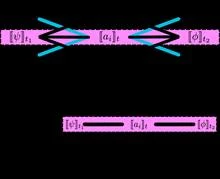
Quantum Debts: When a Photon Has Negative Presence

For the first time, physicists operationally measured how a single photon physically distributes between two paths of an interferometer. It turned out that in the port with destructive interference, 'superlocalization' occurs: the probability of presence in one arm exceeds unity, while in the other
arXiv:2505.00336v2 · 2025-05-01

How a Neural Network Learned to See Quantum Foam

At the quantum level, space and time resemble a foam of microscopic bubbles. Neural networks have learned to instantly compute their interactions, replacing hours of calculations. This brings us closer to understanding the structure of the Universe at the smallest scales.
arXiv:2505.03255 · 2025-05-06

Particle Dance on Curved Spacetime

Researchers examined how tiny bumps in spacetime affect the quantum link between particles. It turns out that altered rules for energy exchange give rise to an interaction that protects this link from breaking. Even as spacetime loses track of the particles, it helps them stay in sync. This discover
arXiv:2506.03282v2 · 2025-06-03

How Information Gives Birth to Particles from Nothing

Physicists have derived formulas proving: when quantum ties are broken, the vacuum responds by birthing matter. The calculations hold for acceleration, black holes, and radioactive decay. Information is no longer a shadow of reality — it's its architect.
arXiv:2508.17067 · 2025-08-23

Time from Disorder: How Atoms Revealed an Internal Clock

Scientists split a cloud of atoms and, by tracking rising disorder, ordered events in one half without seeing the other. This confirms that time emerges from internal changes. Such an approach will help us understand how time flows in black holes and right after the Big Bang.
arXiv:2509.07745 · 2025-09-09

Two Times in the Quantum World

In quantum mechanics, time ceases to be a familiar arrow. One approach claims all moments already exist simultaneously. Another method suggests particles can move backward in time. Comparing these ideas opens the door to understanding the true fabric of reality.
arXiv:2509.22264 · 2025-09-26

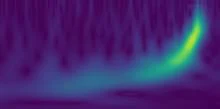
Rhythms of Black Holes: 34 Pulsations in Gamma-Ray Bursts

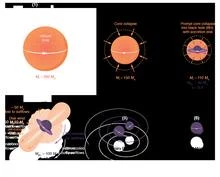
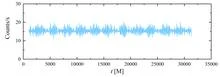
In data from the Swift telescope, 34 gamma-ray bursts with a clear rhythm were discovered. These bursts are born when a dying star collapses into a black hole, and its superheated gas swirls into a rapidly rotating disk. The rhythmic pulsations reveal the dance of matter around the hole: perhaps thi
arXiv:2510.11136 · 2025-10-13

How Gravity Helps Us See the Invisible Electromagnetic Echo

As it fades, the electromagnetic field leaves a permanent record in the quantum state of particles — like a photograph capturing a moment. Using gravity, physicists have learned to take such 'snapshots' inside a falling conductor and develop them with a superconductor. A tabletop experiment will for
arXiv:2511.02363 · 2025-11-04

Time is not a river, but a one-way street

Scientists have proven: black holes and wormholes cannot turn back time. These cosmic “detours” merely redistribute disorder, but the total chaos in the Universe keeps growing. That’s the relentless arrow of time.
arXiv:2512.03380 · 2025-12-03

A Lunar Telescope Will Reveal the Shadows of Distant Black Holes

Combining antennas on Earth and the Moon will deliver incredible sharpness. Astronomers have selected six black holes in alien galaxies whose silhouettes will become visible. The real twist: to glimpse the thinnest ring of light around them, we'll need antennas floating in space between planets.
arXiv:2601.02812v2 · 2026-01-06

A black hole rings nonlinearly: new gravitational overtones heard

In the gravitational waves from the black hole merger GW250114, nonlinear overtones—vibrations born from the interaction of the fundamental tones—have been directly detected for the first time. This discovery proves the complex nature of strong gravity and provides a new way to test relativity.
arXiv:2601.05734v1 · 2026-01-09

Why neural networks are like black holes: a lesson from 'bald' models

Inside language models like LLaMA lie tangled patterns, their strength depending on the training method. But to an outside observer, the model always yields the same result—much like a black hole that 'forgets' every detail of the matter it swallows. This explains why simple fine-tuning methods are
arXiv:2601.06788 · 2026-01-11

Entanglement Born in Collisions

Molecular collisions weave their states into quantum knots. Physicists have learned to measure this entanglement and control it with a magnetic field. This will allow control over quantum processes in chemistry and ultracold gases.
arXiv:2601.17144 · 2026-01-23

Gravity Can Push Away — A Quantum Experiment

Ordinary gravity only attracts. But if the source of gravity is in two places at once, you can make it push a test particle. This is impossible in classical physics and serves as proof of gravity's quantum nature.
arXiv:2602.12266 · 2026-02-12

Quantum Bounce: A Universe Without Singularity

Classical gravity theory predicts that the universe was born from a singularity—a point of infinite density. New research shows that quantum effects replace this moment with a smooth bounce. In a model of space closed like a ball, a special energy, akin to a spring, makes it contract and expand. Phy
arXiv:2603.06481 · 2026-03-06

Secret of a Black Hole's Fastest Chaos

Astrophysicists have shown: the merger of two non-spinning black holes always produces an object with maximally chaotic movement of light rays at the horizon. The discovery helps better decode gravitational waves and test general relativity.
arXiv:2603.08643 · 2026-03-09

Cosmic Gong: How a Black Hole Rings a Wormhole

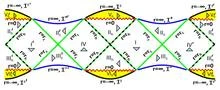
Scientists have calculated the gravitational radiation from a stellar-mass black hole radially falling into a thin-shell wormhole. The signal resembles rhythmic beats: a burst as the black hole approaches the throat from our side, and a deep silence as it plunges into another universe. Calculations
arXiv:2605.01216v1 · 2026-05-02

Gravitational memory as a defect in the fabric of spacetime

The gravitational memory effect is mathematically identical to defects in crystals. Ordinary memory is like an extra layer of atoms, while spin memory is like a spiral. This model, consistent with Einstein's theory, makes the search for the elusive deformation more tangible, and pulsars could become
arXiv:2605.02975v1 · 2026-05-03

Alchemy of the Void: Nonlocal Magic of Particle Birth

Schwinger pair production in gauge fields reveals the unexpected depth of the vacuum: instead of simple entanglement, nonlocal magic arises—correlations that cannot be described without a full-fledged quantum computer. Holographic duality links this magic to the geometry of strings and black holes,
arXiv:2605.04210v1 · 2026-05-05

Cosmic Hourglass: The Flickering Shadow of a Wormhole

Numerical simulations revealed how plasma gets stuck in the throat of a rotating wormhole, painting a thin luminous rim on its shadow and making it flicker with a period set by mass and spin. These signatures, observable by the Event Horizon Telescope at 230 GHz, turn active galactic nuclei into nat
arXiv:2605.04631v1 · 2026-05-06

The Singularity That Never Was: How Quantum Tango Erases the Beginning of the Universe

In quantum cosmology, the Big Bang singularity turns out to be a mirage. Using relational time emerging from entanglement between subsystems of the universe, physicists have shown: the probability of zero volume is strictly zero. The Page-Wootters formalism transforms a static wave function into an
arXiv:2605.06093v1 · 2026-05-07

Cosmic Instrument: Resonant Songs of Rotating Wormholes

By numerically investigating the scattering of scalar waves on a rotating traversable wormhole, scientists discovered Breit-Wigner resonances. They sharply intensify under fast rotation and for counter-rotating modes, creating a spectral fingerprint radically different from that of black holes—a sig
arXiv:2605.09426v1 · 2026-05-10

Stellar Mimicry: Boson Stars Pretend to Be Black Holes

The heart of the Milky Way, the object Sagittarius A*, might turn out not to be a black hole, but its perfect cosmic counterfeit — a boson star. Data from the infrared interferometer GRAVITY were compared with models of twelve such stars — giant scalar clumps — and the Bayesian verdict could not tel
arXiv:2605.09521v1 · 2026-05-10

Cosmic Crystal: How Vacuum Defects Twist Light

The cosmic microwave background not only brings a map of the early universe but also a subtle twist in polarization—just a few thousandths of a radian. For a long time, it was attributed to ultralight axions, but they clash with experiments. A new explanation is more elegant: the rotation arises whe
arXiv:2605.11065v1 · 2026-05-11

Polarization Echo: Light Catches the Gravitational Ringing of a Black Hole

A covariant approach has been developed, showing that light in the gravitational "storm" of merging black holes alters its polarization, tracing the damped melody of the ringdown. Numerical simulations based on Kerr perturbation theory confirm: an achromatic rotation of ~10 degrees is a direct impri
arXiv:2605.11499v1 · 2026-05-12

The Dance of Light Around a Black Hole: How to Keep the Main Frame Sharp

Light from gas around a black hole takes different times to reach us. If not accounted for, rapid changes in an image get blurred. The study proposes an intermediate method, 'brisk light', which preserves important temporal details and is easy to compute. This is critical for future observations of
arXiv:2605.12659 · 2026-05-12

Geometry's Verdict: Why Wormholes Are Doomed to Exoticity

The no-go theorem dashes hopes of circumventing the wormhole paradox: no interaction with dark energy can shield against the geometric demand for 'negative pressure.' The work shows that even the most cunning models with energy transfer between matter and vacuum shatter against the relentlessness of
arXiv:2605.14027v1 · 2026-05-13

Long-Throat Wormholes: How Doppler Notes Give Them Away

New research shows: wormholes with a precisely tuned throat length can cast a shadow indistinguishable from that of a Schwarzschild black hole. But numerical simulations expose a critical flaw in the disguise—the wormhole's accretion disk emits far more energetic radiation thanks to Doppler boosting
arXiv:2605.16413v2 · 2026-05-13

How the Universe is Born from Nothing

Physicists have calculated the probability of a whole universe being born from emptiness — like a bubble in boiling water. Taking quantum fluctuations into account led to a simple formula, similar to the one describing particle tunneling. This is a step toward unraveling the beginning of time.
arXiv:2605.16150 · 2026-05-15

How a Timeless World Gains a Past and a Future

A new study shows that timeless equations are not flawed. They resemble a film reel where each frame exists independently, with no direction. But when a clock emerges within the system—like turning on a projector—the film starts rolling forward, and the familiar flow of time appears.
arXiv:2605.17935 · 2026-05-18

Wormholes Without Exotic Matter

Ordinary wormholes need negative-energy matter to stay stable, and there's almost none in the universe. But if you rewrite the equations of gravity, the bends in space itself replace that stuff, keeping the hole from collapsing. This brings travel through such tunnels closer to reality.
arXiv:2605.18376 · 2026-05-18

Quantum Sound in the Fabric of the Universe

According to one hypothesis, the cosmos is not monolithic, but made of tiny quantum 'building blocks'. Previously, only their synchronized dance was studied. But new work shows: when you account for their inevitable jitter, something like sound waves emerges. This quantum ripple barely influences th
arXiv:2605.18977 · 2026-05-18

A Scout Probe Will Uncover the Mystery of the Nearest Black Hole

A journey to the nearest black hole will take a century, but for the first time it will test gravity's laws at their limits. The probe will set out on an automated voyage to understand: is it a bottomless pit in space or a super-dense star with a solid crust? The answer will rewrite textbooks.
arXiv:2605.19176 · 2026-05-18

Quantum Cloud Near a Black Hole

Near a black hole, the usual quantum rules for solitary particles break down. Physicists tweaked the equations and got a stationary cloud of such particles. This may explain matter's behavior at the horizon and even help unite micro-world physics with gravity.
arXiv:2605.21064 · 2026-05-20

Fuzzy Probabilities in a Blurry Spacetime

If spacetime is grainy at the tiniest scales, it changes the very nature of probability. The odds of an experiment's outcomes aren't hard numbers — they're as fuzzy as a foggy compass reading. This idea could bridge quantum mechanics and gravity.
arXiv:2605.23862 · 2026-05-22

When Black Holes Turn Inside Out

The transition of a black hole into a white hole produces an immensely powerful gamma-ray burst. Scientists have calculated that such a burst creates far more light and lightweight particles than heavy nuclei. This makes it visible across half the universe; especially if primordial black holes the s
arXiv:2605.25709 · 2026-05-25

Shadow of a Shaggy Beast: How Scalar Hair Shatters a Black Hole’s Image

The stronger the scalar field around a black hole, the more distorted its shadow. New simulations reveal that at extreme values, the shadow fractures into crescent-shaped shards.
arXiv:2605.28376 · 2026-05-27

Rotating Wormhole Without Exotic Matter

Scientists considered a theory of gravity where matter curves space more strongly. In this model, rotation prevents the wormhole from collapsing, eliminating the need for exotic matter. Since almost all cosmic bodies rotate, such tunnels could form naturally. They would be betrayed by a double shado
arXiv:2606.01141 · 2026-05-31

Phantom Glow: A Wormhole's Shadow Shines Brighter Than a Black Hole's

Scientists compared images of an Ellis-Bronnikov wormhole and a Schwarzschild black hole with accreting plasma. It turns out the central shadow and photon ring of the wormhole are noticeably brighter—light passes through the throat, adding from the far side of the disk. The result matches Event Hori
arXiv:2606.01699v1 · 2026-06-01

Fading Black Hole Flares: The Key Is the Star's Rapid Spin

Some repeating partial tidal disruption events show flares that fade from one to the next—a phenomenon that contradicted old models. Hydrodynamic simulations reveal that the culprit is the rapid initial prograde spin of a star captured via the Hills mechanism: the tidal torque is inefficient, and ma
arXiv:2606.02692v1 · 2026-06-01

Quantum Eraser Captures Two Pictures in One Snap

This research turns a famous quantum puzzle – the delayed-choice eraser – into a practical imaging method. It uses entangled photon pairs to record both brightness and phase information in one snapshot. Later, analyzing a partner photon determines which image is revealed. The technique ensures perfe
arXiv:2606.03914 · 2026-06-02

Weak Attraction: How Gravity Spares Quantum Superpositions

Scientists have rigorously described how gravity dampens quantum 'miracles'. The result: in terrestrial labs, superpositions die from molecular impacts, while the gravitational whisper remains inaudible. It grows only like a faint echo — each additional kilometer adds as much as the first meter.
arXiv:2606.04099 · 2026-06-02

Quiet Quasar: Ultraviolet Storm at a Third of Light Speed

The quasar SDSS J2318, pretending to be a quiet one with weak emission lines, concealed inside a furious wind accelerated to 0.3 the speed of light. This outflow is capable of sweeping the interstellar medium out of its host galaxy, forever halting star birth. The discovery, made through spectroscop
arXiv:2606.06226v1 · 2026-06-04

The Neutrino Chord: How a Supernova Will Unveil the Hidden Mass Order

The next galactic supernova is a rare gift to astrophysics, capable of answering a key particle physics question in a fraction of a second. Analysis of two independent signals—the sharp peak of electron neutrinos in the first milliseconds and the rise rate of the electron antineutrino flux—points to
arXiv:2606.06580v1 · 2026-06-04

Gravity Entangles Light and a Rotating Object

The exchange of gravitons between a photon and a rotating mirror gives rise to quantum entanglement. The strength of the link depends on the direction of rotation. This brings us closer to experimentally testing quantum gravity.
arXiv:2606.09991 · 2026-06-08

Gravity: Classical or Quantum?

Physicists have shown: if gravity is classical and matter is quantum, then a qubit solves problems beyond any computer. This would violate a fundamental limit on computation. Since we don't see that, gravity must be quantum.
arXiv:2606.14806 · 2026-06-11

Time Loop from an Empty Universe

Scientists have found an exact solution to Einstein's equations for empty space in which paths to the past arise spontaneously. It was once thought that time machines required exotic matter with negative energy, but the new work gets by with just a gravitational wave. This brings us closer to unders
arXiv:2607.00788 · 2026-07-01