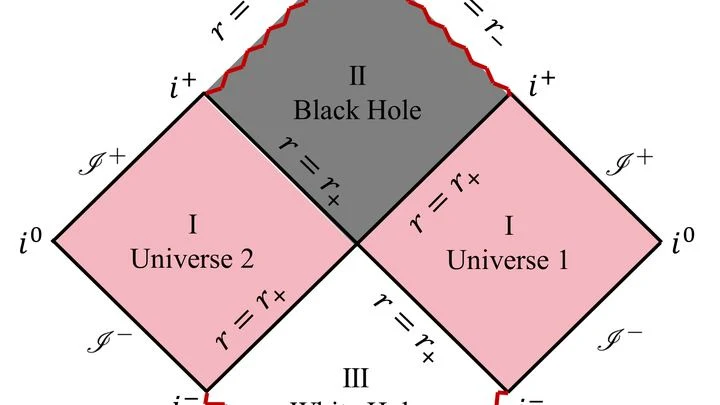
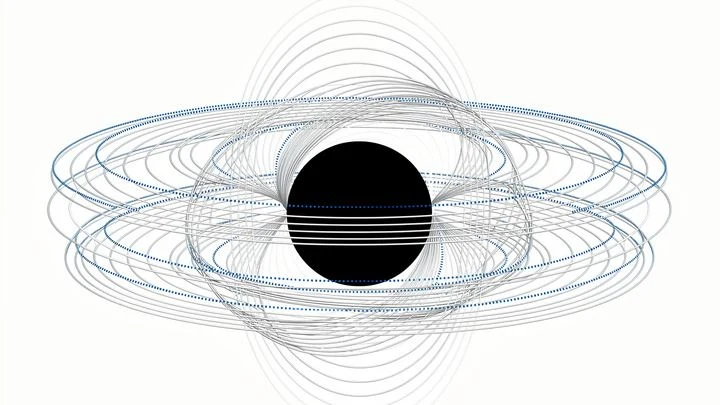
The boundary of a black hole from which not even light can escape. Like the edge of a waterfall: as you approach, the boat can still row, but beyond a certain line the current relentlessly carries it down. Here the falling speed of spacetime equals the speed of light.
History
The first solution of Einstein's equations containing a horizon was found by Karl Schwarzschild in 1916. Initially it was considered a mathematical fiction, but in 1939 Oppenheimer and Snyder showed the reality of gravitational collapse. Key discoveries in singularity theory and horizon properties were made by Roger Penrose and Stephen Hawking in the 1960s-70s. Jacob Bekenstein and Hawking linked the horizon to thermodynamics, proving that black holes have entropy and temperature.
How it works
According to Einstein's equations, a massive body curves spacetime. During collapse, a region forms where light cones tilt inward, and any path leads to the singularity. At the horizon, the coordinate singularity of the Schwarzschild metric disappears in suitable coordinates (e.g., Kruskal–Szekeres). Quantum effects near the horizon lead to Hawking radiation, with its temperature and entropy related to the horizon area by the Bekenstein–Hawking formulas.
Fun fact
The Sun, compressed into a black hole, would have a horizon only 6 kilometers in diameter. Earth would continue to move in the same orbit, but eternal darkness and cold would set in.
The heart of a black hole beats unevenly. One thump is brighter, another dimmer, and this rhythm encodes the temperature of the electrons swirling right at the horizon. Astronomers call this rhythm the spectral index: a number that shows how much brightness changes as you move from one radio frequency to another.
In 2015, the LIGO detectors caught the first ripple of spacetime from a black hole merger. Since then, hundreds of such events have piled up, each carrying the imprint of its ancestry: whether the holes were born together from a single pair of stars or met by chance in a dense cluster. The difference shows in the direction of their spin axes.
A network of radio telescopes scattered across the planet catches the whisper of a distant black hole. Each antenna records a signal, but how do you combine these recordings if the clocks at the stations tick at different rates and the atmosphere distorts incoming waves?
A black hole is a maze with no way out. But what happens to the information inside? To test this, physicists didn't fly to the nearest hole; instead, they built a tiny replica on a quantum processor. The maze was played by a chain of 32 superconducting qubits, where each step leads only forward, like a one-way corridor.
A black hole pulls in anything that gets too close. But if you toss in not one object but a pair, one of them can fly back out, carrying off some of the hole's rotational energy. This trick, devised by Roger Penrose in 1969, works only because a black hole has a horizon — a boundary beyond which nothing returns. Now it turns out the horizon isn't necessary.
A black hole pulls in anything that gets too close. But if you toss in not one object but a pair, one of them can fly back out, carrying off some of the hole's rotational energy. This trick, devised by Roger Penrose in 1969, works only because a black hole has a horizon — a boundary beyond which nothing returns. Now it turns out the horizon isn't necessary.
A courier delivers packages to a building with two entrances. While the door is open, he freely enters both. But once one door starts to close, getting inside becomes harder and harder. That's roughly how information behaves at a black hole's horizon — the invisible boundary from which nothing can escape.
In the new study, scientists described this process as two opposing flows.
A boiling kettle on the stove eventually boils dry — and so, according to the classical picture, a black hole should gradually vanish in a hiss of radiation. But what if you add a special ingredient to the kettle?
A black hole has three laws, just like an ideal gas. The first: energy is conserved. The second: the horizon area never decreases. And the third, the most finicky, demands that at zero temperature the entropy (a measure of disorder) tend to zero or a universal constant.
A neutron star is the ultra-dense remnant of a supernova: the mass of the Sun packed into a sphere the size of a city. For billions of years, it travels through space, gathering around itself invisible matter, dark matter, which emits no light but pulls with gravity.
The idea was elegant: take a BTZ black hole (the three-dimensional analog of a regular black hole) and smooth its horizon with a special function. The hope was that inside, the spacetime signature might change — time becoming space, and space becoming time. But the calculations showed otherwise.
Drop a stone into a calm lake, and ripples spread in even circles. Spacetime around a massive body behaves similarly: if the body is perfectly round, the disturbances it causes are symmetric. A black hole in general relativity resembles a perfectly smooth mirror of water.
A black hole spun up almost to its limit is like an athlete balancing on the edge of a record. The most interesting action isn't inside the hole itself, but in the thinnest film of spacetime at its horizon. It's there that tiny corrections to Einstein's gravity can suddenly swell to gigantic proportions.
A black hole's shadow isn't just a black circle. Usually, we see a dark void surrounded by a glowing ring of hot gas. But if a black hole wasn't born from a dying star but has existed forever, its shadow might hide a surprise.
An eternal black hole is a solution to Einstein's equations with no past and no collapse.
A black hole that swallows matter might not just evaporate over billions of years: it could pop like a soap bubble and turn into its opposite: a white hole. This scenario emerged from numerical experiments in semiclassical gravity.
You could send a short radio pulse toward a black hole and wait for the reflected echo. Intuitively, the shorter the signal, the better it would probe the finest details of spacetime right at the horizon: that region from which even light cannot return.
Light freezes at the edge of the abyss: that's what the event horizon of an ordinary black hole looks like. But at the center of this abyss lurks a singularity, a point where the laws of physics break down. What if, instead of a point, there were a hard shell?
A gravastar is not a black hole.
A black hole is not an empty funnel. Invisible matter can accumulate around it, and then the familiar boundaries shift.
A group of theorists found a simple condition: if the mass of this surrounding material grows smoothly and satisfies the inequality 1 − 2m' − rm'' > 0, then the event horizon remains well-defined and the hole stays stable.
A black hole is like a perfectly smooth sphere. It has no features — only mass, charge, and spin. This rule is called "no-hair." But nature loves to complicate things: sometimes a cloud of a scalar field (a special field described by a single number at each point) spontaneously appears around a black hole.
Imagine a factory capable of producing a million parts per hour, yet it only makes a hundred. That's roughly how our Universe behaves when viewed through the lens of entropy — a measure of disorder that, according to physics, must only increase. The main "machines" of this factory are supermassive black holes.
A cosmic object spins, but its shadow isn't round. Astrophysicists examined a black hole in an unusual version of gravity — the so-called brane world (where our universe is a three-dimensional surface in a space of higher dimensions).
When two black holes merge, ripples spread across the fabric of spacetime — gravitational waves. But what if one of them isn't a run-of-the-mill black hole but something else — an exotic compact object?
Light from afar bends around a black hole like a cyclist taking a sharp turn. Get closer, and it starts looping around an invisible sphere of photons. Every black hole has such a sphere, but usually it's wobbly: the slightest nudge sends light flying away or falling in.
A black hole doesn't just spin: it's surrounded by bristles of an extra field (the Kalb–Ramond field). This paper explores how a massive field (waves with mass) behaves near such a black hole when it's almost spinning at its maximum rate.
The Klein–Gordon–Fock equation for this field was separated into two independent parts — radial and angular.
A black hole devours everything, even light. Yet it obeys the laws of physics: it possesses entropy — a measure of the hidden information an object 'remembers.' In the 1970s, Jacob Bekenstein and Stephen Hawking discovered a strange pattern: a black hole's entropy grows not with its volume, but…
Two neutron stars whirl in a close dance, each feeling the tidal field of its partner. It's like the Moon raising oceans on Earth, but here it's spacetime itself and the star's matter that deform. Astrophysicists call this tidal deformation — a measure of how much an object 'bends' under the gravitational pull of its companion.
A climber on a ridge notices something strange: the horizon around them seems to freeze. No forward, no backward — only emptiness and silence. This is roughly the picture painted by new calculations for our Universe. At some point in its expansion, the invisible boundary, the future event horizon, stopped growing.
A black hole is not an eternal vacuum cleaner. Surround it with a non-ideal fluid (matter with internal friction), and the geometry starts to lead a life of its own. The authors of the paper showed that a special geometric flow, the almost η-Ricci–Yamabe soliton, acts like an invisible sculptor.
Water turns to ice at zero degrees — sharply, with no intermediate states. Something similar happens to complexity when we take a random quantum state of an entire system and look only at a part of it. As long as that part occupies less than half the system, its complexity grows smoothly. But as soon as the fraction crosses 50%, a jump occurs.
A black hole is a place from which nothing can escape. But some theories allow that deep inside, at the quantum level, it might bounce and turn into its opposite — a white hole, which only spews out matter and light.
A group of physicists built a computer model of such a transformation.
An eardrum at the very edge of a waterfall. Sound behaves strangely here: echoes don't multiply: they fade. That's exactly what gravitational waves look like at the horizon of a black hole — the boundary beyond which even light disappears.
A black hole's horizon is not a wall but rather a one-way membrane. Anything that crosses it disappears forever. Stephen Hawking showed that this boundary should glow faintly, emitting particles. But catching such radiation from a real black hole is impossible: it's too far and too dim.
Physicists have found a workaround: build a "toy" black hole out of magnetic atoms.
Space is full of invisible waves — ripples in the fabric of spacetime left behind by cataclysms like black hole mergers. An ordinary black hole swallows everything without a trace. But there are hypothetical exotic objects — ultradense clumps of matter without an event horizon (a surface from which not even light can escape).
A rotating black hole is like a whirlpool in a river — spacetime swirls around it, dragging along everything nearby. In some gravity theories, this whirlpool also includes an extra field — a vector field. At each point, it has a direction and a length, like a compass needle.
The agony of a solitary black hole lasts forever. But in its final moments, as its mass evaporates according to the law discovered by Hawking, it manages to send a radio farewell signal. Not a quantum whisper, but a classical hum — if only there's a magnetic field nearby.
A black hole is not just an abyss where everything falls. Right at its horizon, in the so-called quantum atmosphere, a faint glow is born — Hawking radiation. This is not calm light but a churning stream of particles that can influence the most delicate quantum connections.
In 2019, the world saw the first image of a black hole's shadow — an orange doughnut on a black background, becoming a symbol of scientific progress. But this image wasn't captured by a camera: it was born from mathematical alchemy, where data from eight radio telescopes, which gathered only crumbs of signal, merged into a single picture.
At the hearts of many galaxies, cosmic tops of incredible power spin — supermassive black holes. Their nature was first described by Schwarzschild right after Einstein gifted the world with general relativity.
A black hole is not just a dark silhouette against the stars. Its shadow is surrounded by a thin glowing ring of photons that loop around the event horizon before escaping to an observer.