Topology is the mathematics of what remains unchanged when things bend, stretch, and squeeze, but do not tear. Imagine you are sculpting from plasticine: a cup with a handle and a donut are topological twins because both have exactly one hole. And a T-shirt is like a disk with three glued-on sleeve-tubes.
History
The roots of topology go back to Euler's solution of the Königsberg bridge problem (1736) and his polyhedron theorem (1758). Henri Poincaré (included in the scientists list) laid the foundations in a series of works 'Analysis situs' (1895–1904), introducing the fundamental group and homologies. In the 20th century, the theory flourished thanks to Brouwer, Hurewicz, Whitehead, and others; the Poincaré conjecture was proved by Perelman in 2003.
How it works
Topological invariants extract algebraic information from a space. For example, the fundamental group π₁(X) encodes all possible loops up to continuous deformation: for a sphere, π₁ = {0}; for a circle, π₁ = ℤ. Homologies Hₙ(X) count 'holes' of various dimensions. For manifolds, the de Rham theorem, linking differential forms and cohomology, is often used. In physics, topology manifests through quantum anomalies, solitons, and string theory: Calabi-Yau spaces have non-trivial topology affecting the compactification of extra dimensions.
Fun fact
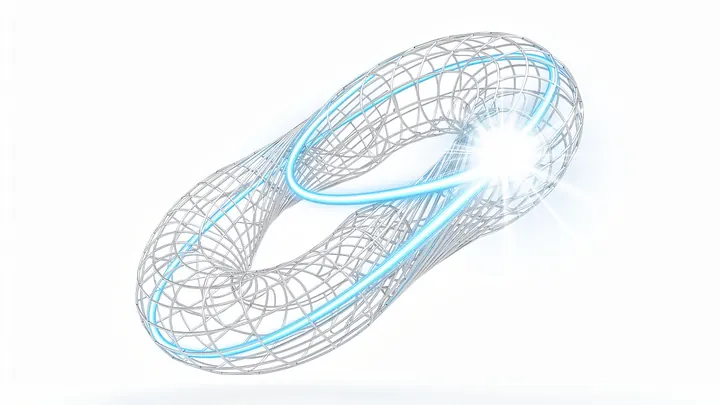
If you were an ant on a Möbius strip, you could crawl over the entire surface and return to the starting point... but upside down, because this strip has only one side!
A cell monolayer resembles a crowd of people lined up one behind the other. If there are obstacles in the crowd, say two pillars, people must go around them, and vortices appear in the flow. In living tissue, such vortices are called topological defects, and they are not just a random occurrence but a way for the tissue to adapt to the shape of its surroundings.
A sheet of paper tears where tension exceeds strength. Epithelium, the cell sheet lining our organs, behaves similarly, but until recently models could not show how tears appear in it. The classical vertex model describes tissue as a network of polygons tightly packed together and forbids cells from detaching.
A deck of cards in which each card is slightly rotated cannot lie flat: the backs and faces will never align. But if the cards are flexible, they will start to adjust, shifting by fractions of a millimeter to find the perfect match. Something similar happens inside crystals when two thick layers of MoS2 or MoS2 with WS2 are stacked with a twist of 1–2 degrees.
In a mountain range, there are trails that can be contracted to a point if you walk through a flat valley. But there are also loop routes that cannot be shrunk without crossing a ridge.
The quantum world is often compared to a musical instrument. Electronic bands in a crystal are like strings, each with its own pitch. Usually, if the strings are tuned simply, without tricky interlacing, then the sound produced by their combined motion remains simple.
In the world of crystals, there is a hidden geometry. When an electron runs through a two-dimensional insulator, its path is twisted by an invisible force — topology. This twist is described by the Chern number, an integer that cannot be changed by smooth deformation.
The holographic principle is often compared to a hologram: all the information about a volume is encoded on a flat surface. In physics, this means that three-dimensional spacetime with gravity could be equivalent to a two-dimensional theory without gravity — a so-called conformal field theory (CFT).
Two transparent sheets with circles drawn on them. If you stack them exactly, the circles align. But give one sheet a slight twist, and a new pattern emerges: in some places the circles bunch together, in others they spread apart. That's roughly how moiré works — an unexpected pattern born from rotating two periodic structures.
In 1970, mathematician John Conway invented the Game of Life — a cellular field where just three rules generate surprisingly complex patterns. Forty years later, SmoothLife appeared: a version where space is no longer cellular but smooth, like a blurred patch. The authors of the new study took an even simpler variant of this continuous game: now everything changes smoothly in time as well.
Two cities with the same average population density. In one, a neat grid of blocks; in the other, a maze of narrow alleys and unexpected squares. On a global map they look like twins, but life inside flows quite differently.
In a crystal, electrons are not distributed randomly. Their waves obey the lattice symmetry, like ripples on water taking the shape of a hoop thrown into it. The new work shows that at high-symmetry points, this ripple must have nodes — places where electron density is strictly zero.
An ordinary flashlight emits light whose waves oscillate in all directions at once. But pass that light through a special filter, and you get a beam that oscillates strictly in one plane: that's polarized light. When such a beam travels through biological tissue, the tissue's internal structure slightly alters the orientation of the oscillations.
Two sheets of tungsten diselenide (not carbon, but a compound of tungsten and selenium) are rotated relative to each other by a tiny angle, about 5 degrees. This creates a moiré pattern: an enlarged periodic lattice where electrons behave very differently than in a regular crystal.
A city at night: lights on in some windows, dark in others. If you connect with lines the windows that light up simultaneously, you get a web of connections. Researchers studied such a web in tiny brain organoids — living clusters of nerve cells grown in the lab.
Genes are like houses in a city: in some, life bustles; in others, silence reigns. This 'urban' genetic landscape was analyzed in a thousand women with breast cancer.
For a long time, identifying quantum phases was like interrogating a witness: you had to reach every corner of the system to uncover its secret. In the era of Landau, order was tied to symmetry breaking and a local parameter — everything plain as day.
The book is open to the middle. Current runs along the spine, while the pages remain cool. That's roughly how a two-dimensional topological insulator works — a material where electricity flows only along the edges, while the interior stays still.
In the microscopic world, noise, random fluctuations, usually destroys fragile quantum states, much like ripples on water break the reflection in a puddle. However, in some systems, collective, coordinated noise from many particles produces the opposite effect: a stable unidirectional flow emerges.
Look at an equilateral triangle — the probability simplex for three assets. Each interior point is a portfolio: non-negative shares summing to one. The triangle's center, the barycenter, corresponds to an equal-weight allocation (1/3, 1/3, 1/3). It seems that by moving toward this point, you lower risk and avoid dangerous edges.
Light flows like an invisible river. If you place an obstacle in the stream, the water whirls into eddies. Likewise, specially designed surfaces create light 'whirlpools' that catch nanoparticles like wood chips.
Dim the lights. The stage belongs to a shadow theater, with just r puppeteers, but the screen obeys the laws of hyperbolic geometry. Every wave of the hand births a pattern that mathematicians call a discrete group of isometries.
Two passengers step into an empty car on a ring subway line and take their seats. After one full loop, they are surprised to find themselves in each other’s seats — even though nobody moved. That’s pretty much how monodromy plays out in vineyards — families of persistence diagrams, a method rooted in the work of Henri Poincaré.
The frost pattern on a windowpane doesn't spread uniformly: it sprouts branches, captures new areas, sometimes sealing off voids. This growth is not a smooth expansion but a series of leaps. This image resonates surprisingly with a mathematical model devised by Charles Loewner a century ago.
Magnetic vortices just tens of nanometers across are like tiny tornadoes frozen in metal. Called skyrmions, they are remarkably stable: hard to destroy but easy to move. That's why engineers see them as ideal 'bits' for future memory — fast, energy-efficient, and resilient.
But until now, no one knew how such a vortex is structured within the material's depth.
Why do some systems, from gene networks to air travel, preserve imprints of the past longer than others? For a long time, network science blamed topology: the number of connections, modularity, spectrum. But two networks with the same skeleton can remember and forget in completely different ways.
From childhood, we're used to thinking of space as infinite and isotropic. But Einstein and Lemaître were already asking: could the Universe be closed in on itself, like a Möbius strip or a 3-torus?
A sheet of rubber is squeezed from two sides. At first glance, it's just deformation. But inside, deep within the material, a hidden order awakens. This is not just wrinkles on the surface. It's the birth of special zones where vibrations become trapped, as if in a cage.
Previously, it was thought that such effects require intricate lattices and periodic structures.
A thrown stone follows a smooth arc: its path is easy to predict. But if the stone skips across water, the trajectory becomes jagged and far more interesting. Quantum particles behave much the same way when their state is not a calm wave with fixed energy but a turbulent mix of several waves at once.
Light from an ordinary bulb seems utterly chaotic: its waves oscillate out of sync, like a crowd where everyone walks in their own direction. Such light is called incoherent. For a long time, it was believed that elegant topological structures (knots, rings, links) could only be created in coherent laser light, where all waves march in step.
A person hunting for keys mentally runs through places where they might be. A bird that tucked hundreds of seeds into crevices in autumn retrieves them flawlessly in winter. How can a brain hold so many addresses when all birds have roughly the same number of neurons? The answer lies in geometry.
On a donut-shaped ring, the theory lives on the surface, while inside hides a curved space — like a saddle widening toward the edge. According to the holographic principle of Juan Maldacena, everything happening inside can be described by data on the boundary.
A rubber band stretches and snaps back. A steel spring compresses and expands. Elasticity seems like a property of simple things — a piece of metal or a drop of gel. But the authors of this work looked deeper.
They showed that the electron's spin, its own tiny rotation, can also be elastic.
The quantum birth of the Universe is like a game of dice, where the chance of rolling a six is catastrophically small. The formalism of Hawking and Hartle, an elegant recipe for a world born from timelessness, has spent decades predicting that a universe like ours is fantastically improbable.
A drop of ink falls into a glass of water, and within a minute you can't tell where it landed. In the quantum world, it's even more dramatic: information about a local event spreads across the entire system so quickly that any point-like sensor soon stops feeling anything. This is called delocalization, and for quantum sensors, it sounds like a death sentence.
Every shell is a stone diary of growth. The mollusk doesn't build it from a blueprint like an architect; it simply adds material along the edge, following the same rule over and over. It's as if a snail glued a new strip to its house each day, nudging it slightly sideways and making it a bit bigger. It's this repetition, not complex control, that creates the species' characteristic shape.
A candle flame flickers in a draft but doesn't go out — the tongue of fire briefly changes shape and then returns. Optical skyrmions behave much the same way — tiny vortices in a light beam, reminiscent of swirling eddies. Until recently, they were created only in the perfect, smooth light of a laser.
Water churns behind a rock in a river, air swirls behind an airplane wing: it seems like completely random motion. But the authors of the study found a rigid kitchen recipe in this chaos.
They decomposed the fluid's rotation (angular momentum) into two independent parts.
Imagine a mountain range where height represents an organism's fitness. Every point on the slope is a particular set of genes. Evolution climbs upward, but the terrain of this phylogenetic network landscape is cut by ridges and valleys.
In a strong magnetic field, electrons in a thin metal film move along circular orbits. When the film thickness is comparable to the size of such an orbit, the resistance starts to oscillate: these are Sondheimer oscillations, known since the mid-20th century as a purely geometric effect.
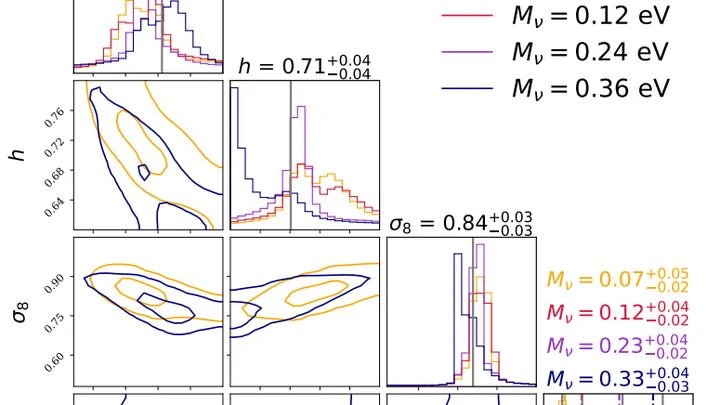
The Universe is a colossal web of invisible dark matter and galaxies, stretched by the expansion of space. Neutrinos, nearly intangible ghost particles, barely cling to the threads, but their collective mass subtly shifts the tension of the entire network.