Symphony of Collapse: The Algebraic Key to Black Holes ✦
Original: "Matter Maps to Geometry in Gravitational Collapse"
A precise two-way mapping has been discovered that instantly translates a dying star's density into a black hole's metric—without a single differential equation.
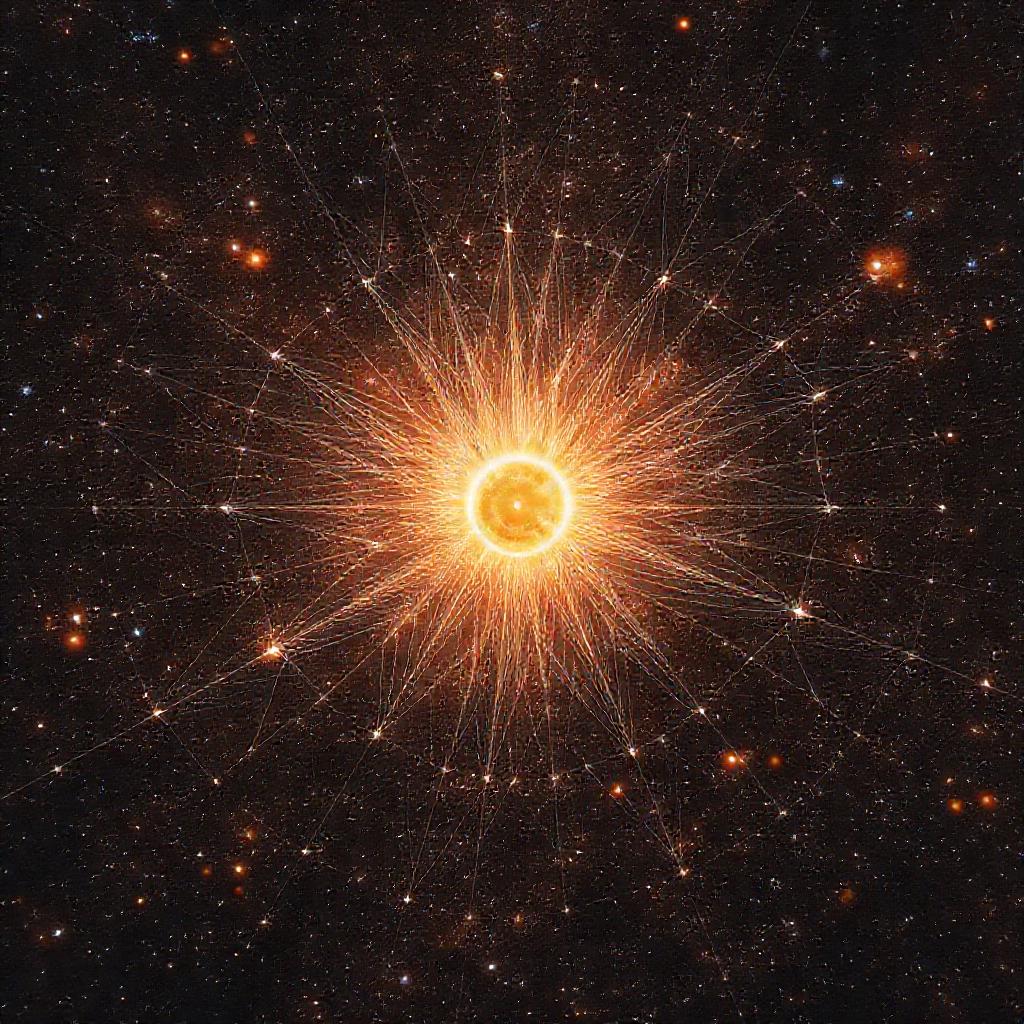
Links in the knowledge graph 1
A massive star collapses, but instead of a hopeless singularity it gives birth to a black hole whose geometry is encrypted in the matter's density. It's like a musical score where the voice of matter and the voice of spacetime sound in unison. A new algebraic mapping lets us read this score instantly—and distinguish a fundamental theory from jazz improvisation. In the future, gravitational-wave detectors will hear the “echo” of quantum bounces, and we may even test cosmic censorship.
🎯 The key algebraic relation connecting density and metric was derived from junction conditions without cumbersome computations—an elegance akin to Kepler deducing the laws of planetary motion from observations.
\rho(R) = \frac{3}{8\pi R^2}(1 - f(R))
The translator formula: density ρ(R) and metric function f(R) are directly linked—plug in one and instantly get the other, without a single differential equation.
1 - f(R) = \frac{2M}{R} + a_2\frac{M^2}{R^4} + a_3\frac{M^3}{R^7} + \dots
Spectral analysis of a black hole: integer exponents (R^{-4}, R^{-7}…) signal a fundamental quantum theory; fractional ones betray a phenomenological model.
Scientists
Alan GuthAndrei LindeGeorges LemaîtreJames PeeblesStephen HawkingJacob Bekensteinblack hole
gravity
spacetime curvature
supernova
neutron star
stellar evolution
gravitational waves
dark energy
Accretion diskLaws
Friedmann equationsHawking radiationgravitational lensingBekenstein-Hawking entropyEinstein field equationsFermi–Dirac statistics