Symphony of Collapse: The Algebraic Key to Black Holes ✛ ✦
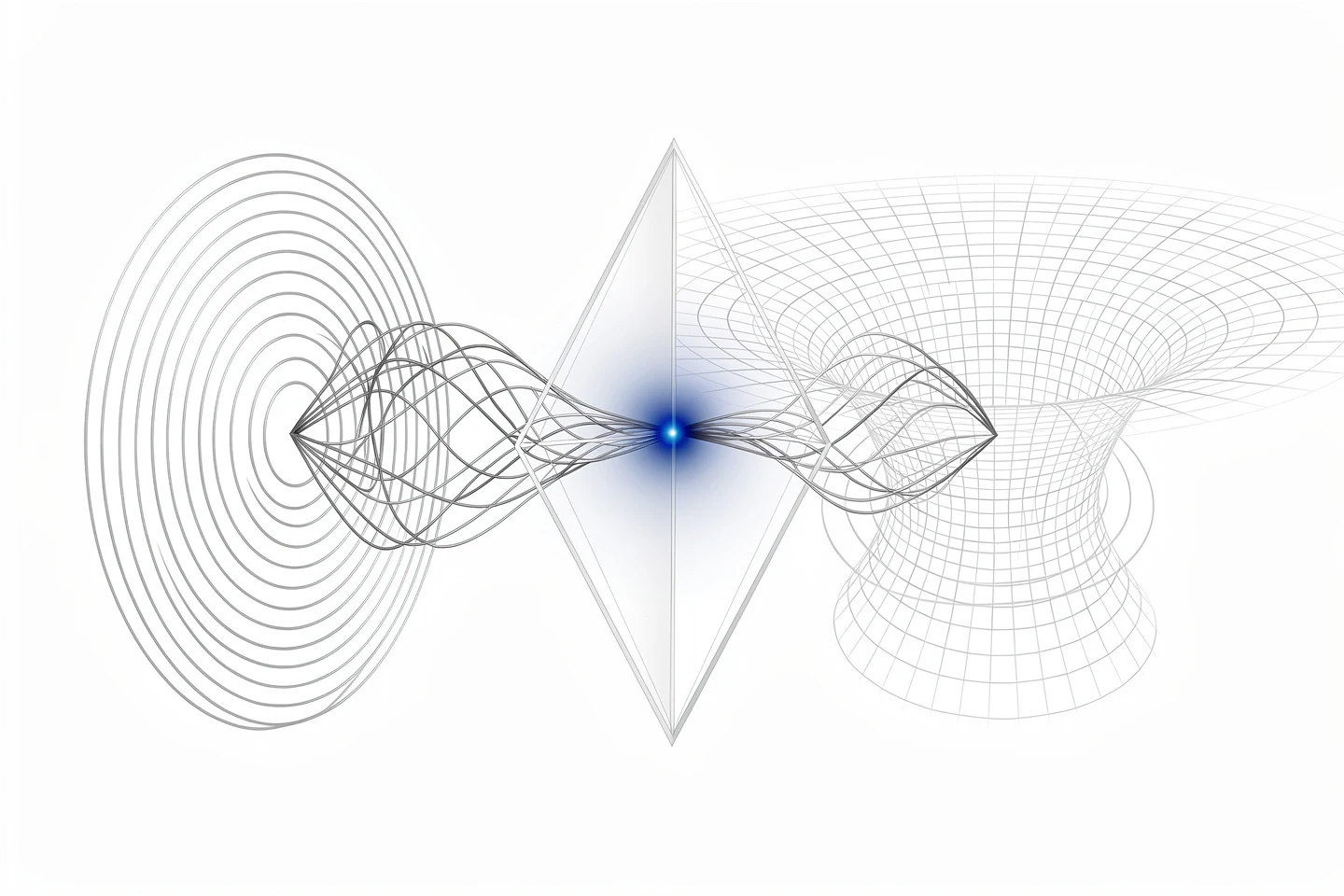
When a massive star exhausts its fuel, the core collapse can spawn a supernova and a neutron star, but with enough mass, nothing halts the crush — a black hole is born. The classical picture painted by Einstein and Schwarzschild predicts a singularity inside — a rupture in spacetime curvature where gravity equations lose their grip. The theorems of Penrose assert that in pure general relativity such singularities are inevitable, like a climactic dissonance in a symphony that cannot resolve. A new work transforms this dissonance into a coherent score: physicists have found an algebraic key linking the density of collapsing matter to the geometry outside the horizon. This is not just a simplification: it's a two-way translator, where every “word” in the language of matter has an exact counterpart in the language of black holes.
Imagine stellar collapse as a musical fugue. The voice of matter, the density distribution, sounds in the inner region, while the voice of geometry — the metric function f(R)—responds from outside. Previously, to hear their harmony, one had to solve the differential field equations, but the authors show that a universal score exists: a simple algebraic relation. It looks disarmingly concise: ρ(R) = (3 / 8πR²) (1 – f(R)). Set the density, and you get the metric. And vice versa. It’s like the same melody played on a piano or a cello, preserving the essence. Such a mapping turns the analysis of quantum corrections from hours of improvisation into sight-reading.
Armed with this score, you can not only instantly generate metrics but also decode the physics behind them. If the expansion of 1–f(R) contains only negative integer powers of the form $R^{-(3n-2)}$, we are looking at a systematic quantum expansion — for instance, from loop quantum gravity. A mixture of fractional exponents, as in the famous Bardeen black hole, betrays a phenomenological model stitched by hand. A surprising twist: a quantum-corrected black hole can sometimes be an exact twin of a classical solution in nonlinear electrodynamics with a magnetic charge. This means that geometry itself can hide a double bottom — the same shape can be produced by completely different physical actors, like one musical theme arranged by different composers. Thus, geometry does not distinguish the “words” of magnetism and gravity, hinting at a deep unity of forces.
The practical power of the approach is in its predictive ability. It gives a clear criterion for selecting serious quantum gravity theories and allows rapid testing of singularity-resolution scenarios. Depending on the form of f(R), collapse may end not in a singularity but in a “bounce” at a finite radius, birthing a gravitational-wave echo that next-generation detectors like LISA could snag. And if dark energy shows up as a cosmological constant, the algebraic bridge easily incorporates it. The shadows of black holes, the properties of accretion disks — all these observable signatures become targets for testing quantum gravity. The cosmic censorship hypothesis, which forbids us from seeing a “naked” singularity, can be stress-tested: algebra will tell whether it stays behind the horizon. And perhaps, one day, this “matter-geometry” dictionary will explain where information goes when a black hole evaporates.
The key algebraic relation connecting density and metric was derived from junction conditions without cumbersome computations — an elegance akin to Kepler deducing the laws of planetary motion from observations.