Two-Way Algebraic Mapping of Matter and Geometry in Collapse ✛ ✦
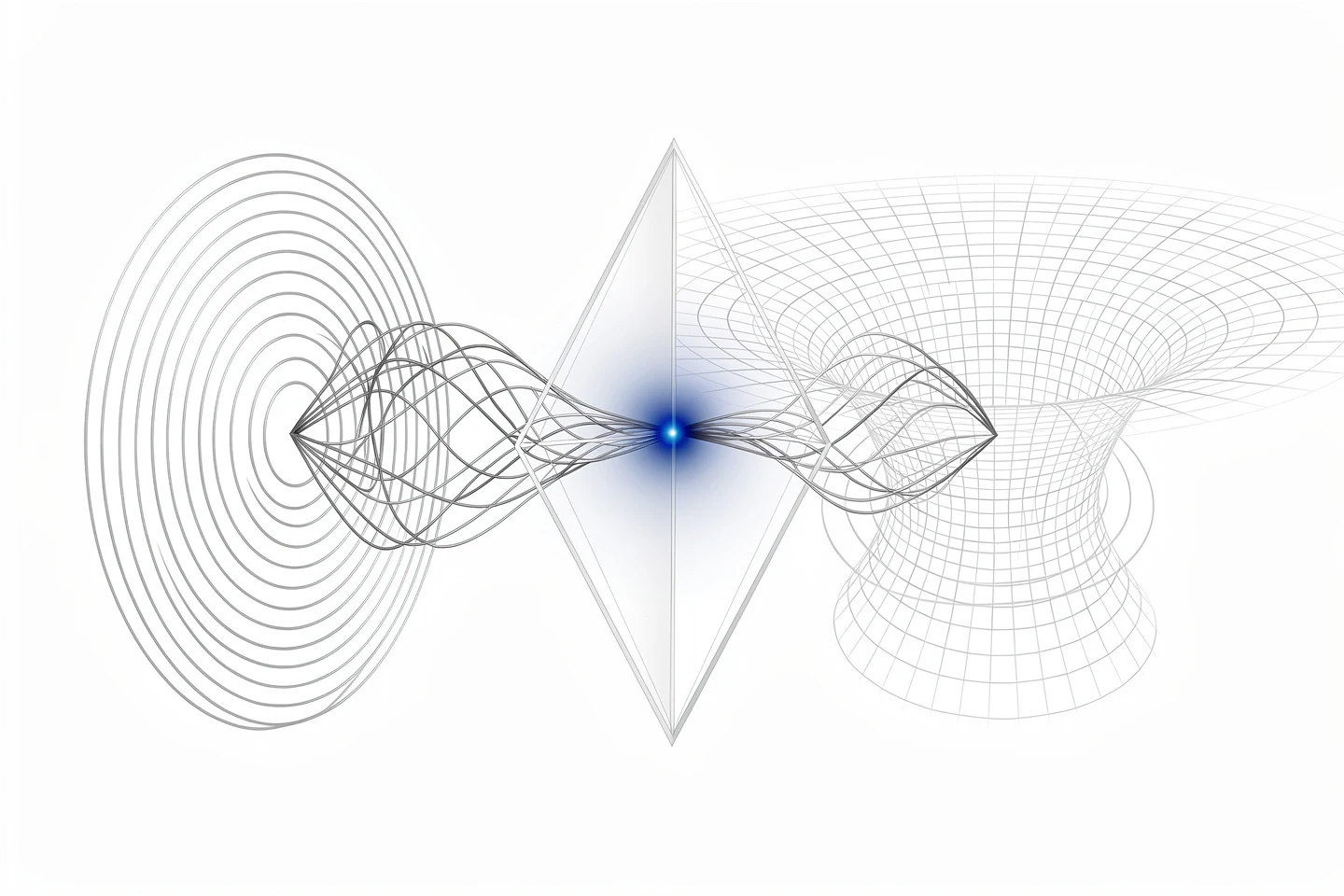
Context
The fate of a massive star at the end of its life cycle is one of the central mysteries of astrophysics. The outcome of core collapse depends on the initial mass: a supernova explosion may occur, leaving behind a neutron star, or, if the Oppenheimer–Volkoff limit is exceeded, a black hole forms. According to Einstein's general relativity, the black hole is described by the Schwarzschild metric, but inside the horizon a singularity arises — a region of infinite spacetime curvature. The theorems of Penrose assert that such singularities are inevitable in classical theory. Eliminating them via quantum effects remains a key challenge, requiring new approaches like the one proposed.
Methods
The researchers applied a generalized Oppenheimer–Snyder model, supplementing it with force-free junction conditions. The key step was establishing an algebraic relationship between the effective density inside the collapsing star and the metric function f(R) outside. This density can include standard components — neutral dust, electromagnetic field, and dark energy in the form of a cosmological constant — as well as quantum corrections, for instance from loop quantum gravity. As a result, any change in density immediately yields the corresponding geometry of the black hole without needing to solve complicated differential field equations. The method also works in reverse: given an exterior metric, one can recover the matter that generates it.
Results
The main result is a diagnostic criterion based on the structure of density corrections. If the corrections expand in integer powers of a dimensionless parameter (e.g., the ratio of density to critical density), then the metric contains only terms of the form $R^{-(3n-2)}$ for integer n. This pattern is characteristic of systematic ultraviolet extensions such as loop quantum gravity or quasi-topological theories. In contrast, the appearance of fractional exponents, as in the famous Bardeen black hole, indicates a phenomenological model. The authors also showed that a quantum-corrected black hole has an exact classical analog in nonlinear electrodynamics with a magnetic charge: when parameters are matched, the evolution of the star's surface and the horizon structure coincide completely. Depending on the form of f(R), the collapse may end in a singularity, a "bounce" at a finite radius, or a "soft landing" with asymptotic approach to the center.
Implications
The results greatly simplify the study of fundamental questions. The integer-power criterion provides a practical tool for selecting serious quantum gravity theories. The equivalence of quantum and classical descriptions underscores that the same geometry can arise from completely different physics, which is important for interpreting future observations. Moreover, the algebraic mapping allows rapid testing of singularity resolution scenarios and checking the cosmic censorship hypothesis.
Future development
The proposed approach can be extended to rotating black holes and inhomogeneous collapses, where qualitatively new dynamical regimes will appear. The integer-correction criterion will serve as a guide for constructing consistent quantum extensions in higher-derivative theories. Observational signatures — gravitational wave echoes from bounces, shadow deformations, and properties of accretion disks — will become targets for the next generation of detectors, such as LISA and the Einstein Telescope.
Impact
The work will impact black hole astrophysics, quantum gravity, and cosmology, offering a unified mathematical bridge between matter and geometry.
Next steps
Next steps include constructing exact solutions for rotating systems and investigating the effect of higher-order quantum corrections on collapse dynamics using the proposed criterion.
Key open problems
The study directly tackles unresolved questions about singularities and cosmic censorship. It offers a way to test which quantum effects can eliminate singularities without violating fundamental principles.
The knowledge machine's view
This section is addressed to the author of the paper and their colleagues. Neighbouring works were found by meaning-based search across our archive, not by word overlap. We do not review: we show the field around the work.
What the work does
The work establishes an algebraic mapping between the effective matter density inside a collapsing star and the external metric function f(R). This allows one to determine the structure of the metric directly from the form of quantum corrections to the density: integer powers indicate fundamental theories, while fractional powers indicate phenomenological ones. It is shown that collapse can end in a singularity, a bounce, or a soft landing, and that a quantum-corrected black hole has an exact classical analog in nonlinear electrodynamics with a magnetic charge.
Where its strength is
The strength of the work lies in the diagnostic criterion that links the analytic structure of density corrections to the nature of the metric, and in establishing an exact correspondence between quantum-corrected geometry and a classical model with nonlinear electrodynamics. This provides a simple tool for classifying collapse models without solving complex equations.
Where it could go next
- It might be interesting to compare the proposed criterion with the analysis of black hole evaporation: the paper on the breakdown of semiclassical gravity during evaporation considers effects that could modify the metric at late stages, and the algebraic approach would allow a quick check of which quantum corrections are compatible with evaporation.based on: Lightning over the Horizon: The Collapse of Semiclassical Gravity in Black Hole Evaporation arXiv:2605.00780v1
- A nearby paper discusses the birth of a black hole without a singularity; it would be interesting to apply your method to their models to see which types of density lead to regular metrics and whether your criterion can be extended to such cases.based on: How a Black Hole Is Born Without a Singularity arXiv:2607.16590
- A possible development is to connect your approach with models of black holes as clouds of spacetime pieces: if the external metric is generated not by classical matter but by quantum structure, the algebraic mapping could provide a new way to test such models.based on: A Black Hole as a Cloud of Spacetime Bits arXiv:2605.18922
Worth trying
- Test how the integer-power criterion works for models where corrections contain logarithmic terms.
- Use the inverse mapping to reconstruct the effective density from metrics arising in loop quantum gravity.
- Compare your method's predictions for collapse with the neutrino processes described in a neighboring paper to see whether they affect the form of the corrections.
Why this may matter
If the criterion turns out to be universal, it could become a standard tool for quickly classifying black hole and collapse models, shortening the path from theory to observational predictions.
Nearby works in our archive
- Lightning over the Horizon: The Collapse of Semiclassical Gravity in Black Hole Evaporationsimilarity 0.69
- How Neutrinos Decide the Fate of Dying Starssimilarity 0.67
- How a Black Hole Is Born Without a Singularitysimilarity 0.66
- Why Tiny Black Holes Didn't Form in the Early Universesimilarity 0.66
- How a Charged Black Hole Loses Weight and Chargesimilarity 0.65
- When a Black Hole Breaks the Voidsimilarity 0.65
- A Black Hole as a Cloud of Spacetime Bitssimilarity 0.65
The closest work in the archive sits at 0.69 by meaning — the usual level for our corpus.
Original abstract
as written by the authors arXiv:2605.08807v1
We establish an exact bidirectional map between the effective homogeneous interior density of a collapsing star and the exterior metric function in generalized Oppenheimer--Snyder collapse. The Darmois--Israel junction conditions reduce this relation to a purely algebraic form, providing a direct way to reconstruct candidate static geometries and their surface dynamics without solving the corresponding differential field equations separately. Correction powers diagnose models: integer exponents signal ultraviolet completions, while fractional powers identify phenomenological ones. Our framework not only simplifies the construction of regular black holes but also provides a universal benchmark for testing singularity resolution and cosmic censorship in quantum gravity phenomenology.
Interestingly, the key algebraic relationship linking density and metric was derived from the junction conditions without bulky calculations. This is a reminder that even in general relativity, elegant simplifications can sometimes be found.
Key numbers
- critical value of α for degenerate horizon: α = 27M²/16
- minimum radius at bounce: R* = (αM/2)^{1/3}
- characteristic scale of quantum correction: ℓ² = 3/(8πρ_c)
- threshold for horizon formation: α < M²
- magnetic charge in NED analog: Q_m ∝ M^{2/3}