Mini

Phantom Glow: A Wormhole's Shadow Shines Brighter Than a Black Hole's

Original: "Ellis-Bronnikov Wormhole Shadows with Spherically Symmetric Accretion Flow"
arXiv:2606.01699v1 · 2026-06-01 · CC BY 4.0 · ⏱ 1 min · General Relativity High Energy HEP Theory
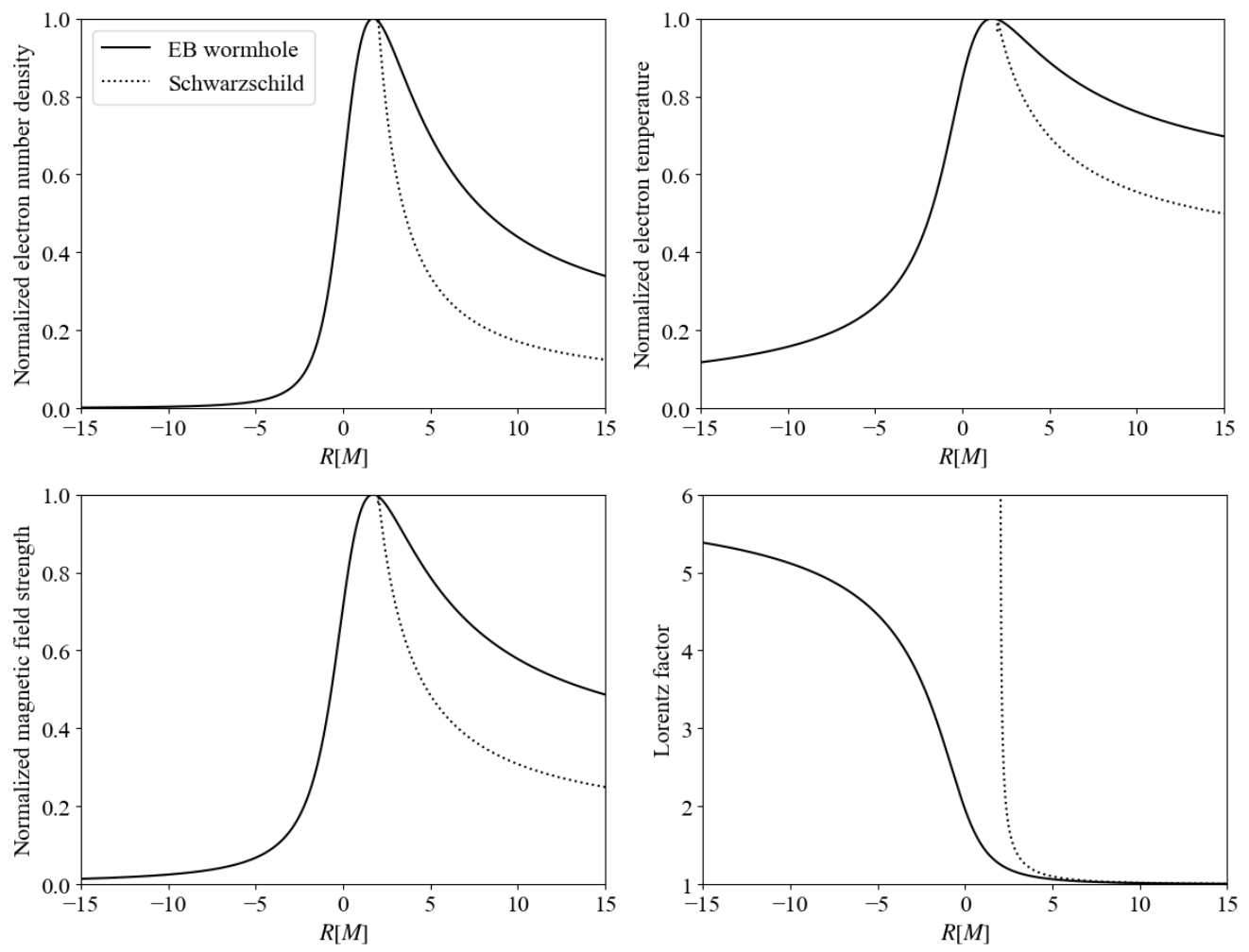
Simulations show: the absence of an event horizon makes a wormhole's photon ring brighter, but current telescopes can't yet tell the difference.
Links in the knowledge graph 1

In 2019, we glimpsed a black hole's 'shadow' for the first time. What if it's a wormhole? Simulations show: without an event horizon, its photon ring is brighter—the glow seeps through the throat, like through ghostly fabric. Future interferometers will catch this phantom gleam, and then bridges through spacetime will become objects of observation, not fiction.

🎯 The Ellis-Bronnikov wormhole, discovered in 1973, has negative mass in another universe—an exotic detail reminiscent that such objects require violation of classical energy conditions.

🎬 In the movie Interstellar, the heroes travel through a wormhole created by a supercivilization. Real models like Ellis-Bronnikov, though plagued by instability, show that a scientific basis for such portals exists.

f(R) = \frac{2M}{\ell}\left(\tan^{-1}\frac{R}{\ell} - \frac{\pi}{2}\right)
determines gravitational redshift and ray bending near the throat
Scientists
Stephen HawkingJacob BekensteinAlbert EinsteinFritz ZwickyVera RubinBernhard Riemann
Tags
black hole gravitational lensing spacetime curvature galaxy photometry cosmic dust Time dilation quasar
Laws
Hawking radiationgravitational lensingBekenstein-Hawking entropyEinstein field equationsLorentz transformationsStefan–Boltzmann law
Original: arXiv:2606.01699v1 · CC BY 4.0 · bridge42worlds