Scientist

Bernhard Riemann

1826–1866 · mathematics, differential geometry, number theory, complex analysis
Bernhard Riemann was a mathematical genius whose ideas transformed geometry and analysis. His concept of curved space became the mathematical foundation for Einstein's general theory of relativity, and the hypothesis about the zeta function remains the greatest unsolved mystery of mathematics.

Biography

Born in the village of Breselenz (Hanover), studied theology, but soon switched to mathematics under the influence of Gauss in Göttingen. Received his doctorate under Gauss's supervision. Was a professor at the University of Göttingen. Died at age 39 of tuberculosis in Italy, where he had gone for treatment.

Key discoveries

💡 Riemann's historic 1854 lecture "On the Hypotheses That Lie at the Foundation of Geometry" was so groundbreaking that only a few listeners attended, among whom was a deeply impressed Gauss. It took more than half a century for Riemann's ideas to be understood and applied by Einstein.
"He viewed mathematics not just as a tool, but as an art that reveals the structure of reality."
Concepts
gravityspacetime curvaturetensor
Laws
Einstein field equations
Scientists
Robert HookeJacob BekensteinKarl SchwarzschildJoseph WeberEmmy NoetherKip ThorneNicolaus CopernicusIsaac Newton

Related articles

Dusty Seasons over La Palma: Thirty Years of Observations
Every clear night, a telescope on the island of La Palma looked at the sky and recorded how much the air dimmed starlight. This was routine work for astronomers measuring stellar positions. But in these records, like in an old diary, traces of a different story remained: the arrivals of dust from the Sahara.
Climate Network: How El Niño Tightens Its Grip and Strikes with Precision
A warm tongue of water stretches along the equatorial Pacific, and within weeks, Peru sees torrential rains while Australia's pastures dry out. That is how El Niño begins: a natural conductor that, at critical moments, makes only a few orchestra members play, but much louder.
A Trail in the Sand: How 135 Years of Weather Yielded the El Niño Equation
A trail in the sand stretches across the entire beach. The animal passed here at night, and from its footprints you can reconstruct not only its size but also its gait: where it sped up, where it slowed down, how it shifted its weight. That is essentially what researchers did with El Niño.
A Council of a Hundred Short Experts Predicts El Niño's Whims
The barometer in the port of Papeete on Tahiti and the one in Darwin, Australia, are separated by 7,400 kilometers. When one shows high pressure, the other often shows low, and this difference, called the Southern Oscillation, drives rainfall from India to Brazil. Predicting it even a month ahead is a problem with a century-long history.
Noise Smooths the Devil's Staircase
The devil's staircase is what mathematicians call a graph that looks like steps leading upward, but the steps are infinitely thin and packed without gaps.
eess.SY2020-04-233 minarXiv:2004.11411
How to Hear the Ocean's Voices
Earth's climate resembles a choir, where each member sings their own part at their own pitch. Some voices hold low notes, like multi-year ocean temperature oscillations, while others produce rapid trills, like short atmospheric waves. The conductor needs to hear each one, but the voices overlap and the notes blend into a mush.
cs.SI2020-08-113 minarXiv:2008.04887
A City's Pulse After a Natural Disaster
In February 2017, Lima, a city of over ten million people, was hit by El Niño: the warm current off Peru's coast brought torrential rains, floods, and landslides. More than a hundred people died, thousands of homes were destroyed, and roads turned into rivers. The city's economy, like a living organism, fell out of rhythm: shoppers visited stores less often, and their spending patterns shifted almost overnight.
A Unevenly Woven Thread: The El Niño–Monsoon Link Strengthens Nonlinearly
In 1982, a warm current off the coast of Peru grew so large that it altered weather across the entire planet. That year, India saw drought, Australia wildfires, and California torrential rains. The world learned that ocean and sky are linked by invisible threads: an event in one hemisphere echoes as rainfall in another.
Mapping Bifurcation Landscapes: How Numerical Continuation Reveals Hidden Mechanisms in Delay Systems
A cartographer charting a route through a mountain range notes not only peaks and valleys but also passes where the trail sharply changes direction.
Climate Teleconnections with a Time Lag
In 1960, a meteorologist at a station in Peru records water temperature, while a farmer in India watches the sky waiting for the monsoon. There is no direct link between these two events, but months later one will echo in the other.
How El Niño Stretches Thunderstorm Fronts
A thunderstorm front is like a rubber band stretched between two fingers. The harder you pull, the wider the strip where lightning strikes. Meteorologists have long been able to measure storm intensity at a single point, but until now they didn't understand why severe weather sometimes compresses into a compact blob and sometimes covers half a continent.
The Overzealous Translator: Why Models Overestimate the El Niño–Hurricane Link
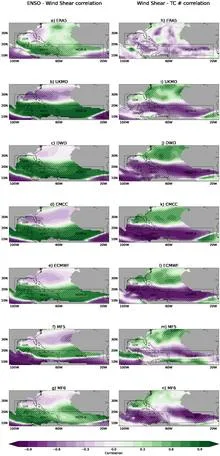
Over the warm waters of the Atlantic, air begins to swirl like water spiraling down a drain. That is a future hurricane, and its fate depends on what happens thousands of kilometers away in the Pacific Ocean. When the El Niño current warms up there, storms in the Atlantic become fewer. The models that forecast hurricane season know about this link.
Multi-Day Rainstorms: How Dynamics Teaches Statistics to Keep Its Story Straight
In February 2022, the eastern coast of Australia was hit by rains that lasted several days in a row. Water inundated towns in Queensland and New South Wales, insurers paid out 3.35 billion dollars, and the flood became the costliest in the country's history.
eess.SY2024-06-202 minarXiv:2406.14474
The Ocean Conducts Blackouts: How La Niña Steers the US Power Grid
The Pacific Ocean behaves like a conductor setting the tempo for outages in the American power grid. When the ocean shifts into its cold phase, known as La Niña, lights start going out more often across the US. Researchers traced this connection over 24 years and confirmed that the ocean really does drive the weather, and the weather batters wires and transformers.
The Knot That Cannot Be Untied: How Interactions Rewrite Charge in a Topological Chain
In 1979, Su, Schrieffer, and Heeger proposed a model that explained the strange electrical properties of polyacetylene, an organic polymer that conducts electricity almost like a metal. Their chain consisted of carbon atoms connected alternately by single and double bonds.
The Climate Symphony: How Random Jolts Produce a Predictable Response
The orchestra plays the symphony of climate. Each violin, each wind instrument carries its own part: these are the Kolmogorov modes, the system's natural rhythms. Suddenly, a thunderclap bursts into the hall: a sharp jump, like a gust of wind or a downpour. Previously, we could only listen to the smooth sound, but we couldn't decipher such chords. In the new work, mathematicians have completed the score.
Navigator and Cabin Boy: How a Hybrid Model Learns to Predict El Niño from the Ocean's Short Memory
An experienced navigator steers the ship by a well-tested chart, but in unfamiliar waters the chart lies. A cabin boy who has watched the navigator err for years learns to anticipate where the chart will fail. Together they plot a course more accurately than either could alone.
Stellar2025-01-213 minarXiv:2501.12478
Fast Stars as Probes of the Galaxy
The Solar System takes 210 million years to complete one orbit around the center of the Milky Way. The last time we were on this same side of the Galaxy, early dinosaurs were roaming the Earth. That number, 243.72 km/s, has now been refined thanks to rare stars that streak through the Galaxy like cannonballs.
Time Is Born from the Shape of the Universe
The clock on the kitchen wall ticks, and each tick relentlessly carries us from breakfast to lunch. This is so familiar that it seems like a law of nature, but physics says otherwise. In Einstein's equations, time is reversible: you can rewind the film, and no frame will give the trick away.
Ionic Liquids on Rocky Exoplanets: Life Without Water
Water is the gold standard for life. We search for its traces on Mars, in icy moons, and in the atmospheres of distant planets. But what if life doesn't need water? On a warm rocky exoplanet with a thin atmosphere, water would evaporate within hours.
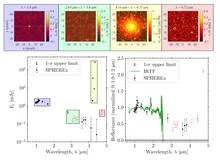
Ice in the Shadows: SPHEREx Spots Vanishing Ice in Prestellar Cores
Deep inside a molecular cloud, where temperatures drop to 10–20 kelvin and gas densities reach a million particles per cubic centimeter, a frozen shadow prevails. There, far from starlight, water, carbon dioxide, and other molecules freeze onto dust grains.
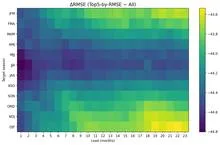
Selecting the Best El Niño Predictors from a Model Ensemble
A team of forty forecasters prepares an El Niño forecast two years ahead. Each works with the same model but slightly different initial conditions and settings, so their outputs diverge. Typically, forecasting centers average all forty opinions, assuming each member is equally useful.
Galaxies2025-09-082 minarXiv:2509.06787
Seven Embryos in One Disk: The Birth of an Extreme Stellar Family
In the dark cloud NGC 6334I-North, 5500 light-years from Earth, the ALMA radio interferometer spotted something unexpected: around a young massive star, a disk of gas and dust is swirling, and inside it are seven dense clumps. Each one could become a star. This is what the birth of a stellar family looks like, and an unusually large one at that.
Hydrogen Hidden in the Depths of a Sub-Neptune
A young sub-Neptune is a pressure cooker where hydrogen and rock simmer in the same pot. Six Earth masses, three percent hydrogen by mass, and interior temperatures above 4000 K. At that heat, silicate melt and hydrogen don't just coexist: they mix completely, forming a single supercritical fluid. There is no boundary between core and envelope.
Galaxies2025-09-253 minarXiv:2509.20832
Galactic Contrail: A Dark Object Carved a Path Through NGC 3627
NGC 3627, a spiral beauty in the constellation Leo, harbors a trail that fits no standard scenario. A narrow band of cold gas, a molecular trail, stretches more than 8 kiloparsecs (thousands of parsecs, each about 3260 light-years) with a width of about 200 parsecs. That is like a thread as long as a football field and as thick as a pencil.
General Relativity2025-10-191 minarXiv:2510.16903express
Gravitational Waves Gain Overtones
A guitar string after being plucked produces not only the fundamental note, but also quiet overtones. A similar phenomenon appeared in the gravitational waves from the merger of two black holes (event GW250114).
Quantum Physics2025-10-221 minarXiv:2510.19969express
Only Quantum Gravity Can Entangle Masses
Two massive spheres in the cosmic void. Push one, and the second will feel the push only after a moment: gravitational influence travels, like an echo of a shout in the mountains, with inevitable delay. This is how curved space transmits signals locally, step by step — predicted by Einstein long ago.
Quantum Physics2025-10-231 minarXiv:2510.20772express
Superfluid Helium Feels How the Earth Spins
According to Einstein's theory, Earth's rotation drags space-time itself along — like a spoon dragging thick honey. This effect is incredibly weak: about one revolution in billions of years. But it can be caught.
Exoplanets2025-11-011 minarXiv:2511.00525express
How to Find Life: Look for Molecular Diversity
The chemical composition of a sample is like a soundscape. A living forest sounds polyphonic: chirping, rustles, the hum of insects. A barren desert is just the whistle of the wind.
HEP Phenomenology2025-11-041 minarXiv:2511.02363express
How Gravity Helps Us See the Invisible Electromagnetic Echo
Gravity works like an invisible photographer. When a piece of metal falls, inside it, according to Albert Einstein and the electromagnetism of James Clerk Maxwell, an electric field is born — that's how spacetime curvature…
Quantum Physics2025-11-241 minarXiv:2511.19242express
Can gravity entangle particles?
Two particles can become linked so that a nudge on one instantly reverberates in the other, even if they are separated by galaxies. Einstein called it "spooky action at a distance." Physicists wondered: can gravity itself, a simple mutual attraction, create such a connection?
Exoplanets2025-11-281 minarXiv:2511.23163express
Dust Storms on a Rogue Planet
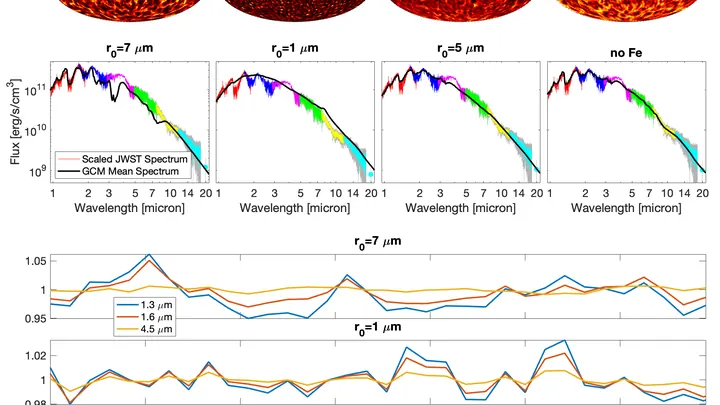
Far beyond the Solar System, a world called VHS 1256B wanders — a giant planet without a star. For a long time, astronomers couldn’t figure out why its brightness jumped by nearly 40% in just a few days. The answer came with the James Webb telescope: it turns out, colossal storms of silicate dust engulf the entire planet.
Twin Winds: How Rotation and Divergence Drive El Niño
Two conductors stand before one orchestra. One waves the baton quickly, setting the tempo every few bars. The second is almost motionless, but his slow breathing changes the overall sound throughout the symphony. So it is in the tropical Pacific: one part of the wind governs the fast oscillations of El Niño, the other governs decadal climate shifts.
Quantum Physics2025-12-061 minarXiv:2512.06333express
Quantum Test of Falling Bodies
All bodies fall the same: this was first observed by Galileo. Einstein elevated the observation to the equivalence principle: gravity and acceleration are indistinguishable, giving birth to curved spacetime.
Exoplanets2025-12-102 minarXiv:2512.09660express
A Nearby Supernova: How Rocky Planets Are Born
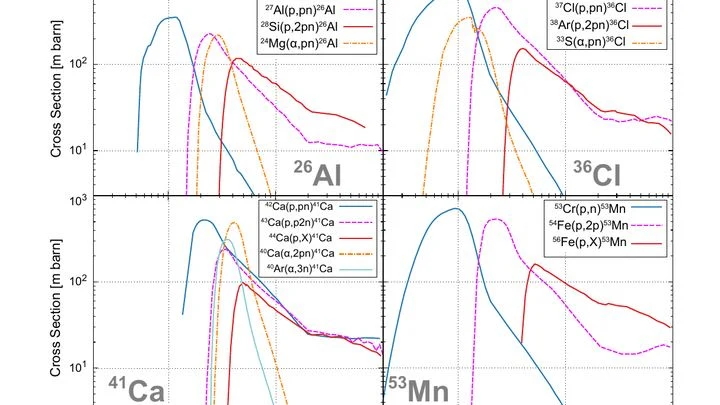
Just as yeast turns flour into fluffy dough, radioactive 'seasoning' from a supernova — the explosion of a massive star at the end of its life helps mold a rocky planet. The key ingredient here is aluminum-26, a radioactive isotope that releases heat as it decays.
Climate Rewires Teleconnections
A warm ocean off the coast of Peru can make winter in Moscow unusually mild. Climate scientists call these invisible threads that link weather in distant corners of the planet teleconnections. For a long time, they were thought of as something like permanent wiring: the signal sources may pulse, but the wires themselves lie still.
Pressure Instead of a Syringe: A New Way to Shield Cells from the Cold
The usual way to freeze a living cell is like trying to put a spacesuit on it: you first need to get a protective substance inside, but while it's crossing the membrane, the cell can burst from salt imbalances or get poisoned by the chemicals.
Fluid Dynamics2026-01-021 minarXiv:2601.00724express
How a Trickle Becomes an Ice Ridge
A thin stream of water flows down a cold inclined board and, before your eyes, turns into an ice ridge. At first, the water paves itself a straight icy path, as if reinforcing its own banks. Then the trickle starts to meander, and the ice quickly spreads sideways. Finally, the ridge stops growing outward and begins to thicken, smoothing out irregularities.
Plasma Physics2026-01-031 minarXiv:2601.07843express
Plasma Brews Herbs in a New Way
Everyone has a kettle in their kitchen, but few brew herbs in water that has just had an electric discharge passed through it. That's exactly what researchers did with neem and tulsi leaves — plants used for centuries in India as natural remedies. First, they 'activated' the water with plasma: they sent a glowing electric discharge through it, like a miniature lightning bolt.
Materials2026-01-041 minarXiv:2601.01354express
Watching a Magnet Melt
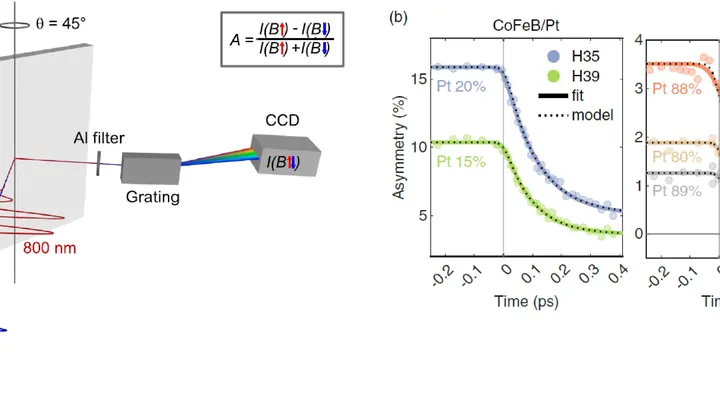
A fridge magnet holds on thanks to tiny internal arrows: each one like a miniature compass. If you hit the metal with an ultrashort flash of light, these arrows start to jitter chaotically, and magnetism melts away in a millionth of a billionth of a second. Previously, such 'melting' was too fast to observe.