Scarlet Invisible Cores: How Hydrogen Fog Conceals Black Holes ✦
Original: "ABCD: The Nuclear Structure of the Little Red Dots Revealted through Absorption, Break, Continuum, and Decrement"
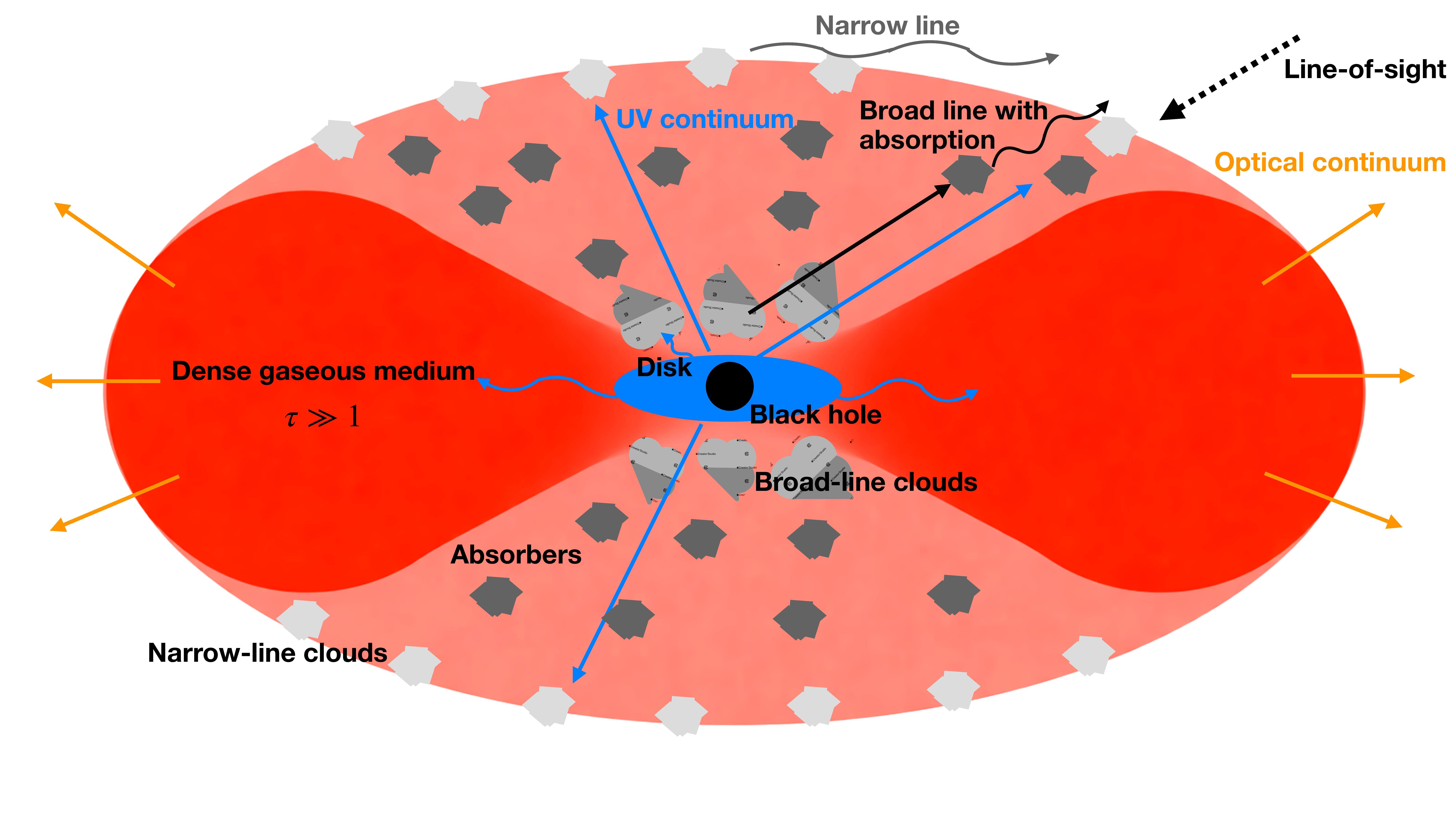
The James Webb Telescope helped unravel the nature of mysterious 'little red dots' — they are not dusty galaxies, but naked cores wrapped in an ultra-dense hydrogen shroud.
Links in the knowledge graph 1
The early Universe is full of 'red dots' — these are not dusty galaxies, but 'naked' black holes in a hydrogen fog. Their light reddens like a setting sun in haze. The gas density there is such that ordinary laws break down — hydrogen lines 'choke' from the crowding. Perhaps these objects will help us understand how supermassive black holes became giants even before stars appeared.
🎯 The name 'little red dots' was coined by astronomers to distinguish these objects from ordinary galaxies with similar colors, but no one expected that these 'dots' would turn out to be almost 'naked' black holes, devoid of a stellar neighborhood.
\frac{H\alpha}{H\beta} \gg 2.86
The flux ratio of hydrogen lines Hα and Hβ, which under standard recombination conditions is about 2.86, but in dense gas becomes greater than 7 due to collisional excitation and optical depth.
n_H \propto r^{-\beta}, \quad \beta < 2
A power-law distribution of hydrogen density as a function of distance from the center, where the exponent β is less than 2, leading to an integrated density that peaks at small radii.