Luis C. Ho

13 articles · 30 co-authors · latest: 2026-08-30
136 citations · h-index 5 · 16 papersData: Semantic Scholar

We have retold 13 papers by this author. 5 of them with a full read. most often about: black hole, dark matter, Accretion disk. 30 co-authors across our retellings.

Links in the knowledge graph
High Energy2026-01-012 minarXiv:2601.00394express
A Black Hole's Shadow Betrays Its Spin
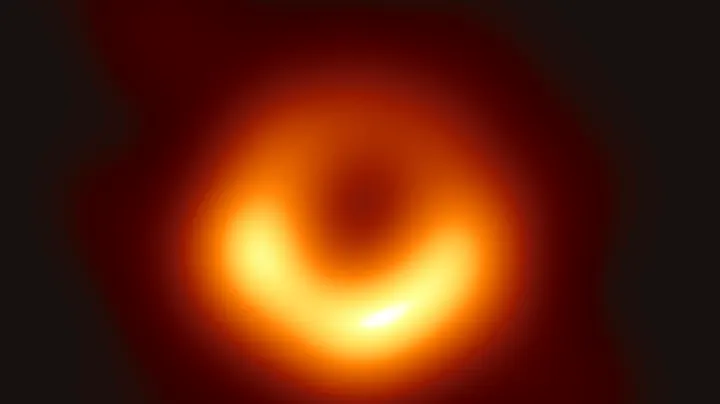
In 2019, astronomers unveiled the first-ever image of a black hole's shadow — a dark void encircled by a lopsided orange ring. This is the supermassive black hole at the heart of galaxy M87, 55 million light-years away. The ring isn't just glowing: one side is noticeably brighter than the other, like a campfire burning unevenly, with flames leaping higher on one side.
High Energy2026-01-191 minarXiv:2601.13356express
The Shadow of a Black Hole and Its Invisible Tail
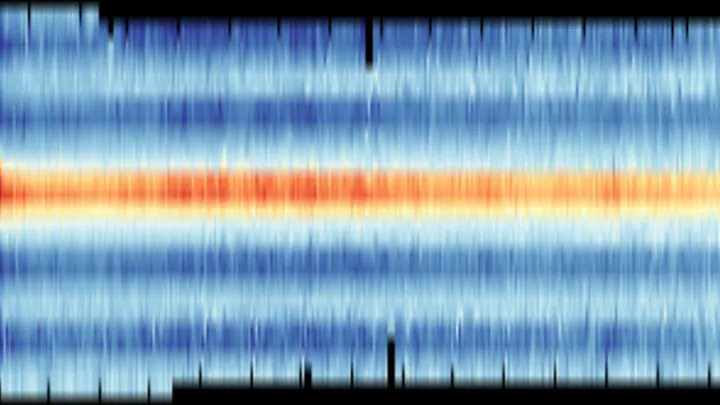
Radio telescopes scattered across the globe pick up waves from distant black holes. But two telescopes placed almost side by side see only a blurry blob — fine details are beyond them. Usually, such pairs are considered useless and discarded. But that's a mistake: even a blurry blob holds clues.
Galaxies2026-01-252 minarXiv:2601.17951express
The Quiet Engines of Galaxies
A quasar is a supermassive black hole at the center of a galaxy that devours matter and shines brighter than all the stars around it. Some of that energy goes into radio emission, which, it was thought, could heat or expel cold gas — the raw material for new stars.
Galaxies2026-02-122 minarXiv:2602.12325express
Cosmic Sprinter: Black Hole and Its Galaxy Grow in a Race
Imagine a city where a skyscraper and a huge park are being built at the same time. The skyscraper grows upward, and the park expands outward. Both processes are fast and get in each other's way, but in the end they are meant to become a single whole. That's the situation in galaxy GNz7q: a black hole grows at the center while new stars burst to life around it.
Galaxies2026-04-031 minarXiv:2604.02831express
The Dwarf Galaxy That Stopped Making Stars
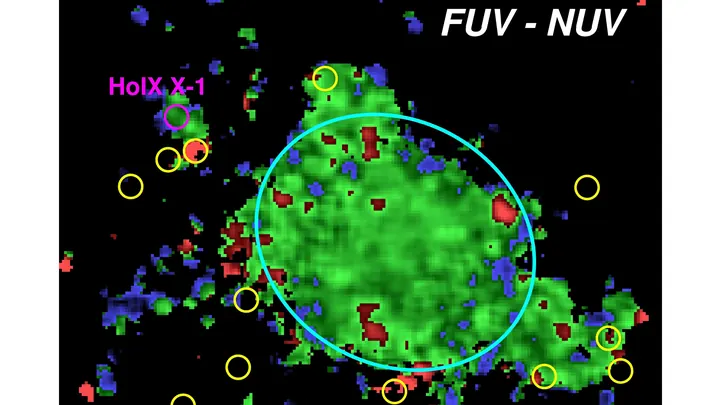
The galaxy Holmberg IX is like a city where construction of new houses suddenly stopped, even though building materials are everywhere. Astronomers peered into it with various telescopes and saw a strange picture: plenty of gas and heavy elements, but almost no dust. Usually, where there's gas, new stars are born, but here it's different.
Galaxies2026-04-111 minarXiv:2604.10287express
The Heart of the Milky Way Flickers in Polarized Light
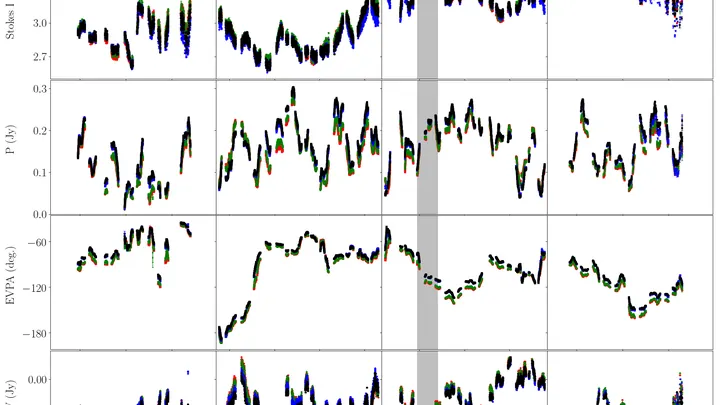
At the center of the Milky Way lies the supermassive black hole Sagittarius A*. It is four million times more massive than the Sun, but by cosmic standards it behaves quietly: it only occasionally flares up when it swallows a clump of gas.
High Energy2026-05-212 minarXiv:2605.22918express
Gusts of Wind Around a Black Hole
The beacon flares up and then nearly goes out, even though the lamp inside burns steadily. That is exactly what astronomers saw when they pointed their telescopes at the galaxy I Zwicky 1. At its center sits a supermassive black hole that devours gas and dust so greedily that a scorching disk forms around it, shining brighter than an entire galaxy.
Galaxies2026-06-013 minarXiv:2606.02773
Ruby Pupae: How Dark Matter Transforms the Face of Galaxies
Among the precious scatterings of the early Universe captured by James Webb, there are objects that resemble ruby beads scattered on black velvet. These are the 'little red dots' (LRDs) — compact sources with steep red spectra, inside which lurk supermassive black holes up to a hundred million solar masses.
Galaxies2026-06-033 minarXiv:2606.04711
Scarlet Invisible Cores: How Hydrogen Fog Conceals Black Holes
The James Webb Space Telescope peered into the era when the expansion of the Universe stretched the light of distant objects into the red, and found a scattering of strange sources — 'little red dots'. Their spectra broke the usual patterns: they are blue in the ultraviolet, but deep red in the optical, as if seen through a cherry veil.
High Energy2026-06-192 minarXiv:2606.21105express
Red Dots in the Early Universe Are Black Holes Seen Edge-On
Imagine a spotlight: if you look at it from the side, it glows dim red, but if you stare straight into it, it blinds you with white-blue light. That, according to new data, is exactly what the mysterious 'little red dots' in the early universe look like. They are giant black holes, objects with gravity so strong that even light cannot escape, turned edge-on to us.
Galaxies2026-07-173 minarXiv:2607.16104
Cosmic Pressure Cooker: Unraveling the Mystery of Little Red Dots
Ten billion years ago, the universe was speckled with strange crimson sparks. The JWST spotted them in images at distant redshifts — compact sources blazing like entire galaxies yet no larger than a tiny central region. Astronomers nicknamed them “little red dots.” Their nature long defied explanation.
Galaxies2026-08-302 minarXiv:2608.29893
Cosmic Census: Why Computers Can't See Galaxy Shapes
A census by body shape: that's one way to describe what astronomers did with 6348 massive galaxies. Instead of height and weight, they measured how concentrated the light is toward the center, how flattened the galaxy is, and how asymmetric its shape is. Then they ran the same measurements on galaxies from three computer models of the universe and compared the results.