The Cosmic Pearl String: How Galaxies Lost Their Dark Matter ✦
Original: "New Measurements of Distances to Galaxies in the NGC 1052 Field with the Hubble and James Webb Space Telescopes: Testing the Bullet-Dwarf Origin of the Trail"
Space telescopes confirmed: the chain of ghostly galaxies in NGC 1052 isn’t a trick of the eye — it’s a scar from a titanic crash that tore away an invisible cocoon.
Links in the knowledge graph 1
As if a string was ripped from a pearl necklace — galaxies without dark matter are frozen in a chain. In the NGC 1052 group, two gas clouds collided head-on: the dark framework shot through, leaving the starry beads behind. Webb accidentally captured this scene while hunting a runaway black hole. Now astronomers see in these orphans a key to unraveling dark matter.
🎯 DF2 first appeared on photographic plates in 1978, but its striking anomaly — an almost total lack of dark matter — was only realized forty years later, in 2018.
m_{\rm bar} - M_{\rm bar} = 5 \log_{10} \left( \frac{d}{10\,{\rm pc}} \right)
In the SBF method, the difference between the apparent and absolute fluctuational magnitude directly yields the distance. M_{\rm bar} is calibrated using old star clusters and is nearly universal.
M_{I}^{\rm TRGB} \approx -4.05
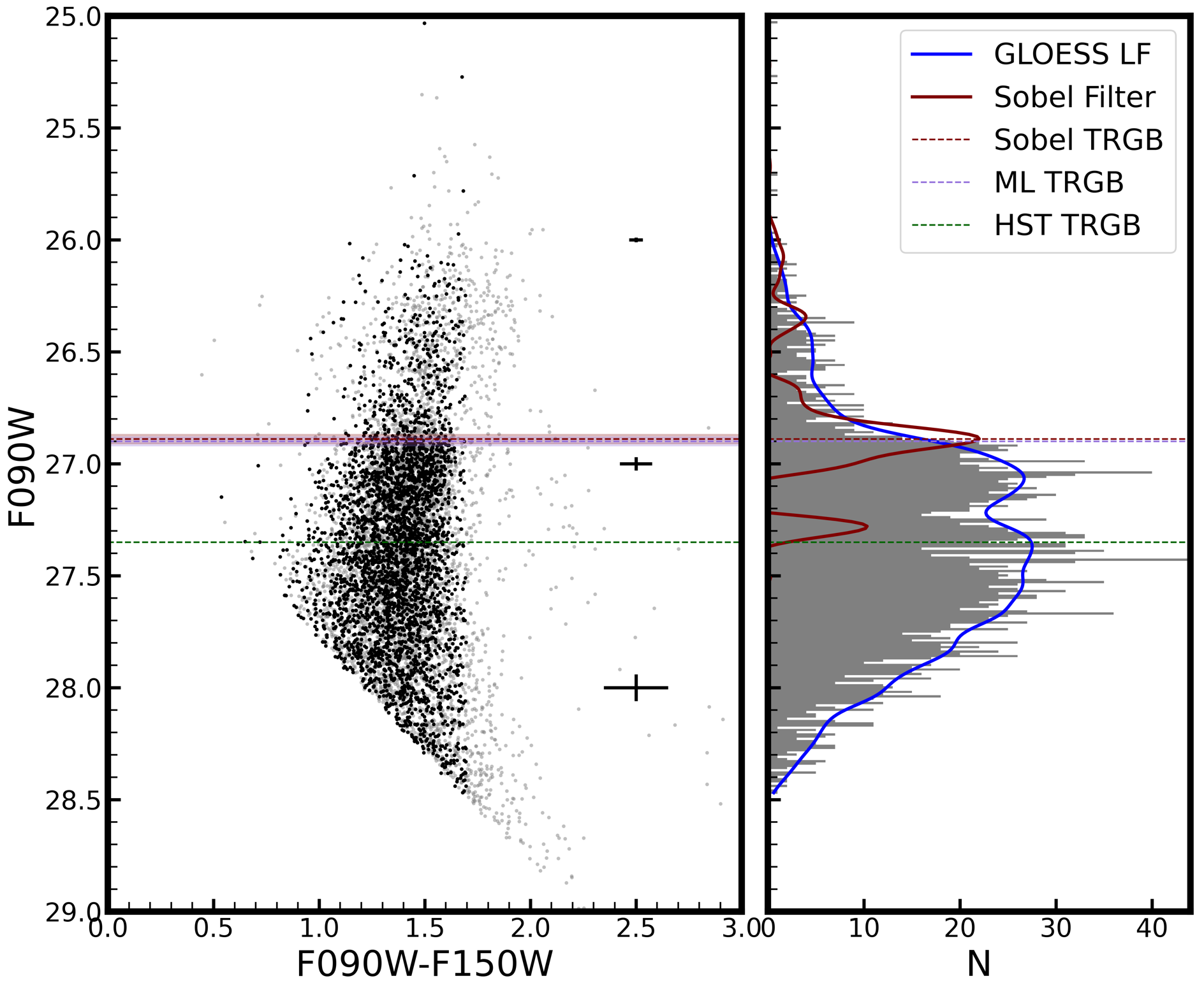
The tip of the red giant branch is the brightest point in a star's life before the helium flash. Its constant absolute brightness in the infrared I-band makes it an ideal standard candle.