Mini

The First Cry of a Merging Black Hole Confirms Hawking's Unbreakable Law

Original: "Measuring a Black Hole's Area Immediately after Merger: A Direct-Wave Test of Hawking's Area Law"
arXiv:2606.06592v1 · 2026-06-04 · CC0 · ⏱ 1 min · General Relativity High Energy
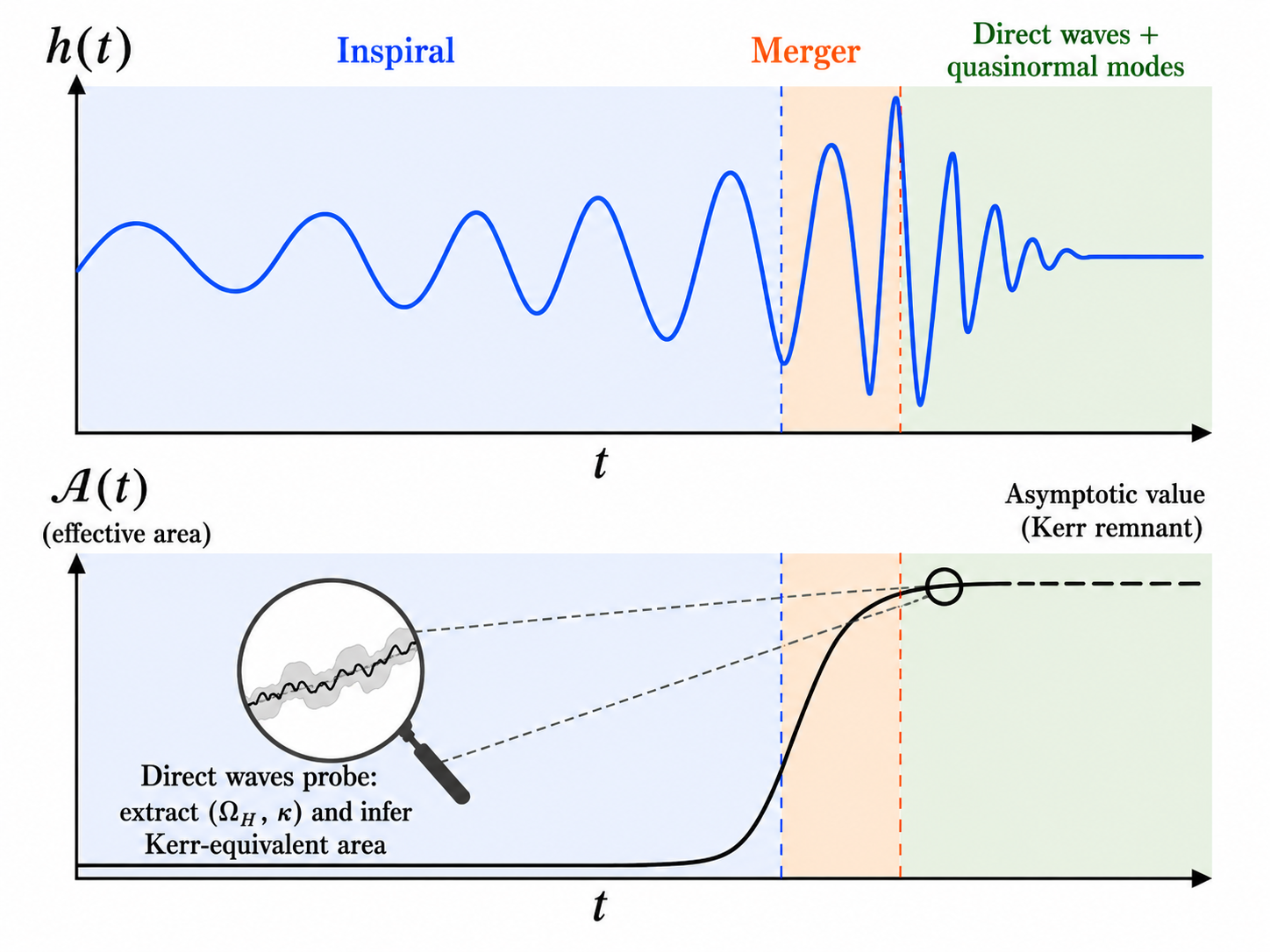
Direct gravitational waves from the GW250114 merger provide the first test of the Hawking–Bekenstein law on the non-decreasing horizon area.
Links in the knowledge graph 1

A black hole merger is a gravitational birth cry. In the first milliseconds, direct waves flare like ripples from a stone hitting water, carrying precise horizon parameters: spin and surface gravity. For GW250114, they showed the newborn hole's area is 40,000 km², and Hawking's law is unshakeable. Perhaps in these signals, the quantum scent of entropy will one day emerge.

🎯 The horizon area of the black hole GW250114 is 40,000 km², equal to the area of the Netherlands, but instead of fields and canals, it's nothingness where time has stopped.

🎬 In Interstellar, the heroes desperately tried to extract gravitational data from the vicinity of Gargantua; studying direct waves is a real embodiment of that dream: we are eavesdropping on the first whisper of a newborn horizon.

A = 8\pi M^2 \left(1 + \sqrt{1-a^2}\right)
This formula computes the horizon area of a stationary Kerr black hole from its total mass and spin.
\delta A = \frac{8\pi}{\kappa} (\delta E - \Omega_H \delta J)
Relates the change in horizon area δA to changes in energy δE and angular momentum δJ via the horizon angular velocity Ω_H and surface gravity κ.
Scientists
Christian DopplerD. B. McLaughlinDidier QuelozMichel MayorR. A. RossiterStephen Hawking
Tags
black hole gravitational waves LIGO entropy spectroscopy spacetime curvature Time dilation
Laws
second law of thermodynamicsDoppler effectHawking radiationgravitational lensingBekenstein-Hawking entropyEinstein field equations
Original: arXiv:2606.06592v1 · CC0 · bridge42worlds