The Cosmic Forge: Why GJ 3929 b Lost Its Air ✦
Original: "GJ 3929 b as the First Complete Rocky Worlds DDT Data Set"
The James Webb Telescope turned warm exoplanet GJ 3929 b into a bare rock: a dense atmosphere is ruled out, though a thin veil may still shroud the world.
Links in the knowledge graph 1
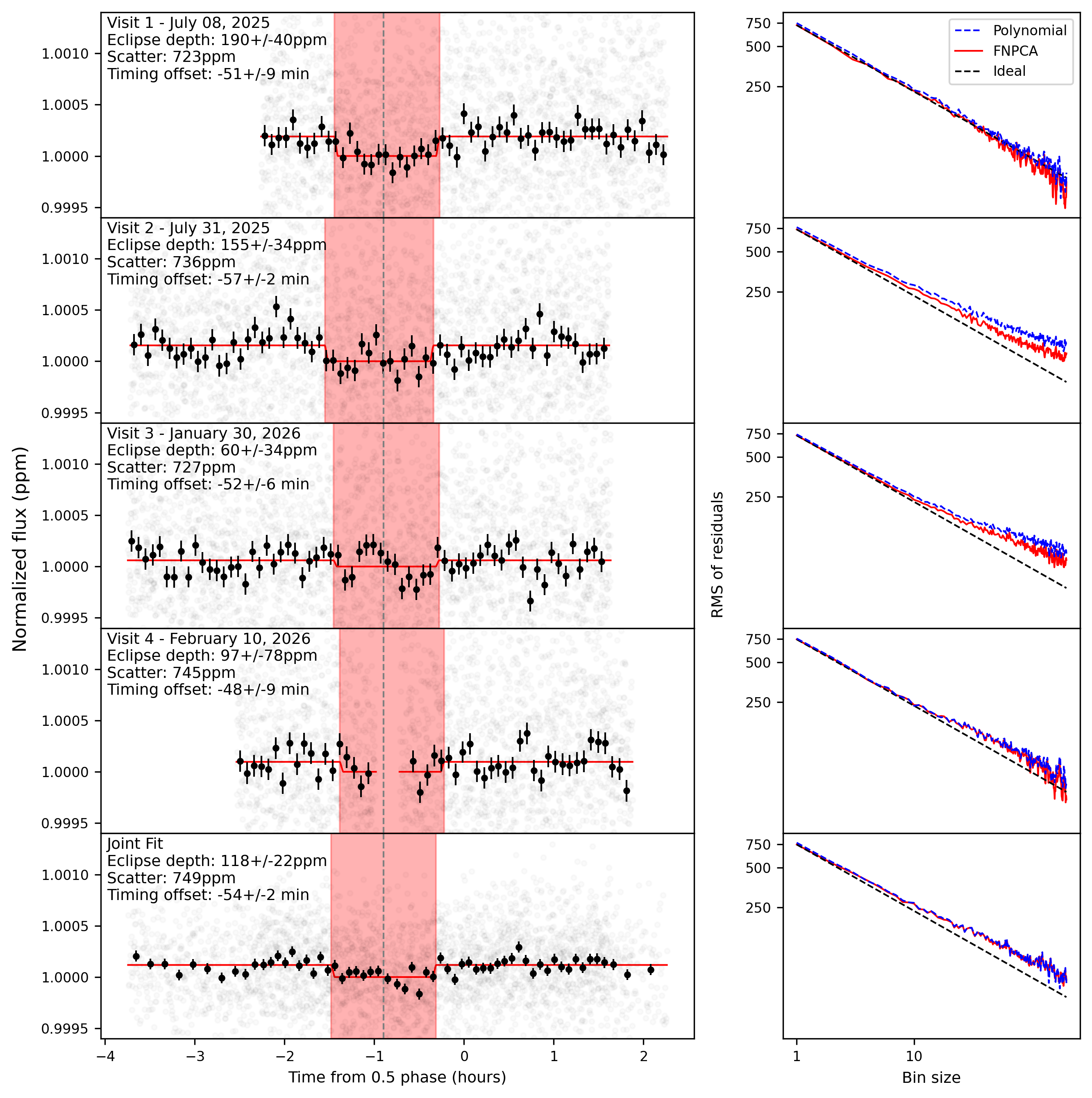
Bare rock, cooling within seconds after sunset—that's what a planet looks like when a blacksmith star has stripped off its atmosphere. The James Webb Telescope measured heat from GJ 3929 b: no dense envelope, just the echo from a hot dayside hemisphere. A desert offering no shelter for life. But the signal's variability hints that maybe a tenuous gas is fluttering. Such worlds are boundary posts along the cosmic shoreline. They will point out where in the Galaxy to search for biosignatures.
🎯 The dayside of GJ 3929 b is heated to 640 Kelvin—about the melting point of tin—and its orbital period is just 2.6 Earth days: a year there flashes by faster than a week on Earth.
e \\cos \\omega = \\frac{\\pi \\Delta t}{2P}
Eccentricity e and longitude of periastron ω are expressed through the observed eclipse shift Δt relative to phase 0.5 and orbital period P. For GJ 3929 b this shift is 54 minutes, indicating a slightly elongated orbit.