Popular

Exoplanets astro-ph.EP

151 articles

Interplanetary medium, planetary physics, planetary astrobiology, extrasolar planets, comets, asteroids, meteorites. Structure and formation of the solar system.

articles

The Invisible Conductor of the Super-Puff Planet System

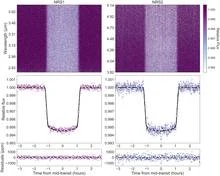
Meticulous 14-year observations of three 'cotton-candy' exoplanets in Kepler-51 yielded an unexpected surprise. The James Webb Space Telescope recorded the outermost known planet crossing the star's disk two hours ahead of schedule. The anomaly was only explained by adding an invisible fourth planet
arXiv:2410.01625 · 2024-10-02

Cosmic Hide-and-Seek: Webb Spots a Planet Near a Neighboring Star

At Alpha Centauri A, the nearest Sun-like star, Webb briefly picked up a dot called S1 — a planet candidate the size of Jupiter but with a temperature around –20°C. The object hid behind the star — its orbit lasts just 2–3 years, and there’s remarkably little dust around.
arXiv:2508.03814 · 2025-08-05

Born Misaligned: Why Planets Don't Dance to Their Star's Tune

Astronomers peeked into planetary cradles and saw: in a third of cases, the disk of gas and dust is tilted relative to its star. That means worlds are born on crooked orbits, not acquiring chaos later. The discovery explains why even our system is slightly lopsided, and promises a whole menagerie of
arXiv:2508.06488 · 2025-08-08

Life Without Water: Warm Salty Worlds

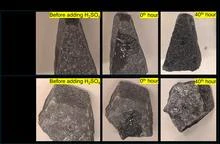
The search for life has typically focused on planets with liquid water. But hot exoplanets lack it. It turns out that ionic liquids—molten salts that don't evaporate in hellish heat—could substitute for water. Scientists created them in the lab from volcanic acid and organic matter. So, there may be
arXiv:2508.08437 · 2025-08-11

The Dance of Three Bodies: New Orbits in Chaos

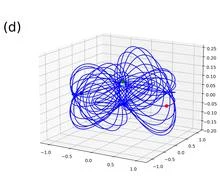
What the work is about: searching for periodic orbits in the three-body problem. What's new: over 10,000 three-dimensional orbits, many of them stable, including round dances and duets with a solo. Why it matters: these refined movements explain the stability of triple star systems and offer a glimp
arXiv:2508.08568 · 2025-08-12

Search for alien radio signals along the planetary plane

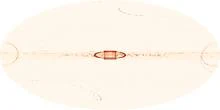
Analysis of 20 years of NASA antenna operations shows that the most powerful terrestrial radio signals are emitted in the plane of the Solar System. If extraterrestrial civilizations follow the same logic, their transmissions should be sought right there, especially when a planet passes in front of
arXiv:2508.15425 · 2025-08-21

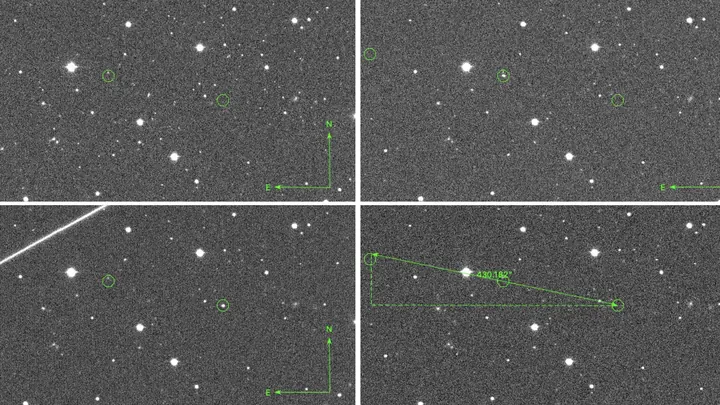
Interstellar Visitor with Carbonated Breath

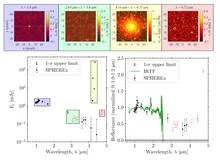
The SPHEREx telescope split the light of the interstellar wanderer 3I ATLAS into colors. It revealed that it's actively emitting carbon dioxide, while water ice absorbs some of the rays like tinted glass. All visible glow is a dusty shell, with the solid core inside being hundreds of times smaller.
arXiv:2508.15469 · 2025-08-21

White Dwarf Plays Hide-and-Seek with Cosmic Dust

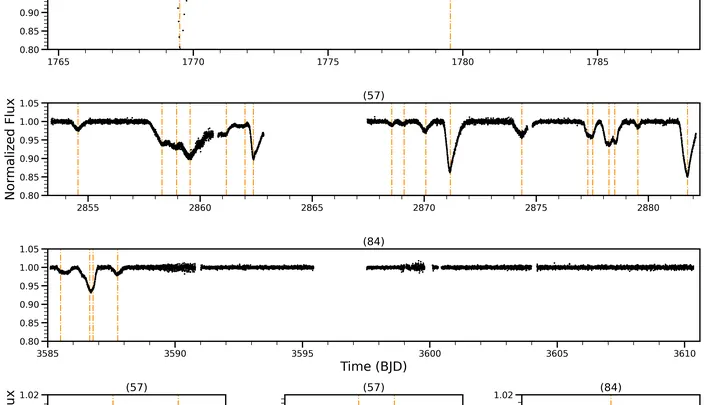
The white dwarf ZTF J1944+4557 plays hide-and-seek: its light dims by 30% every 4 hours 58 minutes. The dust particles here are no smaller than 0.2 microns and they dim all colors of the spectrum equally. But the strangest twist: the pattern of eclipses changes faster than the orbit, and sometimes a
arXiv:2508.18348 · 2025-08-25

How a baby planet drinks gas: a new discovery

A baby planet absorbing gas has been discovered around the star AB Aurigae. Light from hydrogen revealed its growth with a unique pattern—astronomers observed this for the first time in a planet embryo. This is direct evidence of how giants like Jupiter grow.
arXiv:2508.18351 · 2025-08-25

Clouds of Molten Rock on an Alien Planet

On the dayside of WASP-121b, where rocks vaporize from the heat, Webb’s telescope has spotted clouds of calcium titanate — the same white pigment used in paint. The discovery unveils the alchemy of ultra-hot worlds and how the host star gradually destroys its planet.
arXiv:2508.20022 · 2025-08-27

Carbon Giant by a Dead Star

A gas giant the size of Jupiter orbits the pulsar PSR J2322-2650b, heated to 1900°C. Its atmosphere is thick soot of carbon chains, not the usual water vapor. Carbon is a hundred times more abundant than oxygen compared to normal, and ten thousand times more than nitrogen. This doesn't fit the 'blac
arXiv:2509.04558 · 2025-09-04

Cosmic Rain Will Improve Hurricane Forecasts

An invisible stream of particles from space helps assess atmospheric density. Scientists have shown that even a small muon detector can significantly improve hurricane predictions. This method provides a three-dimensional picture unattainable with ordinary pressure sensors.
arXiv:2509.04627 · 2025-09-04

Why is the Moon so similar to Earth?

According to the leading hypothesis, the Moon was born from a collision between Earth and a planet called Theia. However, calculations predicted the Moon should consist mostly of Theia’s material, yet it’s almost a chemical twin of Earth. A new model cracks the paradox: if Theia’s interior was dense
arXiv:2509.06519 · 2025-09-08

The Hydrogen Secret of Young Sub-Neptunes

Scientists have built the first model of sub-Neptune interiors where hydrogen and rock are not separated but mixed. It turns out that in young planets, hydrogen makes up tens of percent of the mass and, as it escapes outward, slows down contraction. This explains why juvenile sub-Neptunes are larger
arXiv:2509.13320 · 2025-09-16

Sulfur in the Clouds: Webb Spies a Super-Neptune's Atmosphere

Webb studied the planet HAT-P-26 b and found water, carbon dioxide, and sulfur dioxide in its air. Previously, SO₂ had only been spotted on scorching hot giants or chilly sub-Neptunes; now it's clear that photochemistry works across a wide temperature range. A trend emerged: the higher the atmospher
arXiv:2509.16082 · 2025-09-19

Ultrahot planet hides under a gas blanket

Planet TOI-561 b orbits its star in less than a day and surprises with its lightness. Infrared observations revealed: the dayside isn't hot enough for bare rock. This means a thick gas coat holds in the heat, rewriting the rules for worlds around bright stars.
arXiv:2509.17231 · 2025-09-21

Failed Star Shakes Up a Phosphine Cocktail

Using Webb, astronomers peered into the atmosphere of the brown dwarf Wolf 1130C and found phosphine — a gas familiar from Jupiter. Its abundance is ten times higher than expected, pointing to vigorous mixing of layers, like in a planetary mixer. Now the boundary between giant planets and brown dwar
arXiv:2510.03916 · 2025-10-04

The Invisible Planet in a Carbon Cocoon: How a Hot Neptune Cheated Death

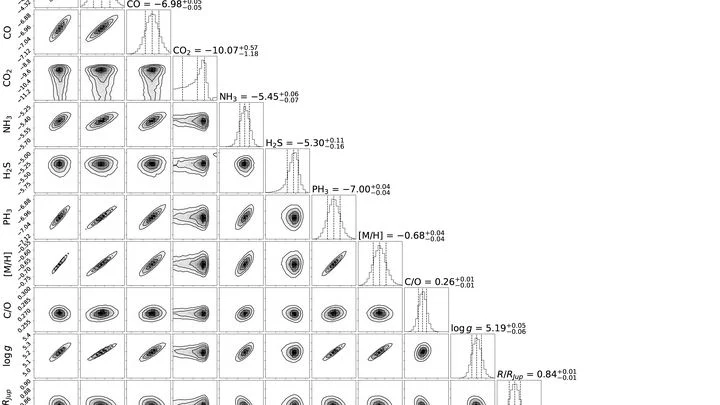
LTT-9779 b is a planet from the 'hot Neptune desert', a region where worlds usually perish. But it survived thanks to a carbon cocoon: an atmosphere of carbon monoxide and carbon dioxide turned out to be so thick that it doesn't evaporate even at 2000°C. On top of that, this exoplanet reflects 80% o
arXiv:2510.04863 · 2025-10-06

The Rings of Chariklo: A Dance of Dust and Light

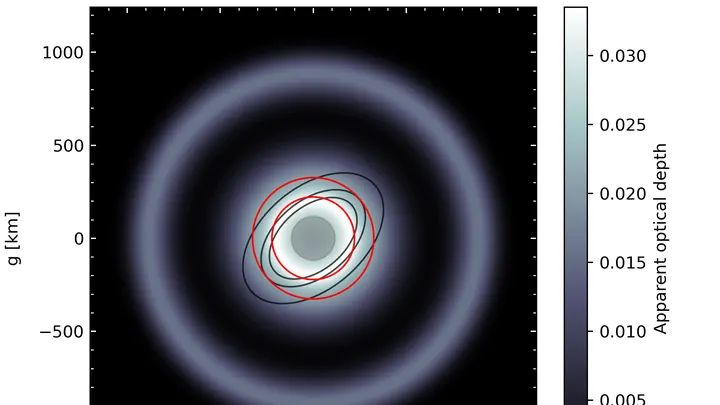
A cosmic dance of dust and light: the James Webb Space Telescope discovered that Chariklo's inner ring suddenly grew denser, while the outer one almost disappeared. Such adornments are likely short-lived and constantly renew themselves.
arXiv:2510.06366 · 2025-10-07

Hydrogen Atmospheres on Scorching Planets: The Volcano Secret

Scientists have figured out how rocky planets hold onto lightweight hydrogen: stellar tidal forces heat up their interiors, triggering non-stop eruptions. Volcanoes belch out gases, replenishing the loss. Such a planet gives itself away by an unusually thin hydrogen envelope — which the James Webb S
arXiv:2510.07378 · 2025-10-08

A Scorching Planet Grew Two Tails

Astronomers using the James Webb Space Telescope observed the exoplanet WASP-121b—a blazing gas giant circling perilously close to its star. It turns out the planet is losing its atmosphere: helium streams into space in two comet-like tails. One tail outruns the planet and plunges into the star, whi
arXiv:2510.09809 · 2025-10-10

Comets around an alien star reveal their sizes

A swarm of comets around RZ Psc briefly dimmed the star's light as they passed in front of it. The TESS telescope caught these dimmings, allowing astronomers to estimate the sizes of these icy bodies—between one and seven kilometers. The size distribution resembled the belt of icy boulders beyond Ne
arXiv:2510.09920 · 2025-10-10

Can the Moon have its own moon?

Astronomers investigated the possibility of submoons—small moons orbiting other moons. It turns out Earth could host an asteroid-sized submoon, while giant planets might have entire Earth-like worlds. But for life to emerge, a submoon needs about half of Earth's mass, and at that very mass its orbit
arXiv:2510.10344 · 2025-10-11

Icy Wanderer Chiron Encircled by Rings and a Disk

During an occultation of a star by Chiron, telescopes caught a series of blinks—three rings and a disk gave themselves away. The outermost ring lies in a zone where moons should be born, not rings. Comparison with old data shows the structure is changing, and we are witnessing the construction of a
arXiv:2510.12388 · 2025-10-14

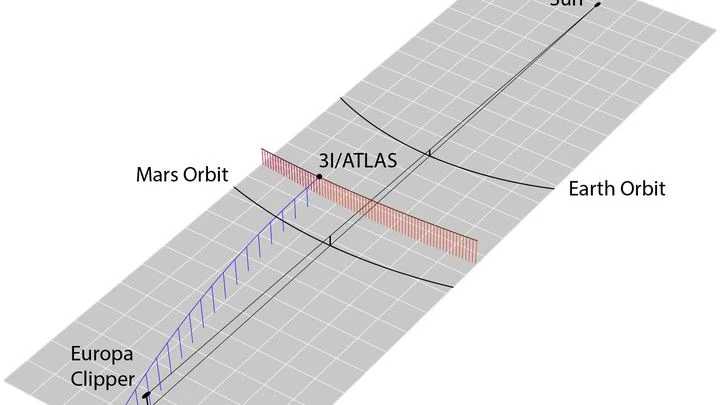
Two Probes Will Dive into the Tail of an Interstellar Comet

A comet from another star system will pass by two Earth spacecraft. In late October, they will spend several days in its tail—this is the first chance to directly study extrasolar material.
arXiv:2510.13222 · 2025-10-15

Coin-sized camera spots distant planets

Scientists pointed the Japanese probe's navigation camera at alien suns and saw giant planets briefly dimming their light. Even such tiny optics, with clever data processing, can rival space telescopes. This trick promises to find planets that have been hiding for years.
arXiv:2510.14229 · 2025-10-16

Earth's Shadow Hunts for Alien Probes

Astronomers tested the idea of using Earth's shadow to detect alien probes. An automated telescope captured brief light flashes near the shadow's edge — objects not listed in any catalog. This could change the approach to the search for extraterrestrial intelligence.
arXiv:2510.17907 · 2025-10-19

The Hunt for Moons of Rogue Planets

Astronomers analyzed data on the orphan planet WISE 0855 — a dim, cold ball not far away. For 11 hours, Webb watched its light, trying to spot the shadow of a moon. No direct discovery happened, but the method proved its worth. If many rogue planets have Titan-sized moons, we will soon find them.
arXiv:2510.24575 · 2025-10-28

How to Find Life: Look for Molecular Diversity

To find life beyond Earth, you don't need to guess what it's made of. A new method evaluates not specific molecules, but the overall chemical diversity of a sample. Living organisms typically produce a rich cocktail of amino acids (the building blocks of proteins) and fatty acids, while non-living n
arXiv:2511.00525 · 2025-11-01

Lunar Heating: How Tides Prolonged Earth's Magma Ocean

After the impact that created the Moon, Earth became a liquid ball. Gravitational 'kneading' heated the planet, prolonging the magma ocean's life from 30 to 500 million years—depending on oxygen levels. Water vapor trapped heat, and weak tides enriched the air with hydrogen. This paints a picture of
arXiv:2511.00952 · 2025-11-02

Planetary pressure cooker: how gas and rock give birth to oceans

Astronomers have found many rocky planets wrapped in a thick layer of hydrogen. Experiments with pressures of 600,000 atmospheres and heat above 4000°C have shown for the first time: deep inside, hydrogen pulls oxygen from rust (iron oxides) and turns it into water. This unseen chemical factory can
arXiv:2511.01351 · 2025-11-03

Warm Moons of Rogue Planets

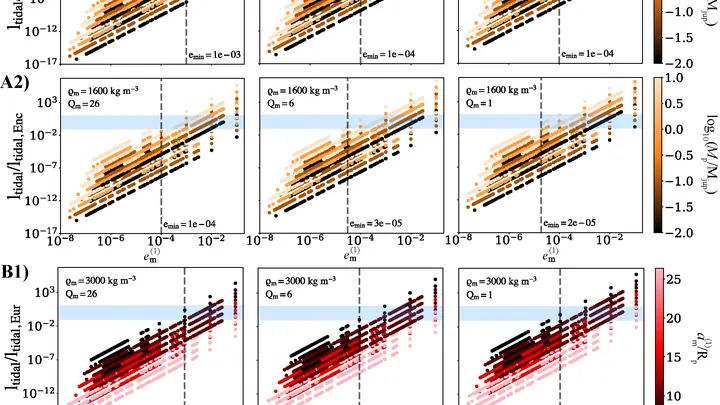
Simulations show that after a planet is ejected by a supernova explosion, all its moons are left on slightly elongated orbits. This triggers constant internal heating — as if the planet endlessly kneads its moons. In 12–15% of cases, the heat is enough for subsurface oceans, like those on Europa and
arXiv:2511.03392 · 2025-11-05

The Moon — a Giant Gravitational Bell

Computer modeling has shown that the Moon's uneven terrain and crust thickness turn its surface into an amplifier of spacetime ripples. In the region of the South Pole–Aitken basin, the signal is amplified dozens of times, paving the way for future lunar observatories capable of detecting the merger
arXiv:2511.04067 · 2025-11-06

How Hydrogen and Magma Create Water Deep Inside Planets

By recreating the interiors of sub-Neptune planets, scientists discovered that under high pressure, hydrogen interacts with magma, pulling out oxygen. Water forms, and its fraction can reach tens of percent. So water doesn’t always come from icy outskirts — it’s born right on the spot. This changes
arXiv:2511.06507 · 2025-11-09

Which Stars Can Give Birth to Life? The Answer's in the Color

Scientists have figured out that not every star is fit for 'cooking' life. By comparing the ultraviolet balance of different suns, they determined: the ideal recipe is found in yellow G-class stars like the Sun. Only there does the ratio of soft to hard radiation allow molecules to complexify into i
arXiv:2511.08624 · 2025-11-09

New Schedule for Faraway Worlds

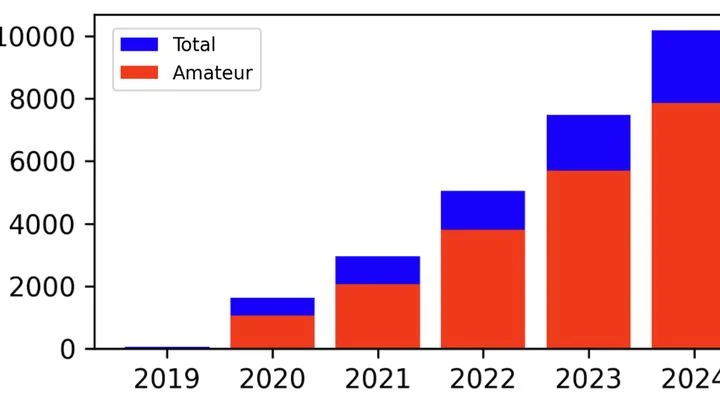
Scientists collected tens of thousands of observations from ground-based and space telescopes to nail down when planets pass across the faces of their stars. It turned out that 45% of the planets needed adjustment. This will help schedule observations on major telescopes like the James Webb. Amateur
arXiv:2511.14407 · 2025-11-18

Shadow or Mirage: Hunting a Moon Around a Scorching Jupiter

Analysis of a single transit with James Webb pointed to a possible moon around exoplanet Kepler-167e. But a slow brightness drift scrambled the clues: it could be a starspot. A new transit in 2027 will settle the case.
arXiv:2511.15317 · 2025-11-19

Webb Spots Chemical Weather on Brown Dwarfs

Astronomers studied the twinkling of the binary brown dwarf system WISE 1049AB. For the warmer component, light from methane and carbon monoxide fluctuated more than from water, which can't be explained by clouds. A new mechanism—chemical instability—has been discovered. A 3D map of atmospheric wave
arXiv:2511.15667 · 2025-11-19

Rusty Heart of an Interstellar Comet Makes It Shine

The second known interstellar object, comet 3I/ATLAS, is rich in water and metals. As it approaches the Sun, its ice melts and water triggers the corrosion of metallic dust. Chemical reactions create a luminous envelope unique in composition. Such visitors from other stars help us study the far reac
arXiv:2511.19112 · 2025-11-24

The Moon Is Older Than Its Rocks: Why 4.35 Billion Years?

Earth's tides kept the Moon from solidifying for a long time, then everything snapped into place at once. This explains the uniform rock age and the mystery of the Moon's two hemispheres.
arXiv:2511.19946 · 2025-11-25

Dust Storms on a Rogue Planet

VHS 1256B is a giant planet, drifting alone in the dark. Its brightness swings by 40% due to global storms of scorching sand. Data from the James Webb telescope and computer models showed that dust clouds blanket the planet entirely, explaining the strange changes in its light and color. This discov
arXiv:2511.23163 · 2025-11-28

Mission: Catch a Guest from Another Star System

The Comet Interceptor spacecraft will hide in a gravitational 'niche' lying in wait for a comet. Scientists propose using the same tactic for sudden interception of objects arriving from other stars. For the first time, we'll get a look at the material that builds the universe beyond the Solar Syste
arXiv:2512.00492 · 2025-11-29

Invisible Black Holes: Planets or Something Else?

Scientists reexamined data from the hunt for planets around other stars and identified objects detectable only through gravity. Six suspicious 'planets' and two cases of light bending might actually be primordial black holes. They don't glow, they don't eclipse stars, but they could be the key to da
arXiv:2512.03118 · 2025-12-02

Deadly Resonance: How Stars Toss Out Planets

Tight binary stars rarely have planets. The reason is gravitational resonance. When two stars draw close, their spin falls into rhythm with a planet’s orbit, like pushes that rock a swing. The orbit stretches, and the planet either flies off into space or crashes into a star. So the very process of
arXiv:2512.03940 · 2025-12-03

Worlds with Eternal Magma Oceans

Scientists modeled the thermal evolution of sub-Neptunes and found that 98% of these worlds probably harbor a permanent magma ocean under their hydrogen atmosphere. This explains why the most common planet type in the galaxy stays hot inside, even though they were thought to have solidified long ago
arXiv:2512.05816 · 2025-12-05

Wiretapping a Star: How a Naked Planet Helps Find Air

The James Webb telescope is hunting for an atmosphere on TRAPPIST-1 e, but the star's flares get in the way. Scientists found a fix: record the noise using the neighboring airless planet TRAPPIST-1 b, then subtract it from the main signal. Early tests show the method works on quiet days, but a power
arXiv:2512.07695 · 2025-12-08

Why Do Hot Jupiters Swell?

Gas giants around alien stars turned out to be more inflated than expected. New modeling shows that heating comes from the surface, not the interior, reshaping our understanding of planetary weather.
arXiv:2512.08932 · 2025-12-09

A Nearby Supernova: Recipe for Rocky Planets

Astronomers have found an elegant mechanism: the supernova doesn't destroy the planetary cradle but sends rays that create the necessary radioactive atoms right inside the disk. At a distance of one parsec, it works perfectly. This discovery makes rocky planets common.
arXiv:2512.09660 · 2025-12-10

The Moon Assembled from a Swarm of Earth's Fragments

Scientists proposed a model where the Moon assembled from debris of Earth's mantle knocked out by numerous asteroids. The debris mixed with dust in a circum-Earth disk and gradually clumped together. This explains why the Moon is iron-poor. The same mechanism works for Charon and binary asteroids.
arXiv:2512.22375 · 2025-12-26

Plant Life Could Last Over a Billion Years

The study estimates how much longer plant life will persist on Earth as the Sun brightens. It factors in seafloor weathering and random changes in CO₂ emissions. The research is crucial for understanding our biosphere's future and searching for life on other planets.
arXiv:2512.24538 · 2025-12-31

A Cosmic Wanderer Steps on the Scales for the First Time

Free-floating planets, untethered to stars, long remained a mystery: without an exact distance, their mass couldn't be measured. By combining telescopes on Earth and in space, scientists calculated the distance to object KMT-2024-BLG-0792 and found its mass—just 0.22 Jupiter masses. It turned out to
arXiv:2601.00057 · 2025-12-31

Rogue Planet Gave Itself Away with Warped Light

Astronomers spotted lone planet KMT-2024-BLG-0816 when, like a cosmic lens, it amplified the light of a background star. The planet passed so close to the line of sight that it was possible to see how the brightness of different edges of the stellar disk changed. They didn't find a host star nearby,
arXiv:2601.00325v1 · 2026-01-01

Star Counterfeiter: How a Twin Mimicked a Planet

Astronomers mistook a dip in star brightness for a planet transit, but careful scrutiny revealed an indistinguishable pair of suns. The culprit: a companion star hiding in the glare of the primary. A story of how easy it is to mistake a shadow for reality.
arXiv:2601.02171v4 · 2026-01-05

Catching an Interstellar Wanderer with a Solar Sling

Interstellar object 3I/ATLAS is racing away, and a regular rocket can't catch it. But if you dive toward the Sun and fire the engines at peak speed, gravity acts like a giant sling. This maneuver gives a chance to reach the target in a few decades, but the probe must survive hellish heat.
arXiv:2601.02533v2 · 2026-01-05

The Red Dwarf Oxygen Trap

Around dim stars like TRAPPIST-1, photosynthesis barely produces oxygen—visible light is scarce. Infrared bacteria, on the other hand, thrive, gobbling up nearly all the available energy. As a result, an oxygen atmosphere may never form, and complex life never arise.
arXiv:2601.02548v1 · 2026-01-05

The Stumbling Dance of Two Planets Around TOI-4495

Around TOI-4495, two planets orbit wrapped in thick gas blankets. Their orbits are almost tuned—two revolutions of the inner planet for one of the outer—but exact synchronization is absent. The elongated path of the inner planet persists for billions of years thanks to the unusual elasticity of its
arXiv:2601.02665v1 · 2026-01-06

Dance of the Invisible Giants: Gaia Finds a 'Desert' of Brown Dwarfs

Astronomers are reimagining the map of nearby stellar pairs. The zone of tight orbits around Sun-like stars was once called the 'brown dwarf desert,' thought to hold few objects heavier than planets but lighter than stars. Fresh Gaia data reveal that many stars are dancing with unseen companions — a
arXiv:2601.03539v1 · 2026-01-07

The Icy Magnets of Uranus and Neptune

Deep inside Uranus and Neptune, monstrous pressure transforms ice into a substance where an oxygen framework is threaded with flowing protons. Temperature differences within the planet set these protons in motion, generating electric current and a magnetic field. This explains the weird magnetospher
arXiv:2601.03659v2 · 2026-01-07

Smashing a moon slowed down the main asteroid

The DART probe's impact with moon Dimorphos caused the main asteroid to spin slower. Measurements showed that Didymos's day lengthened by 0.18 seconds, and the asteroid itself became more flattened. It's the first time a kinetic impactor has reshaped and respun a celestial body.
arXiv:2601.04793v1 · 2026-01-08

Why Cold Stars Lead Scientists Astray

The light of TRAPPIST-1 revealed that standard models were wrong: in its cold atmosphere, molecules collide differently, hiding the chemical composition. Refining the rules will help us better understand the star itself and its planets.
arXiv:2601.05313v1 · 2026-01-08

New Arid Meteor Shower: How a YouTube Camera Helped the Discovery

Hunting for a rare celestial phenomenon is like setting up a camera trap in a dense forest. In the fall of 2021, astronomers aimed a camera with high light sensitivity at the dome of the Subaru Telescope into the empty sky above Maunakea, trying to catch the predicted but elusive Arid meteor shower.
arXiv:2601.05412v1 · 2026-01-08

Planet's Air: Recipe from a Star

The study showed: at the edges of habitable zones, carbon monoxide accumulates to dangerous levels due to a breakdown in chemistry. And formaldehyde, important for life, forms better around hot stars. This will help select planets for detailed study.
arXiv:2601.05480v1 · 2026-01-09

How Giant Planets Kept Their Rapid Spin

Measurements of 32 celestial bodies revealed that giant planets spin almost at the brink of tearing apart because their gaseous cocoon barely slowed them down in their youth. Brown dwarfs, on the contrary, lost spin due to a denser disk. Moreover, planets don't depend on proximity to a star, while c
arXiv:2601.05976v3 · 2026-01-09

Icy Visitor from Another System

ISO 3I/ATLAS is the second known interstellar object. As it approached the Sun, it bared its interior: its icy shell evaporated, revealing a mix of water, carbon dioxide, and carbon compounds. These findings help us understand the chemical makeup of other planetary systems.
arXiv:2601.06759v2 · 2026-01-11

Lava Oceans of Exoplanets

A planet on a slightly egg-shaped orbit swings in close to its star, then pulls away. The changing gravitational tug heats its guts, melting rock into a lava ocean. Tidal waves stir it, spawning wandering hot spots. This makes the planet's glow flicker unpredictably—and sometimes the entire world tu
arXiv:2601.07080v2 · 2026-01-11

The Climate Swings of Ancient Mars

A new study explains how Mars could have had water with a faint Sun: the climate swayed between long freezes and brief thaws, leaving behind riverbeds.
arXiv:2601.07159v2 · 2026-01-12

When the Sun Dived into a Cloud

When the Solar System enters dense interstellar clouds, the Sun's protective bubble shrinks. The intensified flow of cosmic rays spawns beryllium-10 in the atmosphere, which settles in ocean sediments and ice. Studying these layers uncovers when and which clouds the Earth encountered, letting us rea
arXiv:2601.07983v2 · 2026-01-12

The Colors of Life on Distant Planets

Scientists have figured out how to search for life on other planets by looking for colored traces on the surface. These paints are left by living organisms. The HWO telescope will spot such color signatures even if the air shows no signs of life — for instance, when it’s ancient and doesn’t produce
arXiv:2601.08883v1 · 2026-01-12

Titan's Age: Icy Moon Turns Out Younger Than Thought

A new study factored in that Titan's crust is a layered cake of water ice and methane clathrate, and calculated the surface age: just 300–340 million years. Icy volcanoes and methane rains constantly smooth out craters, like an artist reworking a canvas.
arXiv:2601.08306 · 2026-01-13

How to Find Water in a Martian Rock Without Breaking It

Using neutron tomography—like an X-ray for rocks—the NWA 7034 meteorite revealed sponge-like minerals stuffed with water. Their structure matches what the Perseverance rover sees in Jezero Crater: ancient Martian crust likely stored water everywhere in the form of rust.
arXiv:2601.08390 · 2026-01-13

The Mystery of Asteroid Kamo'oalewa: Why It's Not from the Moon

Astronomers have unraveled the origin of Kamo'oalewa. The lunar shard hypothesis hasn't held up: there are dozens of times more similar bodies from the asteroid belt. The Chinese Tianwen-2 mission will settle the matter.
arXiv:2601.08923v1 · 2026-01-13

Cosmic Billiards: How Planets Become Wanderers

Gravitational kicks from distant giant planets knock small rocky worlds (super-Earths) near the star out of the system. The ejected planet becomes a lonely wanderer. This same mechanism can shuffle the orbits of the remaining planets and even send them plunging into the star.
arXiv:2601.09835v2 · 2026-01-14

The Moon as a Gravitational Wave Detector

The first accurate model of the Moon's response to gravitational waves reveals: uneven crust amplifies the signal tenfold. Energy transfers into extra vibration modes — like a bell with irregular walls. This will help pinpoint the ideal location for a lunar detector capable of catching the 'echo' of
arXiv:2601.16567 · 2026-01-23

Rogue Moons: Warmth Without a Star

Scientists have found: moons around rogue planets can stay warm and wet for billions of years. A dense hydrogen atmosphere traps heat, and tidal forces warm the interior. These conditions are suitable for the emergence of life, including the formation of RNA.
arXiv:2602.05378 · 2026-02-05

Saturn's Rings: Trace of a Cosmic Collision

About 300 million years ago, Titan’s migration triggered a cosmic accident: its ancient moon crashed into it, giving birth to Hyperion and the rings, and also explaining the tilt of Iapetus's orbit.
arXiv:2602.09281 · 2026-02-09

A Waterfall of Planets: The Mystery of the Vanishing Water Worlds

The model divides exoplanets into rocky and water worlds. Water worlds with steam atmospheres nicely account for the size gap, but at three Earth radii, their numbers plummet — like water over a cliff. This points to the inevitable capture of light gases by large planets.
arXiv:2602.11923 · 2026-02-12

Cosmic Oven: How Heat Baked the Building Blocks of Life on Jupiter's Moons

In the gas-and-dust disk around a young Jupiter, like a giant oven, slow frictional heating cooked up complex organics — precursors to life. Ultraviolet light only broke molecules apart. These substances got frozen into the icy moons and may still be waiting in their oceans. The JUICE and Europa Cli
arXiv:2602.14334 · 2026-02-15

Meteorite craters — a bowl for the first life

Experiments revealed how in the shallow crater ponds of young Earth, lipid bubbles hid from harmful ultraviolet radiation. Gathering into a dense layer at the bottom, they exchanged materials and divided — a crucial step toward the first cell.
arXiv:2602.18510 · 2026-02-19

Martian Ice: A Find Just a Meter Deep

Mars climate modeling showed that subsurface ice at mid-latitudes is remnants of ancient deposits from when the planet's axis was more tilted. The ice sublimated, and dust formed a protective crust. Calculations match the data: ice deposited 630,000 years ago lies at a depth of 25–150 cm. This is yo
arXiv:2602.18847 · 2026-02-21

Mountains on Exoplanets Prevent Eternal Winter

On tidally locked planets, mountains and hills can stave off a permanent ice age. They disrupt air currents, transporting moisture to the dark side, where clouds blanket the surface and trap heat. Even modest relief can transform an ice ball into a world with liquid water.
arXiv:2602.20155 · 2026-02-23

Why Red Dwarfs Have Fewer Chances for Photosynthesis

The study calculates how much energy plants can extract from the light of different stars. Cool red dwarfs lack enough suitable light particles for efficient photosynthesis. This reduces the likelihood of complex life. For Earth, the results match real-world data.
arXiv:2602.20789 · 2026-02-24

How a Swallowed Planet Spun Up a Star

The star GJ 504, similar to the Sun, spins too fast for its age. After devouring a Jupiter-sized planet, it gained extra angular momentum and regained its magnetic youth. A similar case with HD 75332 shows that stellar cannibalism is not uncommon.
arXiv:2602.22979 · 2026-02-26

Why a Tent on Mars Beats a Full-Blown Planetary Makeover

Making Mars warm and with breathable air would require energy comparable to all of Earth's factories working for hundreds of years. The mirrors needed for heating would cover an area the size of Africa. Instead of a global overhaul, scientists propose building massive dome-tents over cozy valleys —
arXiv:2603.00402 · 2026-02-28

Star Superflares: Warming Planets and Synthesizing Amino Acids

In the lab, a mix of carbon dioxide and nitrogen was bombarded with particles, mimicking the young Sun's era. This produced nitrous oxide and glycine. Nitrous oxide, like a lid on a pot, trapped heat—so early Earth didn't freeze. The same mechanism could warm distant exoplanets where stellar heat is
arXiv:2603.18206 · 2026-03-18

Interstellar Comet: Water 14 Times Heavier Than Earth's

Spectroscopic analysis of comet 3I/ATLAS by Webb revealed an anomalously high deuterium content. This chemical marker suggests the comet was born in the bitter cold of a distant star system.
arXiv:2603.20445 · 2026-03-20

How Bacteria Battle on Water Planets

Researchers applied Earth’s competition models to bacteria on hycean planets—worlds with deep oceans and hydrogen skies. Light-eating microbes grab the surface, like weeds taking over a garden. Viruses can crash the system or boost diversity. On worlds with one side always facing their star, life is
arXiv:2603.22491 · 2026-03-23

Enceladus's Ocean — A Perfect Heat Pump

Water salinity drives Enceladus's ocean currents. When salt concentration is very low or very high, circulation speeds up, carrying heat to the poles and thinning the ice. This finding narrows down the ocean's possible properties and brings us closer to finding life.
arXiv:2603.22602 · 2026-03-23

How Sound Helped Find a Space Rock Over Alaska

A meteor missed by satellite cameras was reconstructed using sound and vibrations. A low-cost alternative for polar latitudes, where the never-setting sun blinds optics.
arXiv:2603.22630 · 2026-03-23

Planetary Orbits: Not Random, But Music

Analysis of exoplanet surveys showed that their orbits are grouped, not scattered randomly. It's like piano keys: there are preferred positions and gaps in between. The cause is standing waves in the gas-dust disks that dictate the birthplaces of worlds. The discovery changes our view of planetary s
arXiv:2604.08428 · 2026-04-09

Secrets of the Lunar Garden: How Meteorites Mix Cosmic Dust

The Moon looks dead, but its surface is constantly refreshed by meteorite impacts. A new mathematical model recreated this process as a fascinating form of cosmic gardening. It accurately predicted the distribution of rare atom varieties from supernovae. In the future, by studying lunar samples, we’
arXiv:2604.09524 · 2026-04-10

The Sun Conducts Ice Ages

New research settles an old debate: ice ages are controlled not by complex chemistry but by sunlight. A simple model links the flow of solar heat to ice volume, accurately reproducing 800,000 years of data. The ocean, like a mute, dampens the slow 400,000-year cycle, making the 100,000-year cycle th
arXiv:2604.12143 · 2026-04-13

Hydrogen Made the Moon's Core Lighter

Scientists discovered that hydrogen seeps into molten iron, making it less dense. Under the conditions of the Moon's core, iron absorbs up to 1.2% hydrogen, reducing its density by 9% — exactly the amount needed to explain data about the Moon's oscillations. This finding overturns our understanding
arXiv:2604.12222 · 2026-04-14

Asteroids Instead of Trucks: Metal for Mars

Metal-rich asteroids could become a source of raw materials for Martian colonies. Scientists have calculated routes to the nearest ones and a way to produce fuel on site. This will make it possible to build homes and vehicles right on the Red Planet.
arXiv:2604.18664 · 2026-04-20

How Stellar Flares Change the Atmosphere of Faraway Planets

The study examines how radiation from stellar flares affects the air of young planets. Scientists modeled a year of chemical changes and found that moderate flares have a strong impact. Atmospheres with high water vapor content are particularly vulnerable. This discovery is important for correctly i
arXiv:2604.20325 · 2026-04-22

A Planet’s Breathing Unveils the Mystery of Life

Usually, life on distant planets is sought by telltale gases in the atmosphere. But their buildup isn’t only from life. A new approach gauges not the concentration but the rate gases stream from the surface — like figuring out if bread is baking not by the smell, but by the waft of heat from the ove
arXiv:2604.21848 · 2026-04-23

The Universe Sings: Resonance of Dark and Ordinary Matter

Scientists have shown that different speeds of dark and ordinary matter create a gravitational resonance. Like a bow on a string, it amplifies sound waves in ordinary matter, explaining the longevity of spiral arms and gas heating. This makes it possible to 'hear' dark matter by its seismic imprint.
arXiv:2604.22665 · 2026-04-24

How Comets Revealed Dark Matter's Secret

When invisible black holes pass through the Oort Cloud, they leave a trail: comets fly off in all directions, some even falling toward Earth. By comparing the actual frequency of comet appearances with calculations, scientists found that black holes a thousand times the mass of the Sun make up only
arXiv:2604.22961 · 2026-04-24

Atmosphere found on a small icy body beyond Neptune

Astronomers have for the first time found an atmosphere on a small object (612533) 2002 XV93 in the Kuiper Belt. Previously, it was thought that only large bodies could retain gases, but this icy ball 250 km in diameter proved otherwise. The discovery forces a fresh look at the hidden activity of sm
arXiv:2605.02243 · 2026-05-04

Mars's dense layer reveals the fate of rocky planets

When a young planet is covered in scorching liquid rock, heavy particles like iron want to sink. But the mantle melts from below, and light droplets float up, churning the ocean. On big Earth, the 'stirring' was strong—no layers formed. Mars is smaller, its rocky soup was shallower and calmer, so ir
arXiv:2605.04840 · 2026-05-06

The Secret of the Metallic Comet from Another Star System

After its close approach to the Sun, comet 3I/ATLAS ejected an abnormally large amount of nickel and iron into its tail. These metals hid deep inside as volatile compounds with carbon monoxide. When heat seeped beneath the surface, the compounds evaporated, freeing the atoms. This mechanism unveils
arXiv:2605.07652 · 2026-05-08

Moon Bell: How Gravitational Waves Unveil Lunar Secrets

Scientists have found a way to peer into the Moon's interior by using it as a detector of gravitational waves. Ripples in spacetime passing through the satellite cause it to tremble almost imperceptibly. By analyzing these tremors, the internal structure can be reconstructed ten times more precisely
arXiv:2605.13960 · 2026-05-13

How to Hear a Planet Near a Dead Star

Simulations show that a planet buffeted by a pulsar's wind generates radio waves. This means exoplanets around neutron stars can be detected by their radio glow. The method has been tested on the system PSR J0636+5129 b.
arXiv:2605.14077 · 2026-05-13

How Not to Mistake Life for Lifeless Chemistry

On Saturn's moon Enceladus, scientists search for signs of life in the subsurface ocean. Non-living processes create similar signatures. Researchers developed a method to estimate the non-biological background and showed: without precise geophysical data, distinguishing living from non-living is imp
arXiv:2605.15337 · 2026-05-14

Martian Spores: How Life Could Have Flown to Earth

Scientists simulated the journey of microbes inside a Martian fragment. The spores survived harsh ultraviolet radiation, and computer calculations showed the trip takes only a year. This makes the idea of interplanetary spread of life more plausible.
arXiv:2605.15595 · 2026-05-15

The Comet That Wanted to Ignite the Sun

In 2011, Comet Lovejoy passed through the solar corona. Almost immediately, instruments recorded a bright flare. Scientists calculated that the comet's energy was 10–1000 times less than needed for such a flare. Probably, comets don't cause explosions themselves, but can trigger ones that are alread
arXiv:2605.18280 · 2026-05-18

The Chemical Signature of Life: How to Find It by Its Elements

Scientists have revealed a universal recipe for living matter: it contains more oxygen, hydrogen, sulfur, and nitrogen relative to carbon. This pattern holds for any organism and isn't tied to specific biomolecules. The chemical signature of life is universal—future missions could search for it on o
arXiv:2605.19252 · 2026-05-19

The Ice Centaur Riddle: What Is Chiron Hiding?

Chiron releases methane from its depths, carbon dioxide from the surface, and carbon monoxide is locked inside. This reshapes models of how icy bodies behave.
arXiv:2605.23038 · 2026-05-21

The Kilometer Barrier: Why Tidal Disruption of Asteroids Leaves Only Boulders

When a white dwarf tears apart a passing asteroid, we expect a dust cloud. But new analysis flips the picture: particle cohesion — those very van der Waals forces that hold sand grains in your palm — erects a kilometer barrier. Fragments smaller than hundreds of meters simply cannot be born during t
arXiv:2606.02457v1 · 2026-06-01

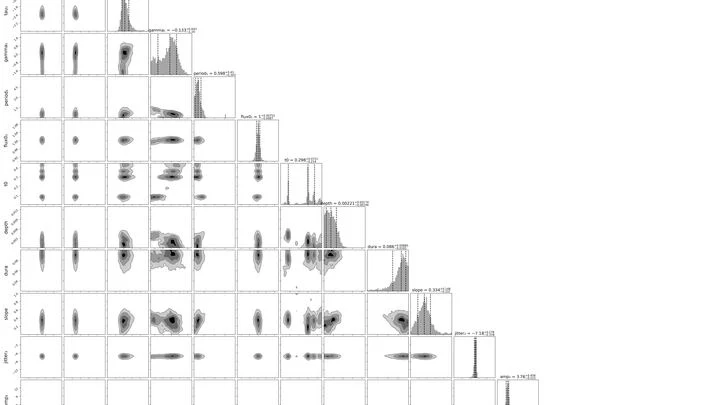
Stellar Orthography: How ExoVeil Reads Missed Planets

Traditionally, astronomers caught planets by waiting for multiple passes across stars. ExoVeil breaks this mold: a transformer neural network learns to predict the star's normal twinkling and spots even a lone shadow. A blind analysis of Kepler data revealed 179 new candidates, and on TESS data with
arXiv:2606.02778v3 · 2026-06-01

Neptune's False Note: Nereid — Not an Interloper, but a Last Survivor

Neptune's third-largest moon, Nereid, was long counted among the icy intruders from the Kuiper Belt. But its unique infrared spectrum, captured by the James Webb Space Telescope, is unlike any other: crystalline water ice with a reddish tint and traces of carbon dioxide hint at a birth near the plan
arXiv:2606.02818v1 · 2026-06-01

Erythrulose: The First Sugar Baked in an Interstellar Furnace

Spectral lines of erythrulose (C₄H₈O₄), caught by the Yebes 40m and IRAM 30m radio telescopes, betrayed the presence of this sugar in the cloud G+0.693. For the first time, we see how, in the interstellar medium, on the surface of icy dust grains, components of nucleic acids are born from glycolalde
arXiv:2606.03313v1 · 2026-06-02

Steam from Scorching Rocks: Silicon Gas in the Atmosphere of TWA5B

The CRIRES+ spectrograph on the Very Large Telescope captured the faint light of the young super-Jupiter TWA5B and resolved the SiO lines—the main carrier of gaseous silicon. The detection with a signal-to-noise ratio of 7.5 means: silicon almost entirely floats in the gas phase, not locked in silic
arXiv:2606.03824v1 · 2026-06-02

Levitating Graphite Web Captures the Moon's Embrace

In Southampton, the thinnest graphite flake has been turned into an ultrasoft gravitational antenna. Levitating above magnets, it shifts by nanometers under tidal forces, and a laser interferometer converts this into a precise signal. The instrument distinguishes lunar and solar contributions, achie
arXiv:2606.14738v1 · 2026-06-02

Interstellar Wanderer with a Polar Orbit

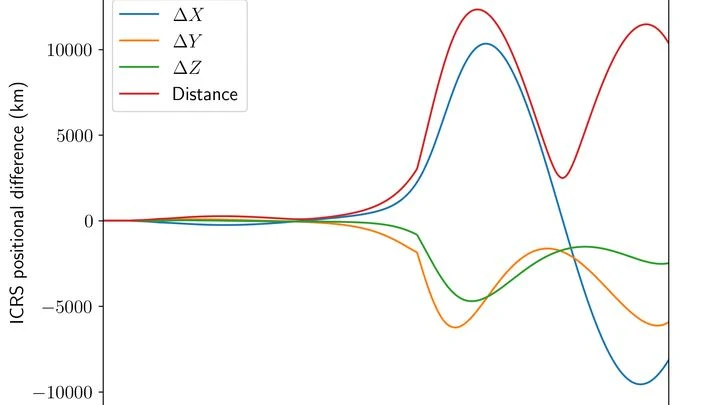
Analysis of the fireball that blazed on April 1, 2026 over the South Atlantic showed its heliocentric velocity was 51.73 km/s. That's 9.59 km/s above the threshold at which an object forever leaves the Solar System. Scientists accounted for gravitational acceleration, recalculated coordinates, and r
arXiv:2606.04379v1 · 2026-06-03

Comet Spice: How a Late Influx of Matter Reshaped the Outer Solar System

Carbonaceous chondrites that fall to Earth carry a double isotopic signature. Measurements of silicon, iron, magnesium, and chromium tell us that the stuff of Jupiter and Saturn came from two reservoirs, with a late addition of comet dust making up more than a third. Even more surprising, CI chondri
arXiv:2606.04529v1 · 2026-06-03

Shattered Inkwell: Impact Downpour 800 Million Years Ago

About 800 million years ago, in the main asteroid belt, the parent body of the Eulalia family — a giant chunk of primitive carbonaceous chondrites — broke apart. Nearly three-quarters of the fragments, caught by Jupiter's gravitational resonance, rushed into the inner Solar System, causing a true im
arXiv:2606.05036v1 · 2026-06-03

Speed Filter of the Skies: How Swift Visitors Elude Telescopes

Since 2017, only three interstellar bodies have been discovered — Oumuamua, Borisov, and ATLAS. New research reveals: rapid sky motion renders most such objects invisible. Analytical models and simulations show that faint visitors streak by faster than survey cameras can capture. This explains the p
arXiv:2606.05344v1 · 2026-06-03

Ultraviolet Trap: How TRAPPIST-1 Star Fakes Signs of Life

TRAPPIST-1 e is a rocky planet in the habitable zone of a red dwarf, one of astrobiologists' prime targets. But decoding its atmosphere requires a precise ultraviolet 'autograph' of the star. Simulations showed: different UV spectra dramatically alter the chemical portrait, producing deceptive pairs
arXiv:2606.05451v1 · 2026-06-03

Cosmic Tan: How Stellar Flares Repaint Water Worlds

Atmospheres of many sub-Neptunes are shrouded in dense organic hazes that hide their true composition. In lab experiments, such hazes were recreated from water vapor, methane, and carbon dioxide, then irradiated with ultraviolet light, mimicking flares from red dwarfs. It turned out that after irrad
arXiv:2606.06691v1 · 2026-06-04

Cosmic Prospector: Sifting Stars in Search of Life

Where to look for intelligent brothers? A new parametric filter of seven criteria rejects stars unable to support complex life. From Gaia DR3's 1.74 million stars, it eliminated 55.4%, retaining 777,835 priority targets — mostly G and K dwarfs. Key rejection factors: low metallicity and youth. Notab
arXiv:2606.06692v2 · 2026-06-04

The Rapids of a Black Hole: The Birth and Death of Blanets

In the turbulent disks of active galactic nuclei, blanets form—giant planets of incredible density. Drifting toward the central black hole, they are torn apart by tidal forces, generating brief but dazzling flares in optical and ultraviolet light. Their density allows them to approach the horizon of
arXiv:2606.06884v1 · 2026-06-05

Freo Doctor: How Wind Governs the Fate of Meteorites

The bright flash of a bolide is just the first act. After an asteroid or comet fades, dark flight begins: the invisible drift of fragments to the ground. That's when wind sows chaos, shifting the impact point by hundreds of meters. The team of Devillepoix and Cupák deployed the WRF model to calculat
arXiv:2606.07144v1 · 2026-06-05

The Cosmic Forge: Why GJ 3929 b Lost Its Air

Ultra-precise photometry of four secondary eclipses of the planet in the red dwarf system GJ 3929 yielded a depth of 118±22 ppm, corresponding to a dayside temperature of about 640 K. Modeling showed that a dense carbon dioxide envelope like Venus's cannot be held, though traces of gases might remai
arXiv:2606.07511v1 · 2026-06-05

Heavy water ice found in planet-forming disk

The Webb telescope directly observed heavy water ice for the first time in a planetary disk—the birthplace of planets. There's unexpectedly a lot of it, pointing to a turbulent history of the ice that might explain the origin of Earth's oceans.
arXiv:2606.10888 · 2026-06-09

Mysterious Trace on Titan's Surface

Titan's dense haze long concealed its surface. But in infrared light, the JWST telescope discerned a narrow dark band — a chemical fingerprint of an unknown substance. A similar, but broader, one was found on Pluto. This discovery brings us closer to unraveling the composition of distant icy worlds.
arXiv:2606.13350 · 2026-06-11

Dark Matter Sways Distant Planets

Planets on the outskirts of star systems prove to be perfect scales for invisible matter. A drifting clump of dark matter nudges their orbit just enough— a shift we can now measure. This method could uncover the primordial invisible structures lingering from the Big Bang and let us chart the dark un
arXiv:2606.14827 · 2026-06-12

Inside Uranus and Neptune Lie Oceans of Magma

A new study turns our understanding of Uranus and Neptune upside down. Instead of layers of frozen water and methane, an ocean of magma soaked with hydrogen likely sloshes inside them. This idea explains all the mysteries of these planets and makes them kin to distant worlds around other stars.
arXiv:2606.18219 · 2026-06-16

A Planet's Rotation Revealed Its Fiery Secrets

Astronomers studied WASP-121 b, a gas giant always facing its star with one side. As the planet transited the star, they detected changes in light absorption: the eastern limb was hotter than the western, which destroys water and leaves carbon monoxide. This opens a method for scanning weather on su
arXiv:2606.19487 · 2026-06-17

The Earth may survive when the Sun becomes a giant

The main enemy here is not heat, but gravity. If the Sun sheds mass fast enough, Earth will retreat to a more distant orbit. Judging by observations of similar stars, we have a pretty good chance.
arXiv:2606.19575 · 2026-06-17

Why the Moon Is a Copy of Earth? The Fluidity Clue

The Moon is almost identical to Earth in composition, which contradicts giant impact models. A new hypothesis: Theia was solid and cold, while Earth was a boiling ball. The impact splashed mostly terrestrial material into space, and the Moon inherited our planet’s chemical signature.
arXiv:2606.20398 · 2026-06-18

James Webb Fishes Out an Invisible Planet from a Dusty Disk

A third giant planet has been found around Beta Pictoris—not in an image, but through chemical traces in light: methane, water, and carbon monoxide. It is 2–4 times more massive than Jupiter and sits so far out that a year there lasts over a century. Its gravity shapes the inner edge of the dusty di
arXiv:2606.23789 · 2026-06-22

Moon Dust May Reveal Alien Technologies

Calculations show that tiny artificial particles could cross interstellar space and survive in the lunar soil. Sunlight filters out the unsuitable ones, and on the Moon, they don't burn up in an atmosphere. Even a handful of regolith could tell us how often technological civilizations arose in the G
arXiv:2606.24028 · 2026-06-23

Cosmic Collisions: How to Witness the Birth of Planets

When two would-be planets around other stars collide, the impact strikes a blinding spark. The glow slowly fades over weeks to years. New sky surveys will capture these events, unveiling the secret of world birth.
arXiv:2606.26026 · 2026-06-24

Can life travel between stars on icy comets?

Data from JWST and SPHEREx on comet 3I/ATLAS revealed that natural spread of life in ice is possible if microbes periodically thaw. But intentional sending of life by another civilization is nearly impossible — the impact would be too hot. The work proposes a method to search for life on such wander
arXiv:2607.00202 · 2026-06-30

Cosmic Carving: Birth of a Bloated Neptune from a Jupiter

Astronomers discovered exoplanet TOI-2195 A b – a hot Neptune with a mass 1.5 times that of Neptune, but a radius almost as large as Jupiter's. Orbital analysis suggests a likely polar orbit. Modeling indicates the planet may have formed as a cold Jupiter, losing up to 90% of its mass during highly
arXiv:2607.01315v1 · 2026-07-01

Smoldering Giant: Methane and Haze over a Dead Star

The James Webb Space Telescope has peered into a previously unseen world: the atmosphere of the giant planet WD 1856 b, orbiting a white dwarf. The transit spectrum from 0.5 to 5.0 μm revealed hydrocarbons, including methane with a significance of 17:1 to 30:1, thick aerosols, and thermal glow from
arXiv:2607.01316v1 · 2026-07-01

The Silence of the Interstellar Wanderer: The Hunt for Radio Signals from 3I/ATLAS

Astronomers took advantage of the visit of the interstellar object 3I/ATLAS to conduct a unique radio reconnaissance. Using the 500-meter FAST telescope and the method of canonical polyadic decomposition, they analyzed the data, trying to extract periodic signals against the background of terrestria
arXiv:2607.01666v1 · 2026-07-02

Galactic Recipe: How the Sun Stopped Being Special

Astrophysicists analyzed ultra-precise spectra of 79 solar twins and concluded: most Sun-like stars acquired their chemical makeup naturally—through Galactic evolution. Only a few candidates show signs of exoplanet ingestion. This confirms that our star is not an exception but a typical product of i
arXiv:2607.01699v1 · 2026-07-02

Invisible Planet in Warped Light

For the first time, a planet has been detected in TESS data using gravitational microlensing. The event Gaia23bra, identified by the Gaia survey as an isolated lens, revealed sharp caustic-crossing peaks in the TESS light curve—an unmistakable sign of a binary system with a planetary companion. Join
arXiv:2607.01853v1 · 2026-07-02

Neutrino Tomography of Earth: A New Look at the Planet's Interior

Earth's internal structure is traditionally studied using seismic methods and gravimetry. But neutrinos—particles that barely interact with matter—offer a fundamentally different, gentle probe. The IceCube collaboration analyzed 10.7 years of muon neutrino observations with energies from 500 GeV to
arXiv:2607.02644v2 · 2026-07-02

Cosmic Kick: Warm Orphans Born from Stellar Death

Analytical estimates and numerical simulations show that kicks during white dwarf formation directly liberate only ~1% of known exoplanets, but in multi-planet systems they trigger dynamical instability in 40–47% of cases, leading to planet ejections. These free-floating planets are heated to up to
arXiv:2607.02653v1 · 2026-07-02

The Voice of Light: How Secret Rings Reveal Themselves in the Disk of CI Tau

Protoplanetary disks harbor complex architecture, but the narrowest rings elude direct view. By analyzing how brightness varies along the disk's tilt, scientists found a 'double peak' — a telltale signal of optically thick rings in an optically thin background. This method unveils substructures beyo
arXiv:2607.02660v1 · 2026-07-02

Gravitational Infancy: Record Orbits in the Cradle of HD 114082

310 light-years from Earth, astronomers have found a remarkable system: a 15 million-year-old star surrounded by two transiting gas giants with record-long orbits of 225 and 314 days. Observations with TESS, CHEOPS, and ground-based telescopes measured their radii and set upper limits on their masse
arXiv:2607.02685v1 · 2026-07-02

Cosmic Debt: How a Planet's Mass Locks Civilizations Forever

Scientists from Blue Marble Space combined geophysics, atmosphere, and rocket dynamics to find the limits of chemical escape from exoplanets. A payload of 1,000 kg — like that of the Voyager probes — was used as a benchmark. It turned out that for a planet more massive than about 11.5 M⊕, the number
arXiv:2607.02691v1 · 2026-07-02

Cosmic Jazz: Three Finales of an Encounter with a Black Hole

How does a primordial black hole, a dark matter candidate, alter the fate of a planetary system? Simulations of the TOI-2796 system revealed three dramatic outcomes: planet ejection, formation of a stable triple system, and capture of the planet into an eternal journey with the black hole. The rare
arXiv:2607.03724v1 · 2026-07-04

Quasi-interstellar objects: when the Solar System meets its own exiles

The discovery of 1I/‘Oumuamua made us wonder: could some interstellar wanderers actually be our own comets, ejected from the Oort cloud and returning millions of years later? Simulations show that such ‘quasi-interstellar objects’ are indeed possible, but they have unique characteristics: extremely
arXiv:2607.04216v1 · 2026-07-05

Cosmic Drops: How Gravity Revealed Four New Cold Giants

Astronomers have reported the discovery of four cold giant planets around low-mass stars. They were betrayed by brief anomalies in the light curves — as if a water droplet on a windowpane momentarily focused distant light. All planets lie beyond the snow line, up to 6 astronomical units from their s
arXiv:2607.04594v1 · 2026-07-06

The Unmixed Cocktail: Why Double Diffusion Is Powerless in the Interiors of Giant Planets

A new study has, for the first time, self-consistently incorporated the recipe of double diffusion into an evolutionary code of planets and traced the fate of Jupiter and Saturn from the moment of formation. It turns out that even a thousandfold enhancement of mixing does not lead to significant sme
arXiv:2607.04629v1 · 2026-07-06

Waltz of Invisible Moons: The First Spectroscopic Find

Astronomers have discovered planetary-mass moons around a brown dwarf for the first time using high-precision spectroscopy. Observations with the VLT and the CRIRES+ spectrograph revealed periodic wobbles in the radial velocity of the starlike object CD-35 2722 B, hinting at at least one moon about
arXiv:2607.05193v1 · 2026-07-06

The Icy Moons' Double Breath: JWST Unravels the Mystery of Uranus's Carbon Dioxide

Spectrograph NIRSpec aboard the JWST telescope has discerned a complex mosaic of carbon dioxide and carbon monoxide bands on Ariel, Umbriel, Titania, and Oberon. Comparison with laboratory ices at cryogenic temperatures revealed signatures of crystalline CO₂, clathrates, and carbonates. The observed
arXiv:2607.05600v2 · 2026-07-06

Icy Whisper: O-PTIR Captures Amino Acids Beyond Diffraction

The O-PTIR method shatters the diffraction barrier: infrared heating translates into thermal expansion, read by a visible laser. This enables submicron resolution and sensitivity down to 0.2 µM. Crucially, organics distort the ice's own absorption bands, creating a subtle yet informative spectral fo
arXiv:2607.05629v1 · 2026-07-06