The Secret of the Kaleidoscope: A Record Count of Invisible Networks ✛
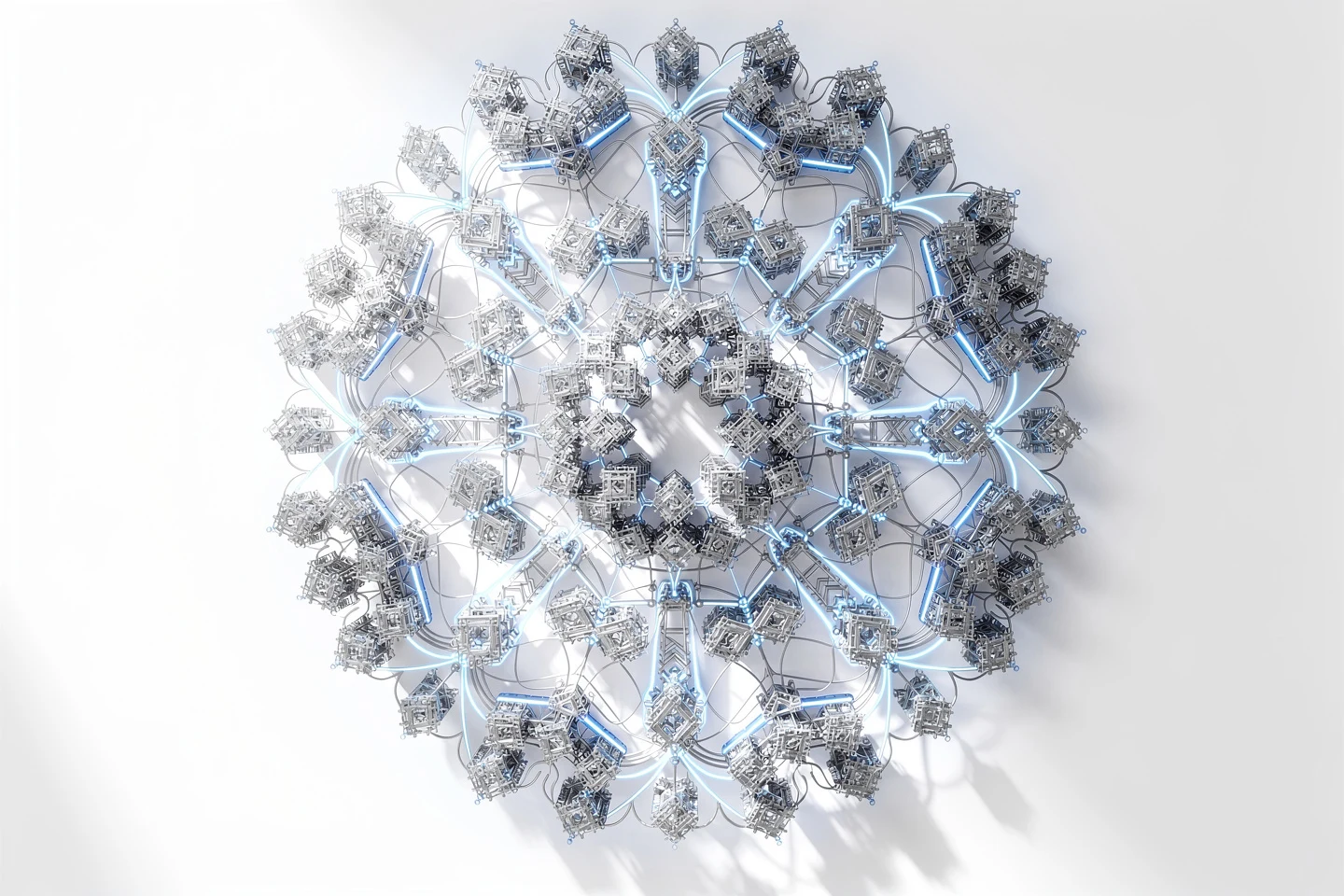
Imagine a kaleidoscope: a handful of colored glass shards, reflecting in mirrors, creates countless patterns. In mathematics, it's often necessary to count possible networks made of identical points — for example, all ways to connect them with lines, if the points cannot be labeled. Direct enumeration is powerless here: for 20 points, the number of options exceeds the stars in the galaxy.
However, there's an elegant trick. Instead of enumerating all patterns, one uses averaging over all possible rotations (permutations of points). For each rotation, one looks at how many patterns remain unchanged, and then takes the average. This gives the exact number. But the number of rotations is also huge — breaking them into identical pieces helps. If a pattern is symmetric, it consists of repeating chunks. Noticing this, mathematicians applied a recursive approach: the problem reduced to counting such chunks, making it exponentially faster. The kaleidoscope folds itself.
This made it possible, for the first time, to precisely count the number of patterns for 16, 17, 18, 19, and 20 points. The result for 20 points is a colossal number: 7 278 601 292 779 396 715. Behind this number is not chaos, but a streamlined architecture of reflections. The method will be useful not only for pure patterns, but also for screening drugs and new materials, and could accelerate machine learning in the search for optimal neural network configurations.
To count all possibilities for 20 points, 627 different symmetry types had to be considered.
The idea of enumerating all possible structures recalls Borges' 'Library of Babel' — the book of all conceivable books.