The Chern number is a topological invariant that characterizes the quantized Hall conductance of a band structure in a material. It is an integer that describes the global geometric properties of the electron wavefunctions in a periodic crystal, and it cannot change unless the material undergoes a phase transition. The Chern number is central to the quantum Hall effect and the classification of topological insulators.
History
The concept was introduced by David Thouless, Mahito Kohmoto, Peter Nightingale, and Marcel den Nijs in 1982, in their seminal paper explaining the integer quantum Hall effect. This work later contributed to Thouless's Nobel Prize in Physics in 2016.
How it works
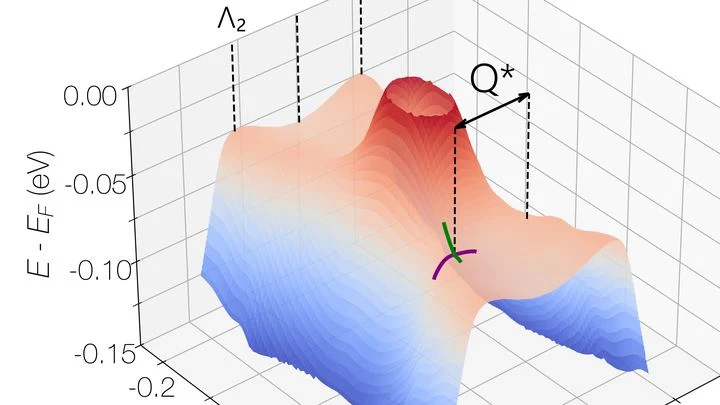
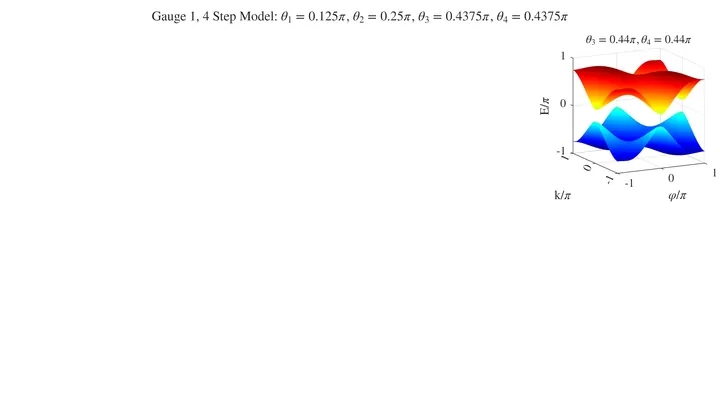
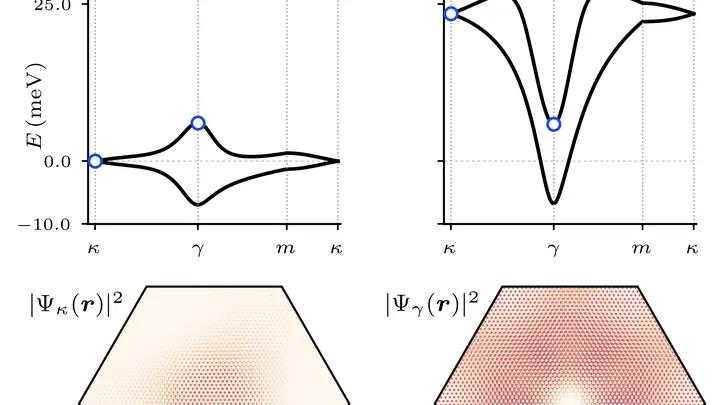
In a periodic crystal, electrons occupy energy bands. The Chern number is calculated by integrating the Berry curvature over the entire Brillouin zone. This curvature is a geometric property of the wavefunctions, analogous to the curvature of a surface. A nonzero Chern number indicates that the band has a nontrivial topological structure, which leads to the appearance of conductingedge states that are robust against disorder and scattering.
In practice
Chern numbers are used to identify and design topological materials, which have potential applications in spintronics and quantum computing due to their robust, dissipationless edge states.
Fun fact
The Chern number is named after the Chinese-American mathematician Shiing-Shen Chern, who developed the mathematical framework of characteristic classes in the 1940s, long before its application in physics.
An ultrathin film of tellurium, tantalum, and iridium atoms behaves as an insulator in its interior but conducts current along its edges. This property, the quantum spin Hall effect, promises lossless electronics. However, calculations of the electronic structure did not predict such a phase for the 1T-TaIrTe₄ monolayer.
In a superconductor, where electrons move in pairs without resistance, special waves can run along the edges, like ripples along the edge of a carpet. The number of such waves is an important characteristic of the material, but measuring it directly is difficult.
The quantum world is often compared to a musical instrument. Electronic bands in a crystal are like strings, each with its own pitch. Usually, if the strings are tuned simply, without tricky interlacing, then the sound produced by their combined motion remains simple.
A highway where opposing flows are separated not just onto different sides, but onto two independent roads: each with its own entrance and exit. Something similar happens to electrons in a new type of topological insulator described by the authors of the study.
In the quantum world, particles fall into two irreconcilable camps: bosons love to pile into the same state (like light in a laser), while fermions are individualists that never occupy the same spot. You'd think one neural network couldn't learn both personalities at once.
Two observers, Alice and Bob, sit at opposite ends of the same lab. Between them is a source that fires off two pulses in turn. Each pulse gives birth to a wave packet flying toward its own detector. So far, this looks like an ordinary experiment with quantum particles.
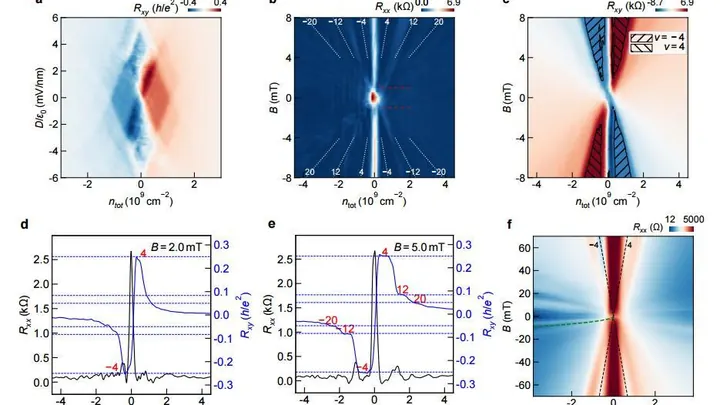
In the world of crystals, there is a hidden geometry. When an electron runs through a two-dimensional insulator, its path is twisted by an invisible force — topology. This twist is described by the Chern number, an integer that cannot be changed by smooth deformation.
Take two thin sheets of a semiconductor. One is saturated with free electrons, like a packed café where every table is taken. The other, by contrast, is full of empty spots—'holes' eager to be filled. When these sheets are brought close together, a spark of attraction jumps between them: electrons and holes begin to feel each other across the thin gap.
In a crystal, electrons are not distributed randomly. Their waves obey the lattice symmetry, like ripples on water taking the shape of a hoop thrown into it. The new work shows that at high-symmetry points, this ripple must have nodes — places where electron density is strictly zero.
Cut a spin chain, and particles without an energy gap appear at the edges. They are called zero modes, and they live only at the boundary. Previously, they were counted using complex topological invariants, but now there is a simpler way.
Two sheets of tungsten diselenide (not carbon, but a compound of tungsten and selenium) are rotated relative to each other by a tiny angle, about 5 degrees. This creates a moiré pattern: an enlarged periodic lattice where electrons behave very differently than in a regular crystal.
In 1915, Albert Einstein and Wander Johannes de Haas demonstrated that when an iron rod is magnetized, it twists slightly — the angular momentum of electrons is transferred to the crystal lattice.
7 278 601 292 779 396 715. That’s exactly how many unlabeled chordal graphs, graphs with no induced cycles of length four or more, can be built on twenty vertices. This number isn’t a puzzle for a supercomputer; it’s the exact output of a new algorithm that treats symmetry as a tool, not an obstacle.
Some materials are internally like a Möbius strip: their electronic states are twisted in a special way. Such topological properties are usually manipulated with a powerful magnetic field, as if trying to flatten the strip with a sledgehammer. A group of researchers has found a more delicate tool.
In a long corridor, a crowd of people tries to keep as far apart as possible. In a spacious hall, they would simply spread out, but here the walls squeeze them so tightly that they have to move single file, coordinating every step. Electrons in graphene layers twisted by a tiny angle behave in a similar way.
A black hole is like a spinning top: the faster it spins, the more noticeable its behavior. It has two boundaries — the outer and inner horizons, the edges beyond which even light cannot return. In the new work, physicists looked inside a rotating charged black hole and multiplied the areas of these two surfaces.
Two entangled photons fly apart in opposite directions but continue to behave as a single whole: measuring one instantly determines the state of the other. That's quantum entanglement. But sometimes it resembles a seasoned spy — leaving no traces detectable by ordinary checks.
Layers of a thin material rotated relative to each other resemble stacked grids. Where the lines intersect, a new pattern emerges — a moiré. In this pattern, electrons move differently than in a regular crystal and can form unexpected states.
In the new study, researchers took two layers of molybdenum telluride and twisted them by 4.8 degrees.
Imagine a triangular grid with tiny magnetic arrows at each node. Electrons, the charge carriers, run across this grid. Usually, the arrows align simply: all pointing the same way (ferromagnet) or alternating in the plane.
Two sheets of paper slightly offset, and against the light, a moiré pattern appears: dark and light stripes. The same happens with semiconductor layers like molybdenum telluride.
A single-atom-thick sheet of tungsten telluride is like thin foil: electrons can't pass through because there's a band gap between their possible states, like a moat you can't jump across. Add two more layers, and the moat disappears; the material becomes a metal, and current flows. Add more layers, and the properties change again, as if someone is flipping modes with a single button.
Among magnets, there are quiet masters of disguise. An ordinary magnet attracts paperclips and has two poles — north and south. But there are materials that are internally arranged like a magnetic chessboard: their atoms are aligned in a strict order, yet externally the material behaves neutrally, as if no magnet exists at all. Such substances are called altermagnets.
In a strong magnetic field, electrons trapped in a thin layer sometimes arrange into a regular pattern, like guests at a crowded party who find a spot where no one jostles them. This order is called a crystal, although it is not ice or salt, but the electrons themselves, frozen in place.
Two sets of swings, rocking in opposite directions, don’t tilt the platform. Yet their motion creates invisible vortices that push a ball sideways. Alternagnets behave just like that: the atomic magnetic arrows are perfectly balanced, but a hidden symmetry bends the heat flow.
If you push heat through a piece of quartz, it usually goes straight, like water through a pipe. But switch on a magnetic field, and the flow veers slightly sideways, as if the pipe suddenly grew a side branch.
In the quantum world, there are rules that seem to be broken. One of them is the conservation law: if in classical physics symmetry guarantees the conservation of charge, then in the quantum description this guarantee can disappear. This phenomenon is called a quantum anomaly.
Water in a stream doesn't flow in a uniform sheet; it carves winding paths where the current runs faster. Electrons in a Hall thruster, a device that pushes a spacecraft with a jet of plasma, behave much the same way.
Inside the thruster, a magnetic field confines electrons, which ionize the gas and produce thrust.
The atomic nucleus isn't a frozen ball but a seething collective of protons and neutrons. They whirl, collide, and arrange themselves into patterns that physicists see as "bands"—ladders of energy levels. In niobium and technetium nuclei, four such ladders have been found, but the last one stubbornly refused to fit the calculations.
A special material — a topological insulator — conducts current only on its surface, as if its interior is a perfect insulator. It hosts a quantum effect similar to the one discovered by Klaus von Klitzing, but mathematically it is equivalent to a four-dimensional world.
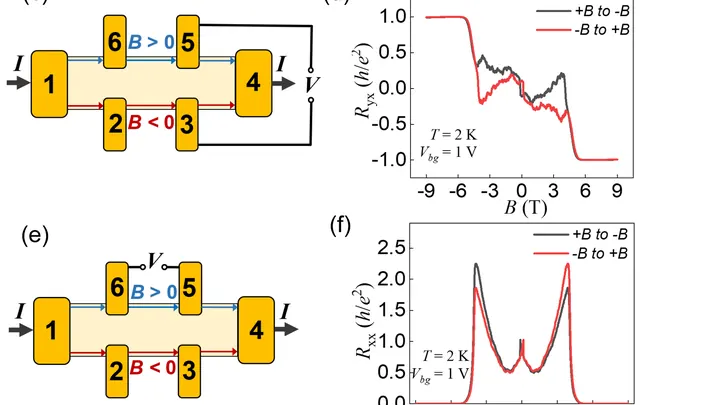
Certain materials, when placed in a strong magnetic field at low temperatures, exhibit a surprising property: their interior stops conducting, becoming an insulator, while along the very edge of the sample electricity runs like a river along a channel, always in one direction.
A thin wire made of a special material, a topological insulator, behaves like a city street: the interior is empty, and all traffic runs along the edges. Electrons in such a wire move only along the surface, like pedestrians on a sidewalk, never stepping onto the roadway.
A layer of electrons trapped between two semiconductor plates lines up into a neat lattice at low temperatures, like beads on a string stretched between your fingers. As the temperature rises, order collapses: the crystal melts. But exactly how it melts has long been a puzzle.
Graphene is a carbon sheet just one atom thick, a fantastic conductor. But its surface is crinkly, like a wrinkled tablecloth that hasn't been ironed. Scientists built a 'sandwich': two of these sheets pressed together with a non-conductive spacer in between. They iron out each other's folds, like two halves of a sandwich making the surface perfectly even.
Water in a glass settles down, but before that, vortices go through a stage where energy losses spike. Physicists seek early signs of this stage to predict flow behavior — from the atmosphere to pipelines. In a new study, they test one such sign: the curvature spectrum of vortex lines, that is, how twisted small and large eddies are.
A fractal that looks like a butterfly hides an order that is not visible at first glance. In the quantum world of one-dimensional quasicrystals described by the Komoto model, the energy spectrum forms a whimsical shape: the Komoto butterfly.
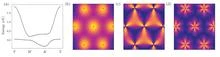
Electronic charge is a tumbleweed that moves camp depending on energy. In tungsten selenide (WSe₂) crystals, this is seen with utmost clarity: at a bias of −1.4 V, near the K point of the Brillouin zone, the maxima of tunneling current sit in the centers of hexagons, where there are no atoms.
In 1979, Su, Schrieffer, and Heeger proposed a model that explained the strange electrical properties of polyacetylene, an organic polymer that conducts electricity almost like a metal. Their chain consisted of carbon atoms connected alternately by single and double bonds.