Reflection is the change in direction of a wavefront when it encounters a surface or boundary that it cannot pass through. It is one of the most fundamental behaviors of waves, applying to light, sound, water waves, and even gravitational waves. The basic rule is simple: the angle at which the wave arrives equals the angle at which it leaves, measured from the normal (a line perpendicular to the surface). This law holds for smooth surfaces, producing specular reflection like a mirror, while rough surfaces scatter waves in many directions, producing diffuse reflection.
History
The law of reflection was known to the ancient Greeks, and Euclid described it in his work on optics around 300 BCE. Hero of Alexandria later provided a geometric proof based on the principle of least distance.
How it works
When a wave hits a boundary, the interaction is governed by the principle that the wave cannot penetrate the new medium (or can only partially). The incoming wave sets up oscillations in the boundary material, which then re-radiate waves in all directions. For a smooth, flat surface, these re-radiated waves interfere constructively in only one direction — the direction where the angle of reflection equals the angle of incidence. This is a consequence of Huygens' principle, where every point on the wavefront acts as a new source of spherical waves.
In practice
Reflection is used in countless technologies, from mirrors and periscopes to radar and sonar systems. In astronomy, the reflection of light off dust clouds reveals the structure of nebulae, and in gravitational wave astronomy, the reflection of waves off black hole horizons carries information about their properties.
Fun fact
A 'retroreflector' — a mirror that reflects light directly back to its source — was placed on the Moon by Apollo astronauts, and laser pulses bounced off it are still used to measure the Earth-Moon distance to centimeter precision.
A wave packet is like a traveler who either loses steam and spreads out along the way, holds a steady pace, or gathers into a fist. In a 50-meter flume with water 5 meters deep, scientists tracked how a bell-shaped group of waves behaves when its height is changed but not its width.
The mirror races along at nearly forty thousand kilometers per second. Light that strikes it bounces back, but changed, like a ball volleyed by a racket in mid-swing. That's exactly the kind of mirror scientists have built inside an ultra-thin glass thread filled with hydrogen.
First, a powerful laser pulse is sent down the fiber.
Waves on the water's surface usually break against any obstacle — a rock, a piling, an island. But what if you arrange obstacles so cleverly that the wave barely notices them? In a new study, scientists assembled a pattern of many points on the water, arranged according to special mathematical rules, and sent waves through them.
In the brain's white matter, the signal travels along axons — long neuronal processes wrapped in an insulating myelin sheath. Water fills the space inside axons and outside, in the narrow gaps between fibers.
In a close binary system, the hot star, like a searchlight, illuminates its cooler companion. Some of the light scatters off free electrons in its atmosphere — this is Thomson scattering — and acquires linear polarization. As the stars orbit each other, this polarization rotates, like the hand of a peculiar cosmic metronome.
Gravitational waves are not vibrations of matter, but tremors of spacetime itself, predicted by Albert Einstein. They travel at the speed of light and pass through objects, stretching and squeezing them.
A pebble tossed into a pond sends ripples spreading in all directions. Now imagine the pond itself suddenly turning into jelly — instantly, faster than the wave can complete a single crest. Some ripples would keep spreading but change their spacing, while others would unexpectedly turn around and run back toward the point of impact, as if time were flowing backward for them.
Light, like a shaken rope, oscillates in a specific plane. Astronomers and engineers often rotate images using a three-mirror system, the so-called K-mirror, but this inadvertently rotates the plane of oscillation as well. For precise measurements, that's a problem.
Light usually behaves like a pedestrian on a two-way street: the path from a streetlamp to a camera matches the reverse path. But near a rotating black hole with broken spatial symmetry, this street becomes one-way. Swap the light source and observer, and the hole's shadow changes shape: from an oval resembling a rugby ball, it turns into a teardrop.
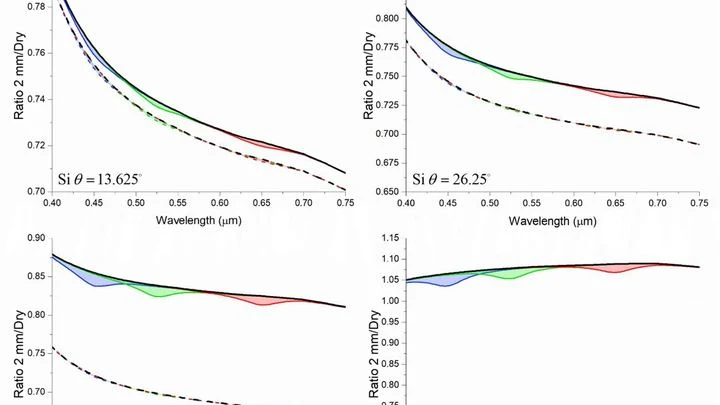
A water droplet on a leaf disappears faster under the sun than heat calculations would predict. A few years ago, a hypothesis emerged: light itself, without heating, could knock water molecules off the surface. This was dubbed the photomolecular effect. If it exists, clouds, climate, and even everyday clothes drying could work differently.
In ordinary water, ripples from a thrown stone spread in even concentric circles. But imagine a liquid whose molecules are like tiny screws with a right-handed thread. In such a medium, the surface acts like a one-way street: waves can only travel in a certain direction.
An ordinary wave in a magnet is like ripples on water: the shorter the wavelength, the higher the energy. Physicists call such waves magnons. But in a thin film of bismuth yttrium iron garnet, they managed to create waves with the opposite behavior: their energy decreases as the wavelength gets shorter. These are antimagnons.