A topological invariant is a property of a physical system that remains unchanged under continuous deformations, such as stretching, bending, or twisting, as long as no tearing or gluing occurs. In physics, topological invariants are used to classify phases of matter that cannot be distinguished by local order parameters, such as the integer quantum Hall effect, topological insulators, and topological superconductors. These invariants are often integers, like the Chern number, which characterizes the quantized Hall conductance. The concept has also been applied to other areas, including magnetic dynamos, where a hidden invariant can dictate the behavior of the system, and to the study of knots and braids in quantum field theory.
History
The concept originated in mathematics, with the Gauss-Bonnet theorem and the work of Poincaré. In physics, the first topological invariant was the Chern number, introduced by Chern in 1946, but its physical significance was realized with the discovery of the quantum Hall effect in 1980 by von Klitzing, and the subsequent theoretical explanation by Thouless, Kohmoto, Nightingale, and den Nijs in 1982.
How it works
Topological invariants are typically computed from the mathematical structure of the system's wavefunction or Hamiltonian. For example, in a 2D electron gas in a magnetic field, the Chern number is an integer that counts the number of edge states or the quantized Hall conductance. It is defined as an integral over the Brillouin zone of the Berry curvature. Because it is an integer, it cannot change continuously — it can only jump when the system undergoes a phase transition, which requires closing the energy gap. This makes topological phases robust against local perturbations, as long as the gap remains open.
In practice
Topological invariants are used to design topological insulators and superconductors, which have potential applications in quantum computing due to their protected edge states. They are also used in metrology, where the quantized Hall effect provides a standard for electrical resistance.
Fun fact
The 2016 Nobel Prize in Physics was awarded to Thouless, Haldane, and Kosterlitz for their work on topological phasetransitions and topological phases of matter, which was initially considered a purely mathematical curiosity.
Two observers, Alice and Bob, sit at opposite ends of the same lab. Between them is a source that fires off two pulses in turn. Each pulse gives birth to a wave packet flying toward its own detector. So far, this looks like an ordinary experiment with quantum particles.
Two cities with the same average population density. In one, a neat grid of blocks; in the other, a maze of narrow alleys and unexpected squares. On a global map they look like twins, but life inside flows quite differently.
Inside planets and stars, in rotating oceans of plasma, turbulent flows, Coriolis forces, and magnetic tension collide. The central question is how the energy of this chaos crystallizes into a stable magnetic framework that can last billions of years.
In quantum field theory, there is a long-standing mystery: infrared divergences. Usually they are seen as an annoying technical nuisance that must be carefully 'papered over' in calculations. But what if this is not a bug, but a feature?
7 278 601 292 779 396 715. That’s exactly how many unlabeled chordal graphs, graphs with no induced cycles of length four or more, can be built on twenty vertices. This number isn’t a puzzle for a supercomputer; it’s the exact output of a new algorithm that treats symmetry as a tool, not an obstacle.
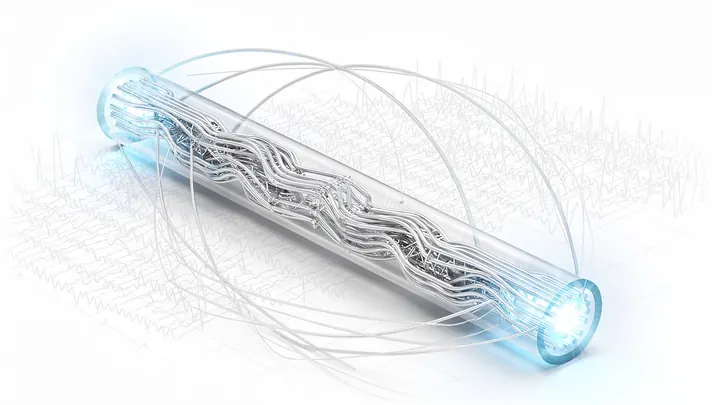
A topological superconducting nanowire is like a bridge, with two inseparable sentinels — Majorana modes — stationed at its ends. These exotic quasiparticles, predicted back in the 1930s, promise to become the foundation of an error-proof quantum computer.
The Schwarzschild black hole is the simplest model in general relativity. But when you switch to teleparallel gravity (TEGR), where torsion replaces curvature, the horizon develops a problem. Some quantities built from torsion tend to infinity.
Toss a handful of phosphorus into silicon, and at a certain impurity concentration the material suddenly starts conducting electricity. This is a metal-insulator phase transition, and it happens abruptly. But what exactly changes in the electron wave functions when an insulator becomes a metal?
In particle physics, it has long been taken for granted that the forces of nature (electromagnetism, the weak and strong interactions) obey a strict symmetry called gauge symmetry. It's like a set of rules by which particles exchange force carriers. But where do the rules themselves come from?
Water can be ice, liquid, or steam. Physicists call these states phases. In theory, each phase has its own measure — a way to describe how likely it is. But not every measure you can imagine occurs in nature. Some phases are real, while others are just mathematical illusions.
Scientists have found a simple criterion that separates reality from mirage.