Corkscrew Galaxy: How a Twisted Jet Reveals the Magnetic Signature of Clusters
Original: "Helical radio jets as probes of magnetised cluster environments: Periodic Faraday Rotation Revealed in the Corkscrew Galaxy by POSSUM"
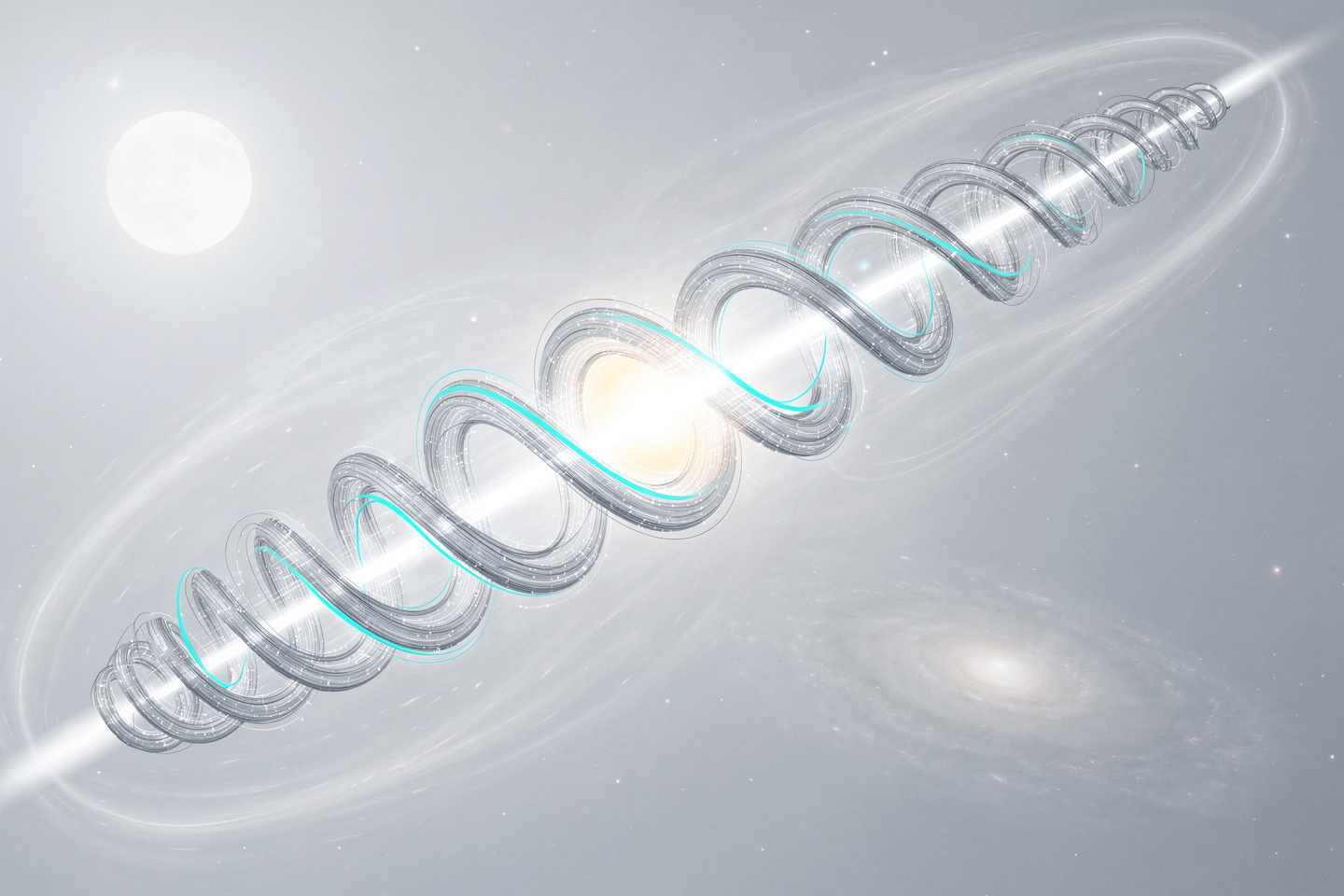
Periodic fluctuations in Faraday rotation within the jet of the Corkscrew Galaxy have for the first time been reliably linked to its spiral structure, allowing us to distinguish the contributions of magnetic fields from the jet itself and the surrounding environment.
Links in the knowledge graph 1
The periodic oscillations of the magnetic measure in the Corkscrew Galaxy’s jet coincided with its bends, like the sound on a vinyl record following the groove. Each turn became a clue: the eastern one – the magnetic handwriting of the jet itself, the western one – the echo of intergalactic plasma. Next-generation telescopes will turn such spirals into tuning forks of cosmic magnetism, reading the unheard music of clusters.
🎯 The name “Corkscrew Galaxy” was given for its striking resemblance to a helix: its radio jet, nearly 600 kiloparsecs long, is twisted into two full turns! This is one of the longest known spiral jets in the Universe.
\mathrm{RM} = 0.812 \int_0^L n_e(s) B_\parallel(s) \, ds \quad \mathrm{[rad\,m^{-2}]}
RM (rad/m²) is proportional to the integral of the free electron density (cm⁻³) and the line-of-sight magnetic field component (µG) along the line of sight.
B_\parallel \simeq \frac{\mathrm{RM}}{0.812\, n_e \sqrt{L\,l}}
For a cell-like field with coherence length l, the contribution to RM adds up as a random walk, allowing estimation of B∥.
Scientists
Christian DopplerD. B. McLaughlinDidier QuelozMichel MayorR. A. RossiterStephen Hawkingblack hole
galaxy
spectroscopy
entropy
gravitational lensing
dark matter
speed of light
hydrogen
heliumLaws
second law of thermodynamicsDoppler effectHawking radiationgravitational lensingprinciple of constancy of the speed of lightBekenstein-Hawking entropy