The Ocean of Spacetime: The Hum of Black Holes and the Precision of Simulations
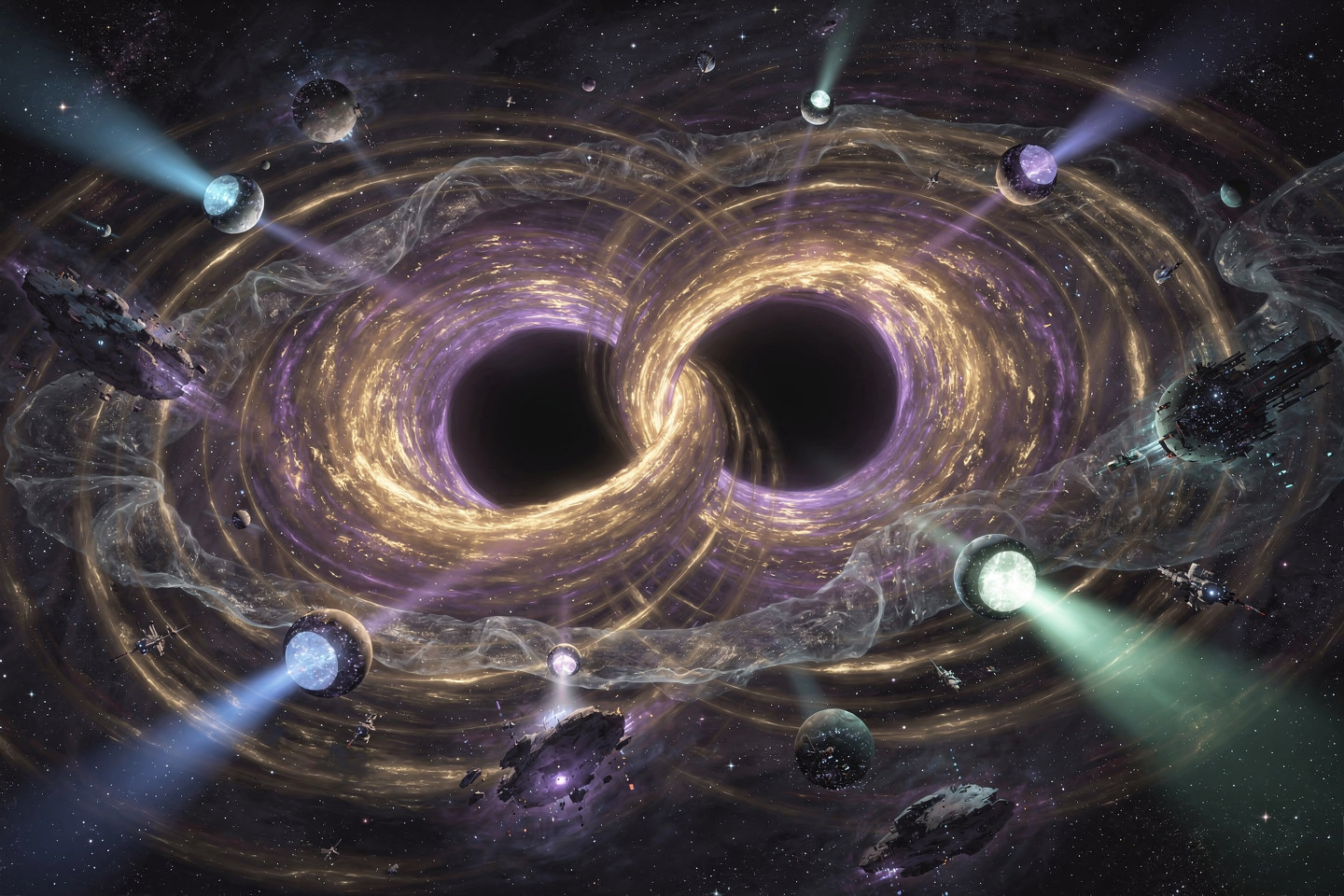
The ocean of spacetime is constantly storming. Each storm — a black hole merger — generates gravitational waves that, after eons, merge into a low-frequency hum. Like beacons, pulsars catch these ripples. New simulations have shown that predictions of such a hum match observations. We are learning to listen to the breath of the Universe — and this is just the beginning.
🎯 The nanohertz background is a sound that, if audible, would hum 12 octaves below the lowest note on a piano. And the pulsars used for its detection rotate with the precision of the best atomic clocks, but their deceleration due to gravitational waves is comparable to the effect of a mosquito flying by in Earth's orbit.
🎬 This work is like a page from Carl Sagan's 'Contact': pulsars transmit not a message from extraterrestrial civilizations, but the rhythm of black holes, and we are learning to read it.