The Ocean of Spacetime: The Hum of Black Holes and the Precision of Simulations ✛ ✎
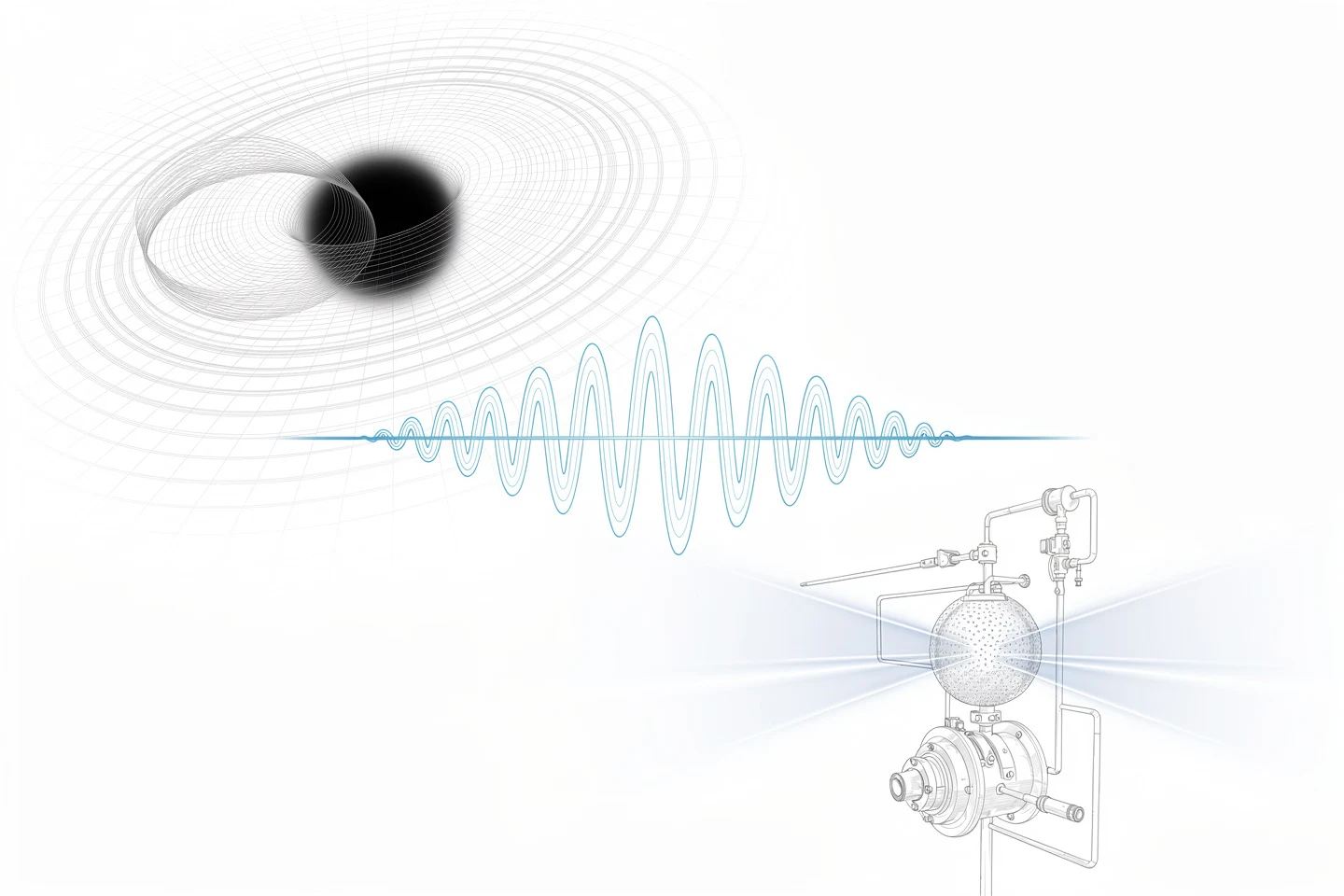
In the ocean of space, every storm of birth or merger of supermassive black holes generates ripples — gravitational waves traveling at the speed of light. Over billions of years, these waves superimpose, merging into a low-frequency hum, like a distant surf. It is this background that pulsar timing arrays (PTAs) have recently picked up — a kind of beacon, whose ultra-precise pulses tremble under the pressure of passing waves, almost like a water surface under raindrops. The very idea of such waves was born from the solutions of Karl Schwarzschild to Einstein's equations, and now we hear their chorus.
However, the credibility of this signal required verification. In the Fable simulation, which recreates the cosmic web of dark matter (discovered by Vera Rubin), gas, and stars in the expanding post-Big Bang universe (with the expansion law formulated by Edwin Hubble), every black hole merger and its gravitational echo were tracked. Comparison with 15 years of NANOGrav data showed that the predicted background amplitude is only 1–2.5 sigma below observations — a negligible discrepancy for such a complex system. Moreover, scientists found that if the growth of black holes in the early universe is enhanced by just five times, or the masses of merging pairs are equalized, the hum from the simulation perfectly matches the real one. The characteristic profile of this hum is described by a simple relation: the amplitude \(h_c(f)\) is proportional to \(f^{-2/3}\) — the lower the frequency, the louder the noise, like in ocean surf, where the main energy is in the longest waves.
The main conclusion: no 'new physics' is needed to explain the background. Current observations fit beautifully into the standard picture of supermassive black hole mergers. A slight underestimation of the amplitude hints that black holes in the young universe grew a bit faster than thought — a curious addition to the findings of the Hubble Space Telescope, which has already spotted 'overfed' black holes in early galaxies. Furthermore, the work confirms that nature has solved the 'final parsec problem' — the mystery of how binary black holes overcome a gap of several light-years, where ordinary friction stops working and gravitational radiation is still weak. The answer, it seems, lies in complex gas dynamics and environmental influences.
Ahead lies the era of multi-messenger astronomy. As pulsar networks gain sensitivity and data are combined worldwide, the spectrum of the gravitational background will reveal fine details, allowing us to distinguish the contributions of different black hole populations. Methods of spectroscopy of active galactic nuclei will help identify individual binary systems even before their fatal merger, and the improvement of simulations will reduce theoretical uncertainties. Thus, the background hum will transform from a mysterious noise into a precision instrument — a kind of seismograph of cosmic evolution. We are learning not just to listen, but to understand the rhythm of the Universe.
The nanohertz background is a sound that, if audible, would hum 12 octaves below the lowest note on a piano. And the pulsars used for its detection rotate with the precision of the best atomic clocks, but their deceleration due to gravitational waves is comparable to the effect of a mosquito flying by in Earth's orbit.
This work is like a page from Carl Sagan's 'Contact': pulsars transmit not a message from extraterrestrial civilizations, but the rhythm of black holes, and we are learning to read it.