Cosmic Ripples: What the Hum of Black Holes Tells Us ✛ ✎
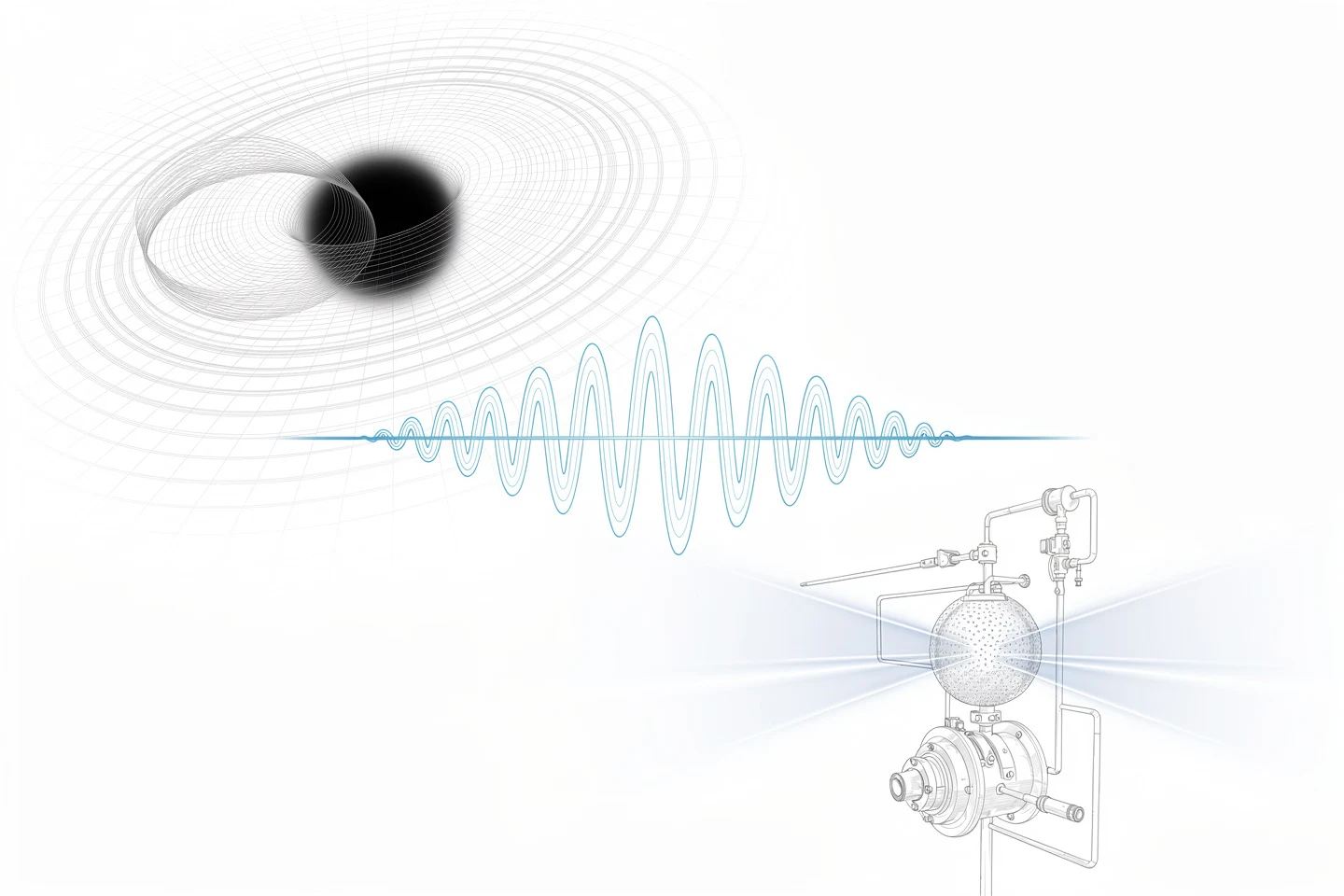
There’s a constant, inaudible hum in the universe, like the drone of voices in a giant stadium. It’s gravitational waves — ripples in space racing at the speed of light from sites where huge black holes collide in the centers of distant galaxies. Such black holes can weigh billions of Suns, an idea first hinted at by Karl Schwarzschild. Around them, like an invisible scaffold, sits dark matter, discovered by Vera Rubin, while the galaxies themselves are fleeing from the Big Bang, as shown by Edwin Hubble.
Astronomers compared computer models of this background with real signals caught over 15 years by a network of radio telescopes. They tracked pulsars — rapidly spinning stars whose pulses are more accurate than atomic clocks. It turned out the simulations barely differ from observations: the difference is no more than two or three “sigma”—such a discrepancy is easily chalked up to chance. And if you tweak the model just a bit, assuming black holes in the early universe grew five times faster, the match becomes perfect. By the way, the mighty Hubble telescope has already hinted at such an “overfed” childhood for giant black holes.
Now the gravitational-wave background will become a new tool: we can use it to “weigh” black holes and test how galaxies grew billions of years ago. In the future, scientists will combine it with spectroscopy, the method that breaks galaxy light into colors, to more precisely locate pairs of merging black holes.
Pulsars are so accurate that the slowdown in their spin caused by a passing gravitational wave is like Earth braking due to a flying mosquito.
This work faintly echoes Carl Sagan’s novel “Contact,” where scientists searched for signals in the flickers of pulsars. But today astronomers hear in this noise not the voices of aliens, but the very “breath” of black holes.