Symphony of Shadows: Neutrino Telescopes Catch the Whisper of Dark Matter
Original: "Galactic Center Neutrinos from Cosmic Ray-Dark Matter Interactions"
Analysis of data from neutrino observatories opens a new window into the search for light dark matter particles arriving from the center of our Galaxy.
Links in the knowledge graph 1
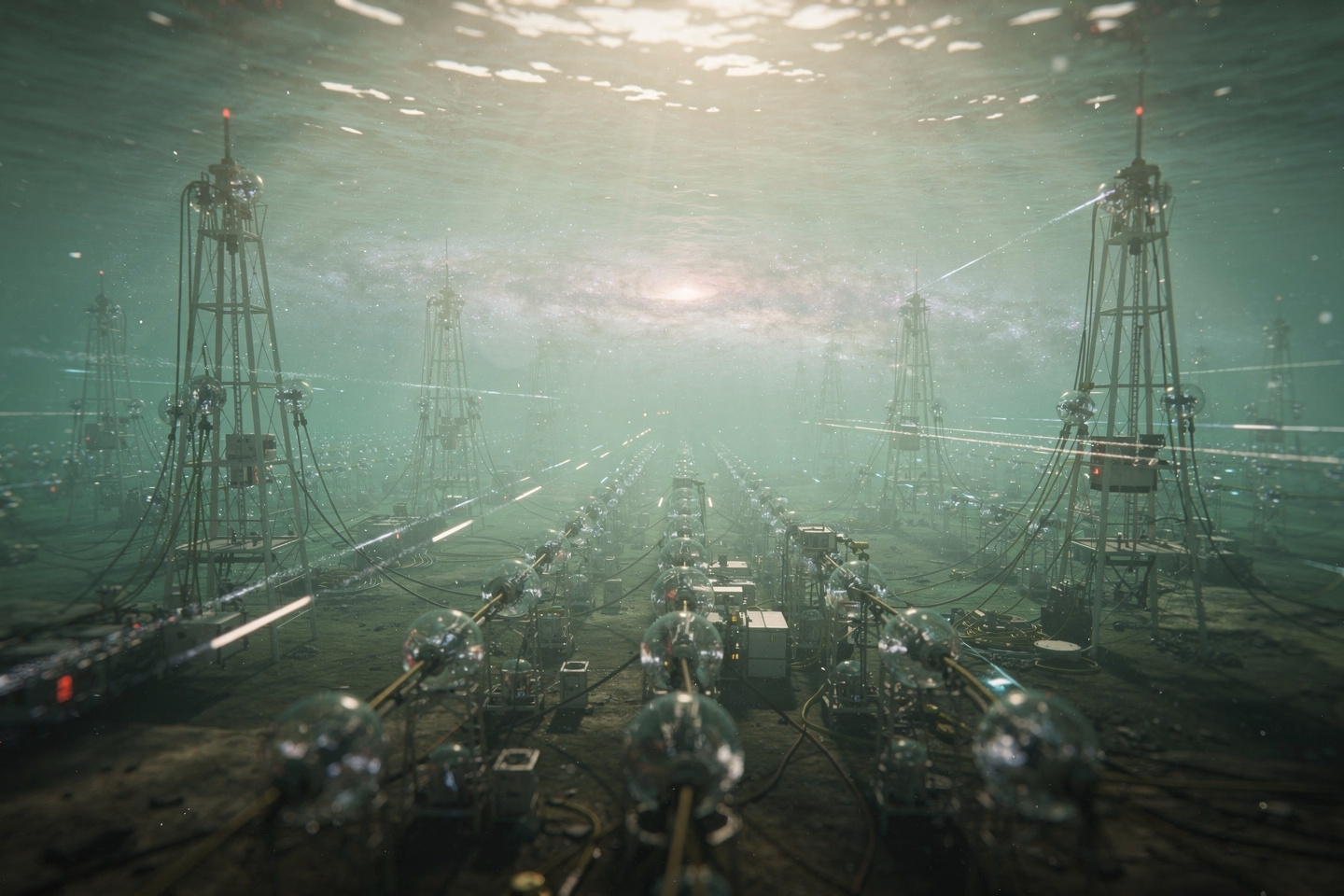
Dark matter is invisible, but its traces are like quiet chords in the symphony of cosmic rays. Neutrino telescopes, submerged in the ocean abyss, catch these notes from the Galactic center. With new observatories, we may finally hear the voice of the hidden universe, transforming our understanding of the cosmos.
🎯 Neutrino telescopes like ANTARES sit more than 2 km deep underwater to shield against cosmic muons, yet billions of neutrinos from the Sun fly through them every second without interacting at all.
\sigma^{\text{el}}_{\chi p} = \frac{g_q^2 g_\chi^2 \mu_{\chi p}^2}{\pi m_V^4} = G_D^2 \frac{9 \mu_{\chi p}^2}{\pi m_V^4}
g_q and g_χ are coupling constants, μ_χp is the reduced mass, m_V is the mediator mass
Scientists
Alan GuthAndrei LindeGeorges LemaîtreJames PeeblesAdam RiessBrian Schmidtdark matter
big bang
hydrogen
black hole
speed of light
spectroscopy
transit method
gravitational waves
Hubble Space Telescope
quantum entanglementLaws
Friedmann equationsHubble's lawSchrödinger equationDoppler effectHawking radiationgravitational lensing