
Gonzalo Herrera

9 articles · 26 co-authors · latest: 2026-08-02
45 citations · h-index 4 · 11 papersData: Semantic Scholar

We have retold 9 papers by this author. 1 of them with a full read. most often about: Hawking radiation, primordial black hole, black hole merger. 26 co-authors across our retellings.

Links in the knowledge graph
HEP Phenomenology2025-10-131 minarXiv:2510.11879express
Microscopic Black Holes: Aftermath of Cosmic Catastrophes
Cosmic rays are elementary particles carrying colossal energy that pierce the intergalactic void. When two such particles smash head-on, the energy density at the point of impact could be enough to collapse into a black hole the size of an atomic nucleus.
HEP Phenomenology2026-04-163 minarXiv:2604.15445express
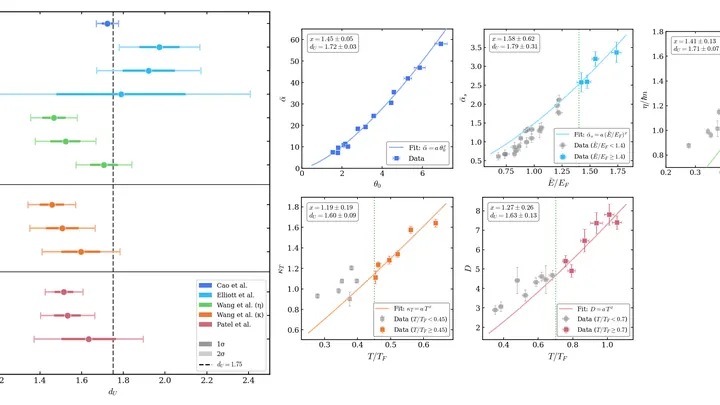
Quantum Whispers in Scale-Free Silence
A stone drops into a pond. Ripples spread, fade, and soon the surface is smooth again. But what if the pond has no shores, no bottom, and no characteristic ripple size? That is the world, a scale-free world, where quantum systems live when surrounded by an environment that picks out no particular length or energy.
HEP Phenomenology2026-06-122 minarXiv:2606.14098express
Quantum Gravity vs. Axions: How Fine-Tuned Is the Universe?
Imagine a perfectly tuned orchestra, where every instrument is adjusted with flawless precision, trying to play in a noisy hall. That noise is quantum gravity — the microscopic ripples of spacetime. It constantly threatens to throw the musicians off.
HEP Phenomenology2026-06-142 minarXiv:2606.15904express
Solar Neutrinos in a Dark Matter Trap: An Unexpected Tool for Helioseismology
Dark matter detectors are essentially incredibly sensitive microphones, capable of hearing a whisper amid the roar of a rock concert. Their job is to catch the rare nudges from hypothetical dark matter particles, which are thought to occasionally collide with atomic nuclei of ordinary matter.
HEP Phenomenology2026-06-152 minarXiv:2606.17042express
Catchers of Solar Ghosts
The Sun is a giant nuclear reactor that continuously sends us light and heat. But it also has another, almost silent postal service: every second, tens of billions of neutrinos, ghostly particles born in the thermonuclear furnace, fly through a square centimeter of your palm. Most of them leave no trace.
HEP Phenomenology2026-07-212 minarXiv:2607.19254express
Invisible Visitors from Space Put Physics to the Test
A billiard ball clicks against another in complete darkness. The sound of the impact and the clatter of balls dropping into pockets: that's all you hear. This is roughly how physicists study the interactions of elementary particles at energies that no terrestrial accelerator can reproduce.
HEP Phenomenology2026-07-311 minarXiv:2607.29682express
Dark Photons from a Wobbling Field
In the first moments after the Big Bang, the universe expanded at an incredible rate — a phase known as inflation. Even the vacuum was restless back then: quantum jitters shook the fields like wind rustling through a wheat field.
Cosmology2026-08-022 minarXiv:2608.00923express
Neutrinos Reveal the Universe's Expansion Rate
Measuring distances in the universe is no easy task. Almost all methods rely on light, which can be absorbed by dust, scattered, or distorted along the way. It's like trying to spot a distant lighthouse through fog and haze. Neutrinos are a different story. These ghostly particles pass through anything without noticing obstacles.
