Anchor in the Shallows: Why DESI Data Misses the Universe's Acceleration
Original: "Present Day Cosmic Acceleration from SDSS and DESI BAO: A Call for Finer Tomography of the DESI Bright Galaxy Survey"
A fresh analysis of DESI and SDSS data suggests: the debate over the Universe's acceleration today is not a sign of new physics, but an effect of missing measurements in our immediate cosmic neighborhood.
Links in the knowledge graph 1
The DESI cosmological survey doesn't see the Universe accelerating right now. It's like trying to tell if a ship is speeding up by only watching its wake far behind. Without an anchor in the shallows—nearby galaxies—the picture blurs. But soon the Bright Galaxy Survey will give us that anchor, and we'll know for sure whether expansion is already slowing down today. Perhaps dark energy is not a constant but changes over time.
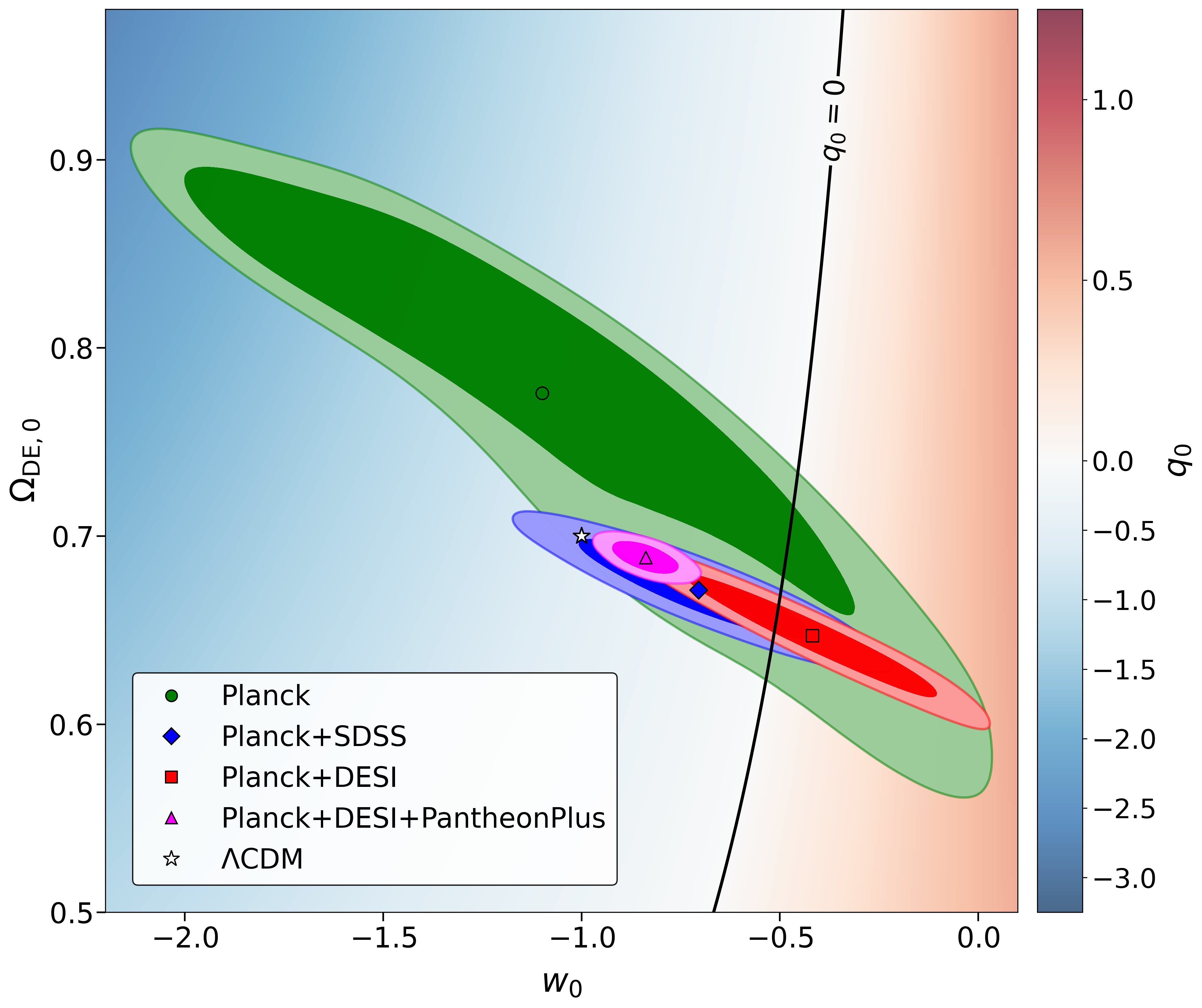
🎯 If we trusted only DESI and CMB, we might conclude that the Universe shifted to deceleration about a billion years ago and then started accelerating again—but this is most likely an illusion caused by a lack of data near us.
q_0 = \frac{1}{2} \Omega_m + \frac{1}{2} (1+3w_0) \Omega_{DE}
The deceleration parameter at the present moment: it depends on matter density, dark energy density, and its equation of state w0. If q0 is negative, the expansion is accelerating.
w_0 < -\frac{1}{3\Omega_{DE}}
Threshold condition for acceleration in a flat Universe: if the dark energy parameter w0 is negative enough, gravitational attraction gives way to repulsion.