Symphony Without Bass: Why DESI Can't Hear the Universe's Acceleration ✛ ✦
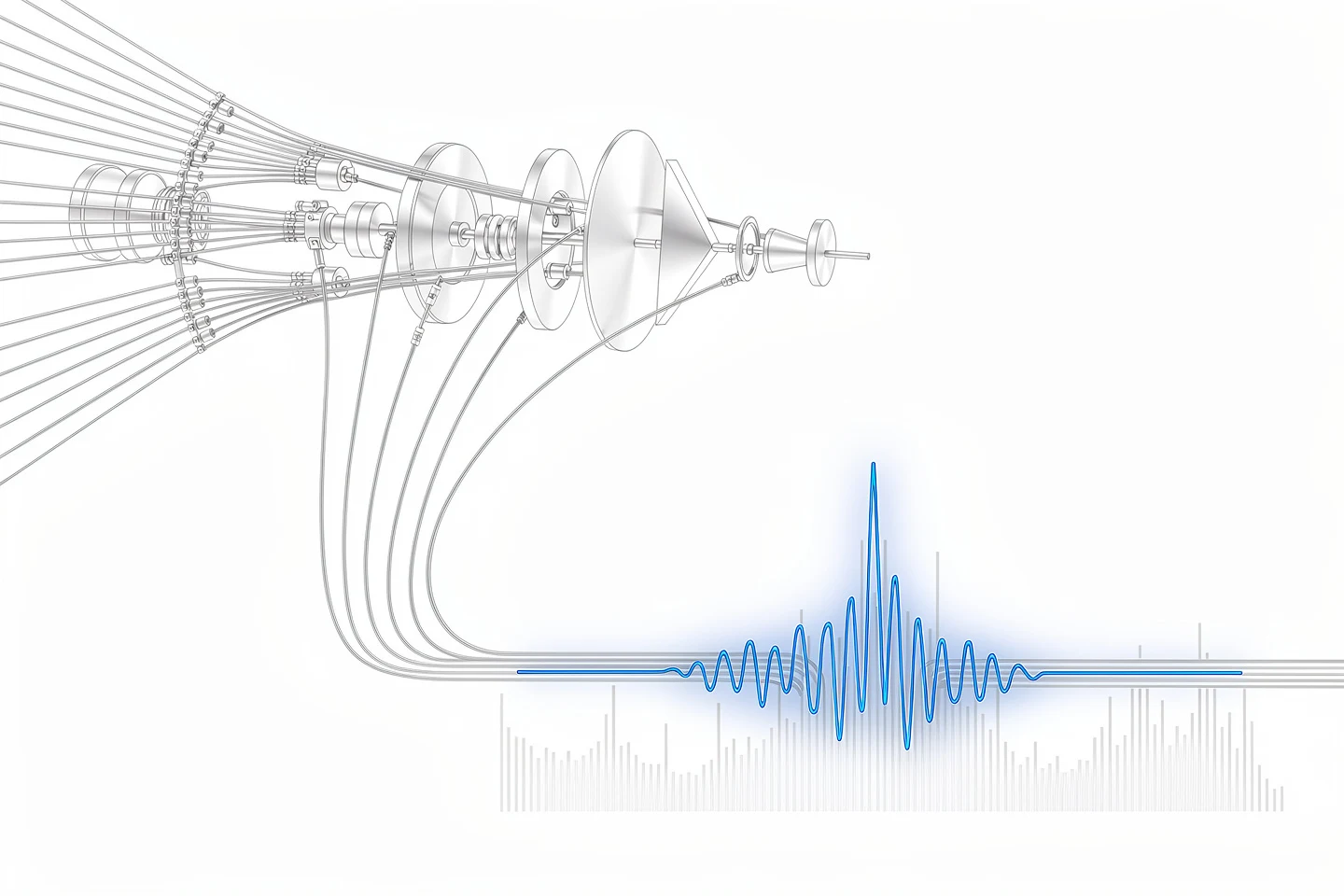
The Universe has been singing its majestic symphony of expansion for almost 14 billion years. Astronomers, like orchestra tuners, catch its harmonics — the redshift of distant galaxies, following the discovery of Edwin Hubble and the theoretical insight of Georges Lemaître, the echo of the cosmic microwave background, rhythmic oscillations in the distribution of matter. But an error has crept into the score: two major spectroscopic surveys, DESI and SDSS, which measure baryon acoustic oscillations, disagree on the most important question — is the Universe accelerating now? One hears allegro, the other a barely perceptible deceleration. The whole snag is the missing deep bass note.
The key to understanding is the deceleration parameter q₀, which in a flat Universe follows from the Friedmann equations and depends on the density of matter, dark energy, and its equation of state. A negative q₀ means acceleration. When Saul Perlmutter and his colleagues first detected it using supernovae, it was a shock. Today, the combination of Planck CMB and SDSS data, which includes very nearby galaxies, gives q₀ ≈ −0.22 — confident acceleration. But DESI, whose nearest targets reach only z ≈ 0.3, paired with the same Planck, shows q₀ ≈ +0.10 — formal deceleration. Without a bass foundation, the melody is unresolvable: we don't know if it's major or minor.
A critical experiment puts everything in place. When nearby galaxies are removed from SDSS data, the effective redshift increases, and q₀ shifts to −0.10 — much closer to DESI's value. It turns out that without a low-frequency anchor, the SDSS orchestra also starts to sound off-key. Adding the Pantheon+ supernova catalog instantly restores acceleration, but the problem of interpreting BAO data remains. So it's not new physics; DESI just hasn't yet learned how to extract that fundamental tone from its strings.
This resembles the psychoacoustic phenomenon of the 'missing fundamental': our brain reconstructs the low frequency from a set of overtones, even if the speaker doesn't reproduce it. Similarly, cosmologists, by skillfully combining data, can recover acceleration — all they need is to add the missing note.
The solution lies in 'tomographic' binning of the BGS bright galaxy sample, which currently covers the range z=0.1–0.4 as a whole. Splitting it into two bins will give a point at z≈0.18 — almost like SDSS — and finally let us hear the missing bass. This is a direct path to testing the nature of dark energy: is it a cosmological constant or has it changed over time? Future observatories like Euclid and Nancy Grace Roman will continue this fine-tuning, but even now we are learning to listen to the symphony of the cosmos in all its richness, from the bass parts of quasars to the ringing overtones of gravitational lensing and even the barely audible whisper of neutrinos.
If the acceleration epoch really ended 1.5 billion years ago, as DESI's median reconstruction formally allows, we would now be witnessing the very beginning of a new deceleration phase — and in a few billion years galaxies would start moving closer again.